The world's most famous and notoriously unproductive Galapagos tortoise, "Lonesome George," died in Ecuador in June 2012. The American Museum Of Natural History (AMNH) commissioned taxidermist George Dante of Wildlife Preservations to prepare his body for display. Following his instructions, the tortoise's keepers wrapped his soft parts in tissue and placed his body inside thick freezer plastic, not easy to find in the remote tropics. He arrived in New York still frozen and ready for the custom preparation. His body was measured (IMAGE ABOVE) and his skin was removed, de-greased, and pared down of muscle and fat. George's skin and shell were soaked in a tanning chemical and then the skin was rubbed with tanning oil. An armature was sculpted from oil-based clay, cast in urethane foam, and reinforced with steel supports. What was left of George was draped over it, the tortoise's wrinkles and idiosyncrasies – using the many reference photos on hand – were sculpted into his skin, and the result coated with a protective seal. The preparators decided on a posture of George standing and stretching his long neck upward as it grabbing some leaves to munch on. But they found that he looked a little too perfect, so around his mouth they added the green stains of his last meal! George now has a place of prominence at the museum. Dante comments, "Somewhere else, there might have been a decision made to just put him in alcohol--to make a wet specimen that would be in a museum collection, never to be seen again. Now we have this monument for conservation that visitors can look at and make a connection with.”
Showing posts with label taxidermy. Show all posts
Showing posts with label taxidermy. Show all posts
Wednesday, September 24, 2014

 Posted with Blogsy
Thursday, August 7, 2014
Cherry carry
With the help of his brother Richard, Cherry Kearton (who, coincidentally enough, died on the steps of the BBC in 1940) became one of the world's first professional wildlife photographers. They began in the 1890s taking pictures of birds in their natural habitats in their home village of Thwaite, Yorkshire, U.K., with a box camera, but they took the risk of startling their quarry using the cumbersome apparatus. So they began to devise ways to disguise themselves in the field, as boulders, limestone walls, and trees. But they began with the ox blind Cherry is carrying in the image above. They obtained the hide from their butcher, had it prepared by a London taxidermist, outfitted its head with a camera, and hid inside for hours at great physical expense. Recalled Richard, "Once out of sheer agony I dropped from the bottom. Upon seeing me [the bird] sprang almost vertically in the air and, dropping among the grass, stared with outstretched neck in blank amazement."


Tuesday, February 4, 2014
Guy
The most famous resident of the London Zoo was given the name because he was welcomed in 1947 on Guy Fawkes Night. Guy the Gorilla had been born the year before in the French Cameroons and arrived via the Zoo de Vincennes in Paris in exchange for a zebra and a tiger. He became a household name during the three decades he lived at the zoo (PHOTO ABOVE TAKEN BY HENRY GRANT C. 1950, PHOTO HERE TAKEN BY WOLF SUSCHITZKY IN 1958). The British public was heartbroken when he died during a tooth operation in 1978, and outraged that his body was to be mounted and placed on display at the Natural History Museum in South Kensington. The museum postponed its plans and instead stored Guy's half-cured skin in the freezer. But as museum press officer Sue Runyard explained to her superiors, the story would not die. “My interest is that I should not have to explain to the press at some time why we allowed his remains to spoil,” she wrote in 1980. At that point, taxidermist Arthur Hayward was brought in, but found that the pelt was not in very good condition. His only option was to set the hairs in a latex replacement skin, which he stretched over a model. The results went on display to mixed results for a few weeks in 1982. The same year, a bronze sculpture by William Timym was unveiled at the London Zoo. In my humble opinion, neither one (IMAGES HERE) does the beloved gorilla justice.

Thursday, December 19, 2013
Looted leopard
Again, a group of teenagers has been arrested after breaking into a fully furnished but unoccupied mansion and holding a party, this time in the exclusive La Habra Heights neighborhood in Los Angeles, California. The party's organizers charged admission to 100 people on the afternoon of November 23rd. By the early hours of the following morning, the property had been vandalized and the possessions of the owner – was out of the country – had been carried off. Some of the attendees bragged about their haul, which included medieval armor, scuba gear, and designer suits, even posting photos of themselves on social media. Among the items stolen was a mounted specimen of the Central Asian snow leopard, of which there are only an estimated 7,300 or less in the wild. Valued at $250,000, the mount is one of the stolen items which may not be returned to the homeowner. The Los Angeles County Sheriff’s Department is investigating whether it was acquired before the animal was listed as endangered. Sheriff's Lieutenant Arthur Scott said that the partygoer who grabbed the leopard told them he had done so because all the good stuff was gone. Capt. Timothy Murakami commented, "These were not items you could sell, they're so unique. It's probably just another stuffed animal to them."

Sunday, February 17, 2013
Tourist taxidermy

The deaths of 2 popular animals have resulted in recent parallel stories of efforts made to continue the tourism that those animals generated:
- Knut, an abandoned polar bear cub, became a worldwide sensation at the Berlin Zoo in 2006, but died in 2011. The Berlin Natural History Museum has just revealed plans to display a model of the bear. Johannes Vogel, the new general director of the Museum, hopes Knut will attract a new wave of museum-goers. Museum spokeswoman Gesine Steiner said, "It's important to point out that we have not stuffed Knut....Rather, this is a plastic form, true to the original and covered with Knut's very own fur."
- Lolong, the world's largest saltwater crocodile at 6.17m (20.24'), was captured in Bunawan, Philippines, in 2011. The 1-ton animal had drawn countless foreign visitors to the ecotourism park where it was on display, until it died earlier this month (image above). The town's mayor Edwin Cox Elorde plans to have the crocodile preserved and placed in a museum so Bunawan villagers and tourists could still marvel at it: "I'd like them to see the crocodile that broke a world record and put our town on the map."
Knut may no longer be as cute, but Lolong will probably elicit the same oohs and aahs...
Sunday, March 11, 2012
Knit pelts


 Photos by Maja Kihlstedt.
I have blogged about knitting on a couple of occasions in the past (Knitting with hair in June 2009 and She wants her sweaters back in January 2011), and several more "yarny" posts have been inspired by my friend Sue (Yarn-bombing in April 2011, Penguin fashion show in October 2011, and Yarn and you in December 2011), so when Sue forwarded another link with the message, "You must be so tired of knitting stories," I answered, "Not yet!" Behold the artistry of Ruth Marshall (4th image) in the form of stretched pelts of a clouded leopard (1st image), Amur leopard (2nd image), ocelot (photo here), jaguar and tiger (3rd image). Marshall is Australian by birth and did her undergraduate work at the Royal Melbourne Institute of Technology. She moved to New York, where she received her MFA from Pratt Institute and now teaches at the School of Visual Arts. She is represented by Dam Stuhltrager Gallery, and her work has been exhibited at art museums, but is detailed enough to be shown at natural history museums. The pelts she knits are not only life-size, they each replicate in wool the coat of an individual animal (some technical details here). “I’ve always been a cat person,” says Marshall, whose prototype for her Big Cats series was her own housecat. She had a studio at the Bronx Zoo and offers a glimpse of the detailed art that followed: "After leaving the zoo, I got permission to go backstage at the American Museum of Natural History and work with the extraordinary pelt collection in the mammalogy department. It is such a historical institution. I got kind of awe-struck. It has revolutionized my work. For example, I just recently noticed how the direction of the hair on a tiger changes on the shoulders and travels down the forelegs. There are a lot of cowlicks and swirls there. In my next tiger, I will try to imitate that by changing the direction of my knitted stitches." The resulting installation of 14 skins evokes a black market trophy den, thereby referencing the illegal activities driving the extinction of these wild cats. She explains, "My art is related to and bound by a fascination with animals. In essence the work is a synthesis of concepts relating to wildlife conservation and visually interpreting natural animal forms. The twenty-first century is gripped by the predicament of habitat loss and species decline. There is an urgent desire in me to say new things about this disappearing world and to contribute to the efforts to help wild animals and wild places endure." On her website Paloma Textiles, Ruth Henriquez Lyon calls Marshall's work "a constructive answer to a destructive act."

Wednesday, February 8, 2012
Grip


I've never read Barnaby Rudge by Charles Dickens (1812-1870), which is about a simple young man whose life is put in jeopardy when he gets caught up in the mayhem of the Gordon riots and the mystery of an unsolved murder. In the novel, the title character is devoted to his talkative raven, Grip, and The Mirror suggests that the plot can be condensed into a tweet as follows:
But the bird in the fictionalized book was quite real - and important to literary history. Grip was the 1st of a series of 3 pet ravens belonging to the Dickens family (see illustration here).
The bird died in 1841 - possibly from eating lead chips that had been scraped off a wall that was being repainted - and prompted the inconsolable author to describe Grip's final hours to his friends:
The living animal and its literary counterpart had much in common in addition to talking and popping
champagne corks, as Dickens described in print:
champagne corks, as Dickens described in print:
Those words were read by Edgar Allan Poe (1809-49), who was working as a literary critic at the time. Poe reviewed the serialized version of Barnaby Rudge for Graham’s Magazine upon its publication in 1841. Shortly thereafter, Grip took on another identity: the bird in Poe's most famous poem (hear it read by Christopher Walken here). “That’s because Grip is ‘The Raven,’ ” says Edward G. Pettit, author of the forthcoming Edgar Allan Poe in Philadelphia. The poem, published in 1845, reads in part:
Straight I wheeled a cushioned seat in front of bird, and bust and door;
Then, upon the velvet sinking, I betook myself to linking
Fancy unto fancy, thinking what this ominous bird of yore —
What this grim, ungainly, ghastly, gaunt, and ominous bird of yore
Meant in croaking 'Nevermore.'"
It is the bird's connection to Poe* that brings me to the point of this post: Grip is still with us (emphasis on still). When he died, Dickens had him mounted. When Dickens died, Grip was sold at auction and eventually made its way into the Poe collection of Col. Richard A. Gimbel (1898-1970) of Philadelphia. After Gimbel's death, his collection - including the only known copy of "The Raven" in Poe's hand, manuscripts of Annabel Lee and Murders in the Rue Morgue, and first editions of all of Poe's works - was donated to Philadelphia's Free Library. The historic bird (2nd image) is the centerpiece of an exhibit celebrating the 200th anniversary of Dickens' birth. He'll be on display weekdays for the next year if you want to have a look!
*My own connection to Poe is in the form of a Halloween costume (photo in slideshow below) and the travels of the taxidermied bird I sent to my friend George the following Christmas (read about it here).
1st image) Barnaby Rudge in Newgate Prison as depicted in J.A. Hammerton's The Dickens Picture-Book (London: Educational Book Co., 1904) by Halbot K. Browne, who illustrated the works of Charles Dickens under the pseudonym "Phiz." Image scanned by Philip V. Allingham (other illustrations of Rudge here). 2nd image) "Grip," the preserved pet raven that belonged to the Dickens family, now on display in the rare-book section of the Free Library of Philadelphia. The photograph appears in the Daily Mail (another photo with Dickens' great-great-grandson here).
Thursday, November 10, 2011
Zanesville aftermath

A leopard that survived the tragedy in Zanesville, Ohio, on Oct. 18th, in which the owner of 56 exotic animals released their cages before committing suicide, forcing officials to kill 48 of them (slideshow here), rather than compromise public safety. A mere 6 animals - 3 leopards, 2 monkeys, and a grizzly bear (video here) - were taken into the custody of the Columbus Zoo.
Put down: A group of 5 men were arrested this week for their attempt to steal the carcass of one of the lions that had been shot. The night of the tragedy, the 20-year-olds drove 25 miles to the scene, where they found people posing for photos with the dead animals. A pair of the men decided to take the lion and spent 30 minutes getting it into the back of the car, with half-formed ideas of bringing it to a taxidermist. Police interrupted their attempt and pulled the body of the lion out of the vehicle. Each of the car's occupants faces up to 6 months in jail and a $1000 fine if convicted of the misdemeanor theft charges. The Muskingum County Sheriff's Office fielded a number of inquiries from those who wanted to have the remains of the animals mounted. "There's a lot of people who would pay a lot of money to get these animals," said Sheriff Matt Lutz. The carcasses were buried on the property the day after they were put down, at the request of the widow of the animal park's owner Marian Thompson.
Put up: After being transferred to the Columbus Zoo, the surviving animals were quarantined and evaluated. The zoo has received donations toward the cost of their care and feeding. Although Mrs. Thompson has the right -and the intent - to request the return of the animals, the zoo administration hopes that she can be convinced (or legally compelled) to leave them in their care. A herd of horses at the animal park were unharmed, though they had been chased by tigers and bears during the incident.
"We're doing our best now to make sure this never happens again in the state of Ohio....No more lions and tigers and bears as pets,"said Jack Hanna*, who is among those lobbying for tighter legislation on the private ownership of exotic wild animals in Ohio.
*I have an idea for next year's Halloween costume!
Saturday, October 29, 2011
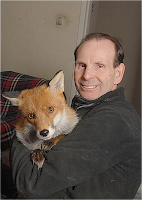
Foxes, feared and fancied
 The photo above, entitled "Lucy's Pet Fox," was found in Cenz's photostream on Flickr.
Many British citizens have had the unfortunate experience of wild foxes invading their homes, terrorizing their pets, and even attacking their children. Meanwhile, others (in the U.S., Siberia, and - yes - England) are intentionally taking them into their homes as pets. The quotes below link to stories on both sides of this divide.
 "One of my kittens was standing on the bedside table, hissing,
 but the other was on my bed and so was the fox. It was just standing there, looking at me and I backed out of the room because I was so shocked....Imagine if my son had been younger - he'd have been in there when the fox came in."



Sunday, October 2, 2011
Catching a bear
 There are individuals who don bear costumes for their art, like prize-winning British conceptual artist Mark Wallinger (video here) and American performance artist Nate Hill (video here, slow to load). There are people who become bears to be on television, whether appearing in a program, featured in an ad, or crashing a live news broadcast. And then there's this guy (pictured). Clyde Gardner of Malone, New York, is a 57-year-old junkyard owner and demolition derby driver. Clyde planned to kill a bear, skin it, and then dress up in the carcass to attack and kill his ex-girlfriend. Wearing the bear hide and using the claws as weapons, he assumed he would leave neither footprints nor fingerprints at the scene of the crime. He went so far as to hide in the woods with binoculars to familiarize himself with her routines and decide he would ambush her as she took out her garbage.
It would be funny if it weren't so disturbing. The man had a violent history with the mother of his child, and had recently been thrown out of the house again. He decided instead to hire a hitman to kill his girlfriend in a car wreck, cutting her throat with a shard of glass if she survived the impact of the collision. After he made a down-payment on the $15,000 murder-for-hire, he was arrested, tried, and sentenced to 5 to 15 years in prison. His girlfriend has been given an order of protection that prevents Clyde from contacting her until 2031.
Monday, August 15, 2011
Blossom


Blossom was a cow. But not just any cow. Blossom was the very cow which led English scientist Edward Jenner (1749-1823) to be dubbed "The Father of Immunology." Blossom gave cowpox to milkmaid Sarah Nelmes. Jenner used pus from her sores to inoculate 8-year-old James Phipps against the more virulent smallpox virus. To Jenner's relief, the 1796 experiment proved to be a success when subsequent exposure to smallpox showed the boy to be immune.
Strangely enough, Blossom's relics seem to have proliferated like those of the True Cross. Her hide was given by Jenner's family to St. George's, London in 1857 and hangs on the wall of the library (photo here). But a hide also said to belong to Blossom is curated by the Gloucester Folk Museum. Blossom's horns are to be seen both on (photo here if you scroll down) and off her head (2nd and 3rd images, plus here) at St. George's. And another horn said to have belonged to Blossom is the pride of a trustee of the Edward Jenner Museum in Berkeley, UK. Not in question is Dr. Jenner's diligence in developing the smallpox vaccine. As he wrote: "I am at least 6 hours daily, with my pen bending over writing paper, till I am grown crooked as a cow's horn."
The 1st and 4th images above were taken by Yusef Ozkizil in Feb. 2010 when St. George's did a chemical analysis of Blossom's hide to assess it for restoration. The 2nd and 3rd images above were taken by Professor Robert Siegel of the Dept. of Microbiology and Immunology at Stanford University, whose research interests include viruses, infectious diseases, and "all things poxy."
Friday, June 10, 2011
Fur coat

Leave it to Barbara to send me another unattributed video! But it was so amusing I had to track down the source so I could share it with you. It was recorded at a performance of the Circus Roncalli, a German troupe that was established in 1976, soon became the largest circus in the country, and began selling out its shows in Europe within 10 years. I have illustrated the post with a photo of one of their clowns, Gensi, whose makeup and costumes are striking and whose performance originates in the Catalan theater of the 1970s. Enough of a preamble, here is the clip which will keep you giggling all day:
Friday, May 6, 2011
Lifeless lions


It is the goal of taxidermists to recreate a stunningly lifelike animal that will withstand close scrutiny and stand the test of time. Sometimes their attempts fall short - sometimes very short. This collection of strange and shabby lions (of both the mountain and African variety) has been culled from the web. I was inspired in my search by this post about the lion of Gripsholms castle (5th image). The fearsome living beast was given as a gift to King Frederick I of Sweden (1676-1751) and lived out his days in captivity. Some years after the lion's death, its pelt was given to a taxidermist to mount for display. In his defense, he had never seen a living lion before! I would venture to say that none of the other artisans have the same excuse. Many of them remain anonymous because the photos are unidentified (click on the images for my sources). The mountain lion with the poorly placed eyes (4th image) was on display in a store in South Dakota. The African lion with the long face (9th image) was among the assets of a Utah man accused of fraud. But we have no idea who prepared or owned the lion with the unnatural ears (3rd image). The caricature with close-up (7th and 8th images) links to Crappy Taxidermy, which notes only that the mount was offered on E-bay. Of the lions that do have a backstory, we have Wallace (2nd image), compliments of Ravishing Beasts, who stands in the Saffron Walden Museum in Essex. Wallace, the 1st African lion to be bred in the U.K. (he was born in Edinburgh in 1812), was a star in George Wombwell’s 19th c. traveling menagerie. He is remembered for 2 incidents: killing all 6 dogs with which he was baited before a crowd in 1825 and, 2 years later, biting a man who later died of the wounds. "After Wallace’s death in 1838, he was sent to the Saffron Walden Museum by stagecoach. A framework for his body was made of wooden struts and wires, over which his skin was stretched and stuffed with wood shavings. He was mounted with his left front paw theatrically posed on the figure of a dog, in remembrance of his triumph in the fighting pit." Next up, the original Nittany Lion (1st image, caution - language), of the University of Pennsylvania. in a display case at the library: "The real-deal mascot, he’s carved out of stone. Looks all heroic and shit, not a sad sack like me. Hell, that thing got so popular they completely forgot I existed. I spent half the last century on loan to the Carnegie Museum in Pittsburgh, stuck in a basement storeroom with the moths and the spiders. The only complete specimen of an Eastern Cougar, out of the hundreds of thousands that were killed for bounty, and I didn’t get any respect whatsoever." Lastly, we have a specimen from an obscure zoological museum at Babes-Bolyai University in Romania (6th image) visited by Curious Expeditions: "The taxidermy displays were amazing. The dioramas and taxidermy clearly have not been updated for the modern age, much to our delight. There were tatty old lions, tigers and bears (oh my) strewn about, not in any case or diorama, but simply facing the museum visitor, inviting a closer look." For the eyeful collected here, you're welcome.
Saturday, November 6, 2010
"Tassie" treasures


The preserved skins of the extinct Tasmanian tiger are worth tens of thousands, but Bill Warren of Fallriver, California, may have picked one up for a song. Warren (6th image) - ironically, an ocean-going treasure hunter - bought the pelt for $5 at a garage sale in June. It had been purchased at another garage sale in Boston 32 years earlier. If authenticated, the skin may fetch $70,000 at auction. John Long, an Australian native and V.P. of research and collections at the Natural History Museum of Los Angeles, has not yet seen the skin in person, but identified the pyramid-like design of stripes as unique to the animal.
Because most of the known skins reside in museums and universities, the pelts of the thylacine (Thylacinus cynocephalus) are rare and extremely valuable to private collectors. A thylacine skin mounted and framed c. 1930 sold at auction for $68,000 (3rd image). A unique thylacine skin "buggy rug" (1st image, click to zoom in) was in private hands for more than a century. Tasmanian farmer Robert David Stephenson had the rug made c. 1903 from the skins of tigers he trapped to stop them from killing his livestock. The thylacine rug was made from rectangular sections taken from the striped backs and rumps of 8 of the animals, and measures 1180cm x 1070cm. Stephenson's descendants sold it to an Australian couple at an estate sale in 1945 for a little over £3. The buggy rug was among the items put up for auction by their daughter, Angela Foster, in 2002, and purchased by the Federal Group for the Tasmanian Museum and Art Gallery and the Queen Victoria Museum and Art Gallery for $270,000.
The National Museum of Natural History in Washington, D.C., acquired their specimens - including a mounted female thyacine that died in 1904 and the unmounted skin of a young adult male that died in 1905 (2nd image) - from live animals brought to the Smithsonian's National Zoo for a captive breeding program. The museum recently sequenced the DNA from their hair. Specimens held in the mammal collections of the Australian Museum include a mounted thylacine skin (a little worse for wear) (4th image) and a wet specimen of a thylacine pup (5th image). I would rather see geneticists resurrect the thylacines than the dinosaurs!
Saturday, July 3, 2010
Follow-ups
 I have friends in town the next few days and plan to get caught up on my follow-ups as I have time. I will be adding to this post, so please keep checking back! Happy 4th!
Oil and turtles 6/30/10 A New York reporter nearly loses his nose when a snapping turtle does just that.
White elephants 6/29/10 An elephant given by Indian Prime Minister Indira Gandhi to Yugoslavia has died and been recycled.
Weightless Hawking 6/28/10 A reader passed along this link about a series of anti-gravity monuments on East Coast college campuses.
Faux fur 6/14/10 The San Diego Zoo and the Scripps Research Institute have a plan to bring back endangered animals from near-extinction.
Fireflies 6/6/10 These photos reminded my former boss about the photos of Picasso drawing with light.
Freediver 6/4/10 My Mom thought this guy and this woman would make a good couple!
Swimming the English Channel 6/2/10 An armless woman in China is highly skilled at embroidering with her feet. The TSA is slammed for their shameful treatment of amputees. Police in Jacksonville, Florida, were looking for the owner of a prosthetic leg that washed up on the beach, and were successful at finding him. A motorcyclist lost his prosthetic leg while traveling a New Hampshire highway. Doctors replace a woman's missing thumb with her big toe.
Geronimo 5/16/10 I was contacted by the makers of this film who are fundraising to get the true story of the Trail of Tears told. A reader informed me of the story of Hannah Dustin, who was captured by Indians and is commemorated with a statue showing her with a tomahawk and a fistful of scalps.
Environmental disaster 4/20/10 Video footage of oil and gas leaks from cracks in the sea floor, which may affect BP's attempts to cap the gushing oil well. BP is also responsible for polluting the atmosphere this spring. Rachel Maddow has refuted this video from Louisiana by confirming with scientists that oil cannot fall as rain. However, this video shows that BP has purported covered up oil on the beach with sand they have trucked in. The New York Times points out that the Niger Delta has been spoiled by repeated massive oil spills.
We lost another munchkin 4/11/10 A tornado ripped through New York's Oz-Stravaganza, forcing the cancellation of many events.
Stomach growls 4/6/10 I recently learned that the origins of ventriloquism lie with the ancient Greek method of divination called gastromancy, in which the sounds emanating from the diviner's stomach were believed to be caused by the undead and could be interpreted to communicate with them and forecast the future.
Dwarfs on display 3/26/10 Little people have an issue with the use of the word "midget" in the new wrestling show "Half-Pint Brawlers." The world's smallest mother shows off her 3 children.
Napoleon's hair 3/5/10 A lock of Napoleon's hair has sold at auction for $13,000.
Jacques Cousteau 2/28/10 A compilation of some of his most memorable clips on the occasion of the 100th anniversary of his birth. A Russian man has taught his dachshund to scuba dive.
Ironic deaths 2/4/10 A man in India died of a heart attack after receiving a bill for his own cremation, which supposedly had occurred the week before. A singer in Mexico was killed hours after denying reports that he had been murdered. A woman was attacked by macaques when she went to a Thai island to confront her fear of monkeys.
Ancient Egyptian finds 1/30/10 A lost tomb has been rediscovered in Memphis.
Natural arch collapse 1/26/10 An arch in a national park in Nevada has collapsed.
Vivisection 1/22/10 A cannibal in the Ukraine did unspeakable things to his living victim (caution).
Gatorland! 1/21/10 Crocodiles body surf. A 9-year-old Colorado girl wrestles alligators.
Kite-fighting 1/19/10 A man in Oregon fell off a cliff and died chasing his kite.
Sinkholes 1/12/10 A deadly tropical storm in May opened a giant sinkhole in Guatemala that swallowed a 3-story hotel -although Discovery says technically it is not a sinkhole - and prompted National Geographic to do a slideshow of the most dramatic sinkholes. Meanwhile, a 5M-wide chasm opened up in Malaysia just last night.
Recent feral children 1/10/10 The Cambodian "jungle woman" has fled back into the forest.
Anatomy art 1/8/10 Lady Gaga is working with Gunther von Hagens to display some of his plastinates on stage during her next tour.
Snakes to the rescue 1/4/10 A flythrough of a python digesting a rat. A global study has found that 8 species of snakes are in decline.
Bushmeat 12/27/09 A Mesa, Arizona, restaurant owner has outraged many (including me) by serving burgers that include real lion meat, as confirmed by a reporter who did a little more fact-finding.
Secret rooms 12/25/09 New homeowners discover a secret room only to find it is filled with moldy garbage. Here is a very clever apartment in Hong Kong.
Octopus achievement 12/15/09 Octopuses can make their boneless arms rigid to form an "elbow" to get food to their mouths.
Aquaria 11/23/09 A beluga at the Vancouver Aquarium died after its airway became blocked by a penny.
Circus animals on the lam 11/13/09 The 1959 kidnapping of a chimpanzee from the St. Louis zoo's "Monkey Show." A man is caught attempting to smuggle 8 live foxes and 50 chameleons out of Cairo in a suitcase. A tiger and 2 camels went missing when a Canadian zoo's truck was stolen, and were later found safe and sound.
Birds in fable and fact 1o/22/09 The brighter a bird's feathers, the poorer its flying abilities. Songbirds learn while they are asleep. A grebe in Madagascar has been declared extinct.
The Mary Rose 10/15/09 A harsh winter has exposed the oldest shipwreck off the coast of North Carolina.
Glasswing butterflies 10/13/09 This is a microscopic image of a butterfly wing!
Anne Frank 10/7/09 A fictional diary of the boy who lived in the same building as Frank has been published.
Dinosaur eggs 10/3/09 Fossil beds in western Canada have been identified as evidence of a mass die-off. A Tennessee couple excavating their yard for a pool found a mastodon.
WWII photographs of "The Kiss" 9/13/09 Edith Shain has died at the age of 91.
Collyer brothers 9/9/09 A woman in Atlanta has been rescued from her trash-filled house, which has been condemned. The body of a Florida woman was recovered from beneath trash in the house she shared with her daughter. A California woman was found to have 100 dead cats in her freezer.
World's heaviest insects 8/28/09 My Mom and I get a big kick out of these Orkin commercials: "Broken down," "Hot Tub," and "Delivery."
Jaws in 1916 8/8/09 Recent findings indicate that as many as half of all shark species can emit a luminescence from their bodies (pictured) that can confuse both prey and predators. On the 35th anniversary of "Jaws," an NPR reporter tracked down the mechanical shark used in the movie.
Creative cremains 7/24/09 The ashes of a Florida man will be scattered over Lake Disston by way of Sunday's fireworks display. Human ashes formed into 3D printed sculptures.
Death masks 7/19/09 A list of 20 famous death masks. An improperly labeled and packed shipment of human heads was opened by a Southwest Airlines employee in Arkansas.
Follow-ups 6/27/09 In this set of follow-ups is an 800-year-old shoe to compare to this discovery of the world's oldest shoe.
Hazards of hail 6/16/09 An article about hailstones of various sizes.
Burial shoes 5/31/09 A blogger complimented me on this post, which informed her very amusing write-up about the subject.
Vultures 5/4/09 Rare vultures in South Africa are being killed to predict the results of the World Cup. I had a Marlin Perkins moment on Thursday watching a vulture tear up and feast on a fish carcass in our front yard here in Florida. A dive-bombing buzzard is terrorizing residents of the Isle of Mull in the U.K. A vulture is spotted in Wales - thousands of miles from its natural habitat.
Chihuahuas in the weird news 5/2/09 A California woman credits her chihuahua for saving her children from attack by 2 pit bulls.
Emmett Kelly 4/25/09 A photograph confirms that a newly married couple were at Disney World at the same time as children.
Bears in the news 4/24/09 A motorcyclist and bear have collided in New Jersey with neither seriously injured. A North Carolina man who was struck by lightning a few years ago has now been attacked by a bear.
Robo-aanimals 4/9/09 A cat receives 2 remarkable bionic feet. A bionic fish has been accepted - and can be used to lead - a school of shoal.
Centenarians - and then some 3/26/09 Jacksonville, Florida cuts off power and water to the home of a 102-year-old woman.
Bird girl 3/3/09 I was contacted about this post by a woman who has photographed and blogged about Savannah's Bonaventure Cemetery, where the statue originally stood.
Taxidermy 1/24/09 A collection featuring a number of trophy heads and other mounted specimens amassed by property developer Warren Anderson were auctioned in Sydney, Australia. A Florida man called 911 when a water buffalo head fell off the wall and trapped him in his recliner. A friend pointed out this article about art from things that were once alive.
Natural mummification 1/23/09 Rather than being neglected after death, this woman was embalmed and stored at the funeral home for 10 years so that her daughters could pay her a visit every weekend. A woman in Pennsylvania was living with the exhumed bodies of her husband and twin sister. A Dutch man's mummified body has been found 4 years after retiring to his bedroom and asking not to be disturbed. A mummified man has been found in a Finnish chimney. A mummified body spotted on an abandoned boat in the Florida Keys turned out to be a mannequin.
Progeria 12/24/08 This woman does not have anorexia, but a rare form of progeria that requires her to eat up to 8,000 calories a day to maintain her body weight.
Conjoined twins 11/29/08 A twin-faced kitten born alive in West Virginia.
Subscribe to:
Posts (Atom)


