

__________
Plenty of previous posts about trees:


 that looked like a piece of cherry-topped cheesecake (see 2nd photo here). It wasn't until I rolled through the door that I realized a) the size scale of the piece and b) that it was one of a series of well-conceived and beautifully crafted little sculptures! There were more than 30 on display (2nd image, museum volunteer Carrie Bow preparing them for exhibit) and I looked at them closely, deciding which I like best. They are the work of
  American artist E. Sherman Hayman, who talks about them in this interview. A few more minutes at the show and I knew I had to have one: Sigmund Freud, André Le Notre*, or Frank Lloyd Wright (1st image). After contacting the artist, I decided Frank - the architect of such visionary houses as Fallingwater (3rd image) - was the most appropriate choice, since I had toured the Dana-Thomas House and Wright's Oak Park, Illinois, neighborhood, blogged about him, and have a Wright-inspired stained glass window (similar to the 4th image) hanging in my "museum." I'm pleased to say that, although I did not get a chance to meet the artist, I am now the proud owner of an original Hayman!


There is a funeral being conducted today - and everyone at the local Historical Society is very excited about it. "You don't get to throw those words together every day," writes Wright, the reader who told me about the event and will be present. "It is even more rare these days to boast of attending a burial for a genuine Revolutionary War hero." Lt. Col. John McIntosh (1748-1826), who commanded Georgia's Fort Morris, reemerged from his grave 4 years ago. The metal burial container (1st image) that surfaced near the Sapelo River was at first mistaken for a fuel tank, but was soon identified as a Fisk coffin (2nd image, examples). Named for its inventor, Almond D. Fisk of New York City, the Fisk coffin (3rd image, patent) is known for its mummiform shape, its viewing window, and its tight seal - which sometimes preserves 19th c. remains intact to this day. An anthropologist at Colonial Williamsburg writes, "The intent was to preserve the remains of people who died far from home more or less intact until such time as they could be brought back home for the family funeral. And it worked, as I was to discover one afternoon....Called by Colonial Williamsburg security to a trench being dug behind the site of the Public Hospital, I was shown one of Fisk's patent cases hanging half out of the side of the excavation. A backhoe had snapped off its feet. The operator had sent his assistant into the ditch to see what had fallen out. He was last seen heading for Newport News." Preservation is not a certainty, however. When a Fisk casket was found already occupying a newly dug grave in Lexington, Kentucky, in 2007, the remains of the occupant consisted of "mostly bones, with some teeth, hair, fingernails and pieces of clothes." But a Fisk coffin found at a construction site in Washington, D.C., in 2005 revealed the shrouded body of a 13-year-old boy in hand-sewn clothes with enough soft tissue to determine from adhesions on the lung and calcifications of the lymph nodes that he had an infection and likely died of pneumonia.
The Fisk coffin containing the body of Col. McIntosh had rolled out of the riverbank onto the edge of the marsh in 2006 due to the natural erosion of the soil. It was turned over to the McIntosh Co. Coroner's Office and stored at Darien Funeral Home, where the soldier's body has been examined and analyzed. "The body inside was somewhat preserved having been buried with charcoal, a burial practice to absorb bodily fluids and perhaps control odor," explained Matthew Williamson of Georgia Southern University, who excavated several members of the McIntosh family - generations of whom have resided near where the Colonel made his reappearance - to prevent them from suffering the same fate. As I finish this post, the committal has just gotten underway at Mallow Plantation to rebury Col. McIntosh and 3 of his grandchildren: 30-year-old Maria, 25-year-old Maizie, and Catherine, who died in infancy. They will be laid to rest (again) after a ceremony including bagpipes, a color guard, and traditional Scottish last rites.


 A curious festival takes place every year on July 29th in Las Nieves, Spain. In the "Festival of the Shrouds," those who have escaped death during the year lay in caskets and are carried by solemn family members to the small church of Santa Marta of Ribarteme. A mass is said at noon to thank God for keeping them alive and broadcast on loudspeakers, since the church is too small to contain the large crowd that gathers by 10AM. The participants in the "mock funeral service" tell the stories of their near-death experiences. After the mass, the caskets are borne in procession to the cemetery as the church bells ring, and then return to circle several times around the church. Penitents chant, "Virgin Santa Marta, star of the North, we bring you those who saw death," and a statue of the saint - sister of Lazarus and patron of resurrection - is also held aloft, decorated with flowers and outfitted with a small box to accept offerings. The sobriety of the pilgrimage then gives way to a typical Spanish fiesta with street musicians, street vendors, street food, and an evening display of fireworks. The custom dates back to the Middle Ages and was an attempt by the Catholic Church to integrate traditional teachings with the pagan beliefs of the Galician residents of northwestern Spain.


 French actress Sarah Bernhardt (1944-1923) was mentioned yesterday as an early example of celebrity eccentricity. The "Divine Sarah" became famous for her stage performances - particularly her death scenes (although this one in her film debut in 1900 is said to be rather restrained). She was known to embellish the truth when talking about her own life, but her peculiarities have been documented by many biographers. She was entranced by skulls and bats. She loved wild animals and at one time had a pet lion and 6 chameleons. Early in her career,
 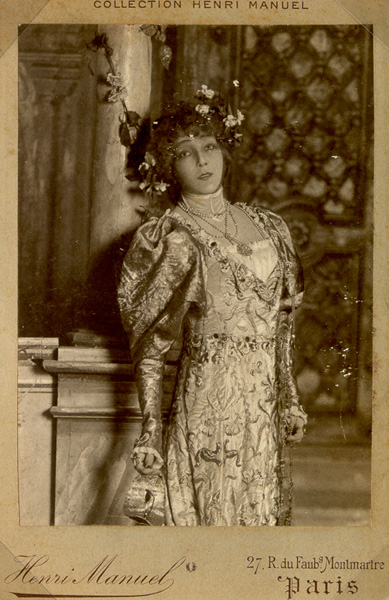 she purchased and began sleeping in a coffin to better understand her tragic roles. In fact, she preferred roles in which the character dies at the end. (When she played one such role before a boisterous American audience, she said, "If they don't keep quiet, I'll die in the second act.") She played both male and female parts, and was in fact openly bisexual. She acted without a prosthetic limb after her leg was amputated in 1915 (and refused an offer of $10,000 to exhibit the severed limb as a medical curiosity). She loved chairs and filled every house she ever lived in with them. She
  married Greek actor Aristides "Jacques" Damala (1855-1889), and after his early death always signed her name as "Sarah Bernhardt, Veuve [Widow] Damala." Bernhardt was recorded by Thomas Edison, photographed by Nadar, and friends (and sometimes lovers) with the luminaries of her day. She wrongly believed she would die young, but attained the age of 88. She died of uremia and is buried at Pere Lachaise cemetery in Paris.
 Steve and I were talking about common graves the other night (yes, such a topic is not atypical at my house!). He was curious when I told him that during the Great Plague, the dead were carried to the common grave in a coffin with a hinged end, so that the body (wrapped in a winding-sheet) could be slid into the pit and the coffin reused. I have come up with the photo above, courtesy of a great site I discovered recently, Curious Expeditions. And I also found two references, one in Buried Alive By Jan Bondeson and the other in The Impact of Plague in Tudor and Stuart England By Paul Slack.


