
Today, something lighter than the usual bad news about rhinos. Rihanna, Keren Peles, and Karnabella took the opportunity to sneak by a sleeping security guard – since terminated – at an open side gate at an Israeli safari zoo. This delightful CCTV footage shows the girls being chased back into the zoo by the manager.
Showing posts with label Zoos. Show all posts
Showing posts with label Zoos. Show all posts
Tuesday, January 20, 2015
 Posted with Blogsy
Friday, January 16, 2015
Orangutongue
She may not look like a celebrity, but Tilda is making a name for herself by babbling in human sounds (VIDEO HERE). Born in the wilds of Borneo, she has spent most of her life in captivity – now at the Cologne Zoo in Germany – during which time she has picked up many human-like means of communication. She waves her hands and shakes her head like a person, and came to the attention of founder of the Pongo Foundation Adriano Lameira when he was studying orangutans that whistle. He describes, "We were waiting for the whistles and suddenly she started to do these bizarre calls. She was producing these calls repeatedly and really quick. And this is also what we observe in humans while we are speaking to each other. We are, on average, producing five consonants and five vowels per second." The research suggests that our human ancestors had the ability to produce speech before they developed a modern vocal tract and brain.


Wednesday, January 14, 2015
Bao Bao ball

On Tuesday of last week, as the Washington, D.C., area was blanketed with snow, the Smithsonian National Zoo's 16-month-old giant panda cub Bao Bao was romping in it for the very first time. In addition to climbing trees and playing with her mother, she rolled herself up in a ball and somersaulted down a hill (VIDEO HERE). Because their diet of bamboo is low in nutrition, giant pandas don't move much. Panda-keeper Nicole MacCorkle points out the exception, "This is their kind of weather. Their whole way of life is all about conserving energy—but when they see the snow, they can't help it."
Saturday, October 25, 2014
Python parthenogenesis
Thelma (IMAGE ABOVE) shares an enclosure with Louise at the zoo in Louisville, Kentucky, U.S. Despite being a male-free zone, this 11-year-old reticulated python produced 6 offspring in June 2012. The female babies – dwarfed by their 200 lb. (91 kg), 20 ' (6 m) long mother – are all half-clones, with 3 retaining her intricate reticulated pattern, and the rest displaying a pattern of bright yellow with black stripes. The number of species capable of parthenogenesis or virgin births – snakes, birds, sharks, and other animals – continues to grow. Biologist Warren Booth of the University of Tulsa in Oklahoma observes, "It's something we used to consider an evolutionary novelty that's much more common than we thought."

Sunday, September 28, 2014
Groundhog goof
In one of the most ridiculous holidays on the American calendar, a groundhog is used to prognosticate the likelihood of 6 more weeks of winter, based on whether the animal emerges to see his shadow or not. The Groundhog Day ceremonies across the country often feature local celebrities. On February 2, 2012, that honor fell on Mayor Bill di Blasio of New York City. A groundhog named "Chuck" was provided by the Staten Island Zoo, but managed to break free of the mayor's grasp and hit the ground. Now there are tongue-in-cheek accusations of a cover-up, since it has only just now been revealed that the groundhog had died of internal injuries a week after the event. Not only that, "Chuck" was actually "Charlotte." The New Yorker magazine has published an open letter to Mayor di Blasio from the groundhogs, who are claiming solidarity in their struggle to have "their" day abolished for their own safety. They write, "When we do decide to go outside, it is because we hope, in our infinite marmot naïveté, that the mayor has, for once, decided to put an end to the practice of thrusting us into the air and precariously dangling us, like some sort of politicized Michael Jackson baby."

Wednesday, August 20, 2014
Meerkat scat
The keepers at New Zealand's Hamilton Zoo became concerned when the droppings of the meerkats looked particularly vibrant (IMAGE ABOVE). Turns out that a young schoolchild inadvertently dropped some rubber loom bands over the railing of their enclosure. Because meerkats are omnivorous – eating plants, insects, and small animals – they gobbled them up. Zoo curator Sam Kudeweh explains, "Meerkats are relentlessly inquisitive and anything novel has to be investigated. If one of the bands was broken, it would have looked all wiggly and meerkats will consume anything. Typically the adults will find food and the babies will nick it off them."

Saturday, August 16, 2014
Tiny Giants
It may be a good thing that by tradition the Chinese do not name giant pandas until 100 days after their birth. Panda mothers have been known to accidentally crush their tiny babies or to sacrifice one of a pair of twins so that they can focus on raising the other. Newborns are also subject to pneumonia, lack of oxygen, and infection. So far, the triplets born in July at Guangzhou’s Chimelong Safari Park (IMAGE ABOVE, SLIDESHOW HERE) have survived longer than many other cubs of rare multiple births. So far, then, we can enjoy their questionably adorable appearance and hope for the best. As journalist Gail Sullivan writes in the Washington Post, "The little cubs are cute — in a naked mole rat sort of way."

Wednesday, July 23, 2014
Flaws by jaws and claws

The Kamine Zoo in Hitachi, Ibaraki Prefecture, Japan, has introduced a new program, not necessarily for the enrichment of the animals but to raise money for the zoo and a conservation group. They are allowing lions, tigers, and bears to tear at denim which is then used to make jeans (VIDEO HERE). The fashionably broken-in jeans are auctioned on the Internet, with the first 2 pairs going for ¥152,000 ($1,500) each. In addition to distressing the material, the activity does seem to de-stress the beasts. Zoo director Nobutaka Namae describes, “We wrapped several pieces of denim around tires and other toys. Once they were thrown into the enclosures, the animals jumped on them. The denim was actually much tougher than we had thought, and it turned out nicely destroyed.”
Thursday, June 19, 2014
Lemurs and lawn ornaments
Lemurs, too, participate in zoo enrichment programs. A San Francisco Zoo spokeswoman explains, "Sometimes this is a long-term, involved project, and sometimes it is as simple as providing a new, colorful and different-smelling object for a short period of time." Hence, the zoo's lemurs were recently allowed to introduce themselves to pink flamingos. But not just for the photo opportunity: their responses to the stimulus offer clues to their mental health. Apprehension may indicate stress and curiosity shows that the lemurs are comfortable in their environment.

Thursday, May 29, 2014
Otter patter
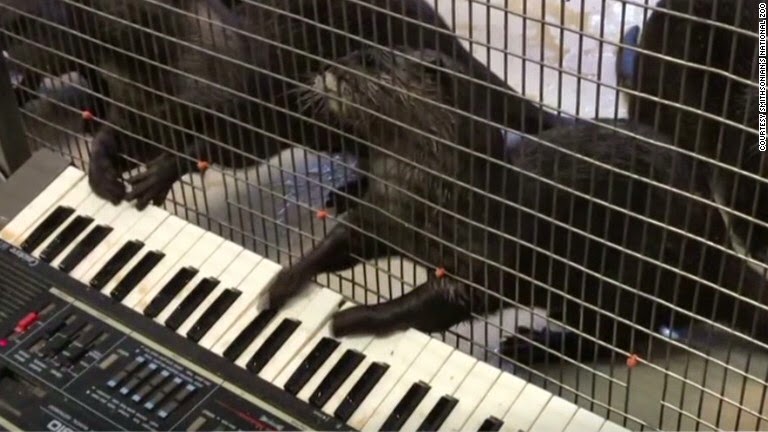
Many of the smarter captive animals take part in enrichment programs to stimulate them physically and mentally. Elephants are given paints and octopus are given puzzles. The Asian small-clawed otters at the Smithsonian National Zoo in Washington, D.C., U.S., are offered a keyboard (VIDEO HERE).
Tuesday, February 11, 2014
The zoo's point of view
Last week, a healthy 2-year-old giraffe unofficially named "Marius" was euthanized at the Copenhagen Zoo. Members of an outraged public staged a protest, signed a petition, and one individual even offered to buy the giraffe for $680,000 (€500,000). The zoo is a member of the European Association of Zoos and Aquaria (EAZA), which has a mission of conserving global biodiversity and recommended the animal be put down because there were a lot of giraffes with similar genes in their breeding program. Two zoos had offered to take Marius, but one already held his brother and the other does not belong to the EAZA. Zoo spokesman Tobias Stenbaek Bro explained that a tenet of membership is that they are custodians of the animals, not owners, and can't sell them to anyone outside the organization who doesn't follow EAZA principles, which would rule out the individual who made the financial offer. The Copenhagen Zoo, by the way, doesn't castrate the giraffes or give them contraceptives because that could have unwanted side effects and because they value parental care. Instead, they went ahead with euthanizing the animal, using a bolt pistol instead of lethal injection so as not to contaminate the meat. With visitors of all ages present (IMAGE ABOVE), the giraffe was then butchered and fed to the lions, tigers, and leopards. Copenhagen Zoo's scientific director Bengt Holst pointed out, "I know the giraffe is a nice looking animal, but I don't think there would have been such an outrage if it had been an antelope, and I don't think anyone would have lifted an eyebrow if it was a pig."

Tuesday, February 4, 2014
Guy
The most famous resident of the London Zoo was given the name because he was welcomed in 1947 on Guy Fawkes Night. Guy the Gorilla had been born the year before in the French Cameroons and arrived via the Zoo de Vincennes in Paris in exchange for a zebra and a tiger. He became a household name during the three decades he lived at the zoo (PHOTO ABOVE TAKEN BY HENRY GRANT C. 1950, PHOTO HERE TAKEN BY WOLF SUSCHITZKY IN 1958). The British public was heartbroken when he died during a tooth operation in 1978, and outraged that his body was to be mounted and placed on display at the Natural History Museum in South Kensington. The museum postponed its plans and instead stored Guy's half-cured skin in the freezer. But as museum press officer Sue Runyard explained to her superiors, the story would not die. “My interest is that I should not have to explain to the press at some time why we allowed his remains to spoil,” she wrote in 1980. At that point, taxidermist Arthur Hayward was brought in, but found that the pelt was not in very good condition. His only option was to set the hairs in a latex replacement skin, which he stretched over a model. The results went on display to mixed results for a few weeks in 1982. The same year, a bronze sculpture by William Timym was unveiled at the London Zoo. In my humble opinion, neither one (IMAGES HERE) does the beloved gorilla justice.

Saturday, December 28, 2013
Flamingo No. 492

There is a particular flamingo which is considered quite a coup for a birdwatcher to add to his or her lifelist. That would be Flamingo No. 492 (IMAGE ABOVE), who has quite a storied biography. The Caribbean flamingo was born in Yucatán, Mexico, and grew up in Tanzania and South Africa before being shipped with 39 of its fellows to the Sedgwick County Zoo in Wichita, Kansas, in 2004. The following year – before the bird had been blood-tested to determine its gender – 492 escaped. Since then it has been spotted in Wisconsin and Louisiana, and 8 years later it is still on the lam! It's a bit of a sore spot with the zoo, explains curator of birds Scott Newland. “It is a black eye, to be honest. It was basically an error. We are not fond of this story....Every two or three years, another sighting of him pops up. The good thing is that if this is what gets people out watching wildlife, there is no harm in that.” The most recent sighting of the legendary bird was earlier this month, by Massachusetts birder Neal Hayward, in Cox's Bay off Port Lavaca on Texas's Gulf Coast. The 4' to 5' tall, pale pink 492 was spotted with a smaller, pinker bird, but with their sexes in question it is unknown whether the flamingos are friends or partners. But at the age of 18 and with a lifespan of 50, 492 has decades left to keep the birders wondering.
Sunday, August 4, 2013
Baffling baboon behavior

Biologists at Emmen Zoo in the Netherlands are puzzled by the behavior of their 112 hamadryas baboons, although they have observed it before in 1994, 1997, and 2007. Monday night it took more than an hour to get them into their night enclosure, when it usually takes but a minute. Starting the next morning, they began spending their days sitting still in the trees or huddled together on the rocks, with their backs turned to visitors. They have only just begun to resume their normal eating patterns. In the wild such hysteria would have been triggered by a predator, but it would not have lasted as long. With the zoo in the city center, it is unlikely that they saw a fox and none of the other animals have been spooked. Biologist Wijbren Landman comments, "What frightened them? We don't know, it's a mystery. There have been many suggestions - an earthquake, escaped snakes, aliens, thunder." While the alien theory has grabbed a headline, the answer may be much more mundane. One of the males in the hierarchy may have seen the image of a predator on a visitor's T-shirt!
Wednesday, March 20, 2013
Furry friend

Subscribe to:
Posts (Atom)


