Monday, April 30, 2012

Un-dead ducks


Click on images for all-too-common stories of ducks impaled by arrows after being shot. Under U.S. law, it is illegal to shoot migratory waterfowl, but state regulations are - at least to a non-hunter - confusing. Whether against the law or not, it is considered abusive not to attempt to collect a hunted duck that has been wounded without being killed.

Sunday, April 29, 2012

Aung San Suu Kyi


While the American press was busy churning out soundbites about presidential politics earlier this month, something momentous happened on the other side of the world. I heard only one mention of it on TV (though it was more widely covered in the print media), and I think it may have gone unnoticed by many, so I am adding the heroic and charismatic Aung San Suu Kyi to Quigley's Cabinet. After decades of suppression by the government of Myanmar (Burma) - including 15 of the last 21 years under house arrest, the 66-year-old dissident has been elected to Parliament. Although the governing body is still controlled by the military-backed ruling party, Aung San Suu Kyi has taken public office as leader of the opposition's party, the National League for Democracy. The New York Times calls her "a symbol of moral fortitude in the face of oppression" and "a repository for the wide-ranging hopes of a long-suffering population." Here is a chronology of Aung San Suu Kyi's life that includes her receipt of the 1991 Nobel Peace Prize. And here is what some of the voters said about Aung San Suu Kyi, who has already made news in her new position:  A 76-year-old woman said, “I feel like crying when I talk about Daw Aung San Suu Kyi. It felt so good to vote for her party - only Daw Aung San Suu Kyi can save us from deep poverty.” “We used to fear speaking with foreigners about democracy. Now we have courage,” remarked a 50-year-old former schoolteacher. " A 61-year-old man remarked, "Look at us – we are so happy, it's like we've each been released from prison....We have freedom now. Said Aung San Suu Kyi herself to the cheering crowd.: "We hope this will be the beginning of a new era."

Saturday, April 28, 2012

An owl for each

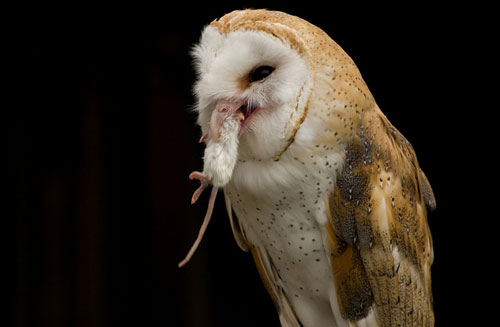
I hadn't realized until yesterday how beautiful barn owls are (although less so as babies!). Apparently, they are also smart enough to overcome their raptor instincts when it means making a friend of another species. A video of an owl and a cat at play is still circulating (I got an e-mail last week) a year after it was posted, and a dog-owl bond is currently making the weird news.
Gebra and Fum the cat (2nd image, video here) live in Tarragona, Spain, and have their own Facebook page. Their names (Fum = smoke and Gebra = frost in Catalan) belie their friendship - the stuff of nursery rhymes, although they have been playmates since Fum was a kitten.

Willow and Merlin the dog (1st image, photos here and here) became fast friends 3 months ago at the falconry center in Corwen, Denbighshire, Wales, where they live. The owl's handler Lorwi Peacock says the special relationship started when she was exercised* as Merlin was taken on his daily walk. Now the bird likes to ride on Merlin’s back with her wings outstretched as he goes for a run. “They are inseparable. People always stop and smile when they see them going by,” remarks Peacock.
Unlike their gorgeous feathers, the voices of barn owls (listen here) are all business.

*Maybe she is being trained like other owls at the center to carry rings down the aisle at weddings they host.
__________
Previous posts about owls:

Friday, April 27, 2012

Tim Curry as Alexander Monro!

What fun! Having written about the famous Scottish surgeon in my most recent book, it was a treat to see the characters in the 19th c. bodysnatching scandals brought to life in the 2010 film "Burke and Hare." The dark comedy about the homicidal actions of William Burke and William Hare to serve the city's anatomists gets most of the details right, such as the transporting of bodies in barrels. The lively cast (Tim Curry above) is almost upstaged by the rich details of the sets, from Dr. Robert Knox's dissecting theater to the cobbled streets of Edinburgh. A review by Top 10 Films reads, "The film is...beautifully shot and is one of [John] Landis’ most visually exciting films thanks to its brilliant period production design." The plot necessitates some gore, but at least it's not accompanied by Smell-o-Vision. Many historical characters make an appearance (including poets William Wordsworth and Samuel Taylor Coleridge), but not naturalist John James Audubon, who was given a tour of the anatomy school by Dr. Knox during his visit from America and is reported to have said, "The sights were extremely disagreeable, many of them shocking beyond all I ever thought could be. I was glad to leave this charnel house and breathe again the salubrious atmosphere of the streets." The movie - which I watched last night on DVD - does not confuse the issue that the Dr. Alexander Monro played by Curry is the 3rd-generation anatomist of that family (distinguished by adding tertius to his name in print). It closes with the authentic information that Burke was hanged, anatomized, and skeletonized, but leaves out the details that his tanned skin was crafted into souvenirs and that during the dissection Monro dipped his quill pen into Burke's blood and wrote, "This is written with the blood of Wm Burke, who was hanged at Edinburgh. This blood was taken from his head." Happy to say that the brevity of "Burke and Hare" (an hour and a half) is matched by its hilarity. Recommended!

Thursday, April 26, 2012

Bodies

A brooch containing a watercolor of Ralph Waldo Emerson's 1st wife Ellen Louisa Tucker. The brooch, now in the Concord Museum, was painted in miniature on ivory in Boston in 1829 and photographed on the cashmere shawl she is shown wearing in the portrait.
A friend of my sister and brother-in-law asked me on Facebook if I knew the story about American poet and essayist Ralph Waldo Emerson (1803-1882) and his wife's corpse. The answer was no, but the question piqued my curiosity, so here's what I found...

Just 2 years after they married, Emerson's 1st wife Ellen Louisa Tucker (1811-1831) died of tuberculosis. He visited her grave in Roxbury, Massachusetts, every day. On March 29, 1832, 14 months after Ellen had been laid to rest, the poet opened the coffin to have a look at his 20-year-old bride. "He had to see for himself," write his biographers. "Some part of him was not able to believe she was dead." He noted only that he had done so in his journal, and did not say much more about the exhumation of his son and mother 25 years later in 1857, when he moved their remains to Concord's Sleepy Hollow Cemetery. Five-year-old Waldo Emerson, the 1st of 4 children he had with his 2nd wife Lidian Jackson Emerson, had died of scarlet fever in 1842 (read Emerson's poem about the boy's death here). "The sun shone brightly on the coffins, of which Waldo's was well preserved - now 15 years," he wrote. While he didn't record what he saw when the remains of his wife - and later his son - were exposed, the sight did influence his writing. "Struck by the horrible decay, Emerson solidly affirmed his belief in the opposition between spirit and mind, and body, with the recognition that while physical particulars change, the universal sense of life remains," say his critics. The 1st experience opened him up to the world and caused him to focus on the here and now.

There was speculation that Emerson believed in vampirism, but Caleb Crain puts it this way: "I doubt Emerson would have believed simple-mindedly in the New England vampire folklore, but I suspect he was aware of it, and it must have been part of the wider social context for his act." For more on the vampire myth, I refer you to Vampires, Burial, and Death by Paul Barber, who explains it (and explains it away). You may also want to read my post about Dante Gabriel Rossetti's exhumation of his wife in 1890, 8 years after she died, to retrieve some poems.


*Thanks, John. Did I miss anything?

Wednesday, April 25, 2012

The elder's end

A later portrayal of Pliny the Elder.. Note that no contemporary depictions of Pliny have survived.
Pierre-Henri de Valenciennes, "Eruption of Vesuvius" (1813).
When follower Cherei linked me to this list of resources about Ancient Medicine on the fantastic site The History of the Ancient World, my eyes lit on the paper about Pliny the Elder (23-79 A.D.). If you are familiar with the biography of the Roman author and naturalist, have read much about volcanoes, or simply recognize the year of his death, you know that he was killed by the eruption of Mount Vesuvius that destroyed Pompeii. Do you also know that we have a firsthand account of that event from the point of view of Pliny's teenage nephew, who was living living at his Uncle's villa in the town of Misenum at the time? Pliny the Younger, as he is known, writes to his friend, the historian Tacitus, "My uncle decided to go down to the shore and investigate on the spot the possibility of any escape by sea, but he found the waves still wild and dangerous. A sheet was spread on the ground for him to lie down, and he repeatedly asked for cold water to drink.Then the flames and smell of sulphur which gave warning of the approaching fire drove the others to take flight and roused him to stand up. He stood leaning on two slaves and then suddenly collapsed, I imagine because the dense, fumes choked his breathing by blocking his windpipe which was constitutionally weak and narrow and often inflamed. When daylight returned on the 26th - two days after the last day he had been seen - his body was found intact and uninjured, still fully clothed and looking more like sleep than death." (Read translations at The Volcanism Blog, Smatch-International.org, and - as quoted above - Eyewitness to History)  Based on this 1st c. description and previous diagnoses, authors F.P. Retief and L. Cilliers come to the following conclusion put forth in "The Eruption of Vesuvius in A.D. 79 and the Death of Gaius Plinius Secundus": "Various reasons have been advanced to account for his death (asphyxiation caused by respiratory problems, carbon dioxide poisoning, heart failure, advanced coronary sclerosis). Basing our findings on the description of the catastrophe in the letters of his nephew, the younger Pliny, we believe that the most probable diagnosis which also fits his description of his uncle’s behaviour and symptoms during his last hours, is that of acute and fatal bronchoconstriction in a chronic asthmatic."
__________
Previous related posts:

Tuesday, April 24, 2012

Smuttynose

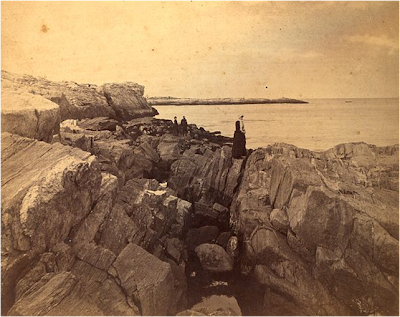
An albumen print by 19th c. photographer L.V. Newell showing the east end of Star Island with Smuttynose Island in the background.


"Smuttynose" is the strange name of an island (coordinates 44° 13' 15.29"N 68° 31' 18.08"W) with a violent claim to fame: a double-murder in 1873. The 2 Norwegian women who were killed, sisters-in-law Karen and Anethe Christensen, lived on one of the Isles of Shoals, which are part of Maine but located 6mi off the coast of New Hampshire. The crime - carried out with a hatchet - was blamed on German fisherman Louis Wagner, who was caught, imprisoned, condemned, recaptured after escaping, and hanged. Wagner had been identified by the only witness and the case was considered airtight, but he had protested so strongly that some believed him to be innocent. The story of the murders was told shortly afterward by a onetime island resident and has been revisited several times since:

1875
Celia Thaxter
"A Memorable Murder"
"I find the women and children with frightened faces at the little cottage; as I go into the room where Maren lies, she catches my hands, crying, "Oh, I so glad to see you! I so glad I save my life!" and with her dry lips she tells me all the story as I have told it here. Poor little creature, holding me with those wild, glittering, dilated eyes, she cannot tell me rapidly enough the whole horrible tale. Upon her cheek is yet the blood-stain from the blow he struck her with a chair, and she shows me 2 more upon her shoulder, and her torn feet....What a mockery seems to me the "jocund day" as I emerge into the sun shine, and looking across the space of blue, sparkling water, see the house wherein all that horror lies!" (Read the whole thing here)

1981
John Perrault 
"The Ballad of Louis Wagner"
"Fire racing through my brain, explosions in my eyes
Anethe lying on the floor and Karen screaming: 'Why?'
The axe, the blood, the sky, the moon, the pounding of the sea
the howling of the crazy wind, the wind or was it me?
" (Read the whole thing here)

1998
Anita Shreve
The Weight of Water
"Sometimes I think that if it were possible to tell a story often enough to make the hurt ease up, to make the words slide away from me and down my arms like water, I would tell that story a thousand times..." (Preview and reviews here)

2008
Mark Bastoni
"Horror on Smuttynose Island (Isle of Shoals)"
Yankee Magazine
"At the house Karen was trying to escape through a window when Wagner burst into the room. He swung the axe wildly at the feeble figure, first on the mark, then missing, splitting the sill, and breaking the handle. Karen's listless form melted into the room where Wagner twisted a handkerchief around her throat and pulled mightily until he was sure his deed was final."
(Read article here)

2009
Emeric Spooner
Return to Smuttynose Island: And Other Maine Axe Murders
"Wagner’s evil deeds should be remembered and not lost to time, or covered up by those that wish to keep this knowledge secret." (Article in the Bangor Daily News)

The grave markers of the Christensen in South Cemetery, Portsmouth, New Hampshire.
Thanks to Sue, who used to live in New Hampshire and has been to Smuttynose Island, for telling me about this.
__________
Previous posts on the subject of murder:

Monday, April 23, 2012

Seed-bombing

Last year at about this time, I learned about yarn bombing. This year, seed bombing! Until now, I had thought of gardening only as a passive pastime. Not so! Seed-bombing is a form of garden activism that has been around for years, but has recently made news.  At a recent seed-bombing workshop in Washington, D.C., Emmy Gran taught participants how to become "guerrilla gardeners" by making and lobbing seed balls - plus the art of captioning this green form of civil disobedience with a little biodegradable moss graffiti. A teenage gardener offers instructions and a Mom in Vancouver, British Columbia, explains, "Seed balls, simply put, are a method for distributing seeds by encasing them in a mixture of clay and compost. This protects the seeds by preventing them from drying out in the sun, getting eaten by birds, or from blowing away. Seed balls are scattered directly on the ground, not planted....I like ‘em because they’re easy to chuck over fences into empty lots." Aerial reforestation has been used on a smaller scale to beautify and reclaim vacant inner-city properties in cities like Detroit (see list of successful projects here) and on a larger scale (from planes) to reintroduce vegetation onto land devastated by forest fires or other natural disasters like Haiti and countries in Africa.
__________
Selected past posts about seeds:
__________
What anthropologist Art Aufderheide says about my new book Dissection on Display:
"Things have slowed down enough for me to finish reading your most recent book and what a book! Since I have a personal interest in the evolution of the autopsy, I know what an enormous effort you must have expended in gathering the often obscure sources. Yet your presentation of them  reads more like an action, especially the section on "bodysnatching"...Historically, dissection with the anatomic knowledge gained must precede the era of the autopsy. This is where your book comes in....one can easily see the enormous vacuum your book fills, especially  the medieval period....Sincerest congratulations again for an enormous contribution to the history of dissection."


Sunday, April 22, 2012

Gladiatrix

I am very excited to watch the Olympics (from home) this summer, but today let us turn from Ancient Greece to Ancient Rome. Alfonso Manas of the University of Granada has reexamined a statue at the Museum für Kunst und Gewerbein to determine that it portrays a female gladiator. The bronze statuette (1st image) is only the 2nd known representation of a female gladiator, the 1st being a bas relief from Halikarnassos (see below). The scythe-like object in her left hand, previously thought to be a "strigil" used for scraping the body clean, has been reinterpreted as a weapon called a "sicca," used by fighters who protected themselves with small shields and metal leg guards. If she had been washing herself, she would be nude and her stance would have been different; instead, she is shown wearing a loincloth and making a typical victory gesture over her opponent, having already put down her helmet and thrown her shield to the ground. Like men, the women would have fought bare-chested and to the death, except under special circumstances. Manas writes in the International Journal of the History of Sport, "No doubt the particular appearance of female gladiators would also cause an erotic impact on viewers." The rarity of depictions of women gladiators is matched by the scarcity of written accounts (10 literary fragments and an inscription), suggesting that all-female contests were rare.

This 1st-2nd c. Roman relief from what is now Bodrum, Turkey, shows the honorable release of 2 female gladiators. "Amazon" and "Achilia" probably earned their freedom after a series of outstanding performances. Women attended the games, but were seated separately, which raises questions about why the remains of a richly adorned woman of high social status were found among the gladiators by the excavators of a gladiatorial school in Pompeii. "What these women love is the sword," wrote Roman poet Juvenal, but more of them were in the audience, obviously, than in the arena.

Saturday, April 21, 2012

Sporty spins


1st 1080
Skateboarding
Tom Schaar
2012
"Tom's a little giant and a spinning machine. Amazing. I look forward to learning a lot from him in the future. All eyes on Tom!" says defending X Games Big Air gold medalist Bob Burnquist about 12-year-old Tom Schaar pulled off the first 1080 - a 3-rotation aerial maneuver that has eluded the world's best for years - on March 26th.
(story and video).

Torstein Horgmo
2010
(video)

1st switch toeside 1080
Wakeboarding
1999

1st triple twisting quadruple
Skiing
Frank Bare
1983

1st triple toe loop landed in competition
Figure skating
Dick Button
1952

1st triple "tours en l'air" in performance
Ballet
1908-1919

Hi Ross!

Friday, April 20, 2012

Handwriting without hands

Kennebec Journal

Pittsburgh Post-Gazette
Last year at this time, Nicholas Maxim (1st image) - then a 10-year-old in the 5th grade at Readfield Elementary School in Maine - was making news by winning a penmanship award despite being born without hands (more photos and sample here). His teachers submitted his entry to a national handwriting contest held each year by Zaner-Bloser and the Ohio-based company was so inspired by his story that they established the Nicholas Maxim Special Award for Excellent Penmanship. They honored him by presenting the trophy at a school-wide assembly, but his buddy Quinn Hyland was not surprised by the accolade. "His handwriting is better than most of the people here. I've probably heard him say I can't like once or twice. But it's not something he can't do, it's just something he needs permission to do." Nick writes using his forearms to hold the pencil without the benefit of his prostheses. "He is who he is and does what he does not to get attention," says his sister, Sarah.

This year, the honor - designated for a student with a cognitive delay or intellectual, physical, or developmental disability - has been given to 7-year-old 1st grader Annie Clark (2nd image). She is one of 8 adopted Chinese siblings and is enrolled at the Wilson Christian Academy in West Mifflin, Pennsylvania. "I think about doing words and spelling [but have] learned to go slow," says Annie (video and sample here).

Neat penmanship is something I'm sure Trish Vickers of Charmouth, West Dorset, U.K., is glad she has. She lost her sight 7 years ago, but just finished writing 26 pages of her first novel by hand. It was not until she asked her son to read it back to her that she learned that the pages were blank - her pen had run out of ink. They called staff in the fingerprint bureau of the Dorset Police who volunteered their time to reveal the missing words by using a crime light to enhance the indentations. "Fortunately apart from one line we managed to retrieve the whole lot. It was nice to do something good for somebody and it was nice to read the book as well," said one of the officers (video here).

Thursday, April 19, 2012

Suicide forest


Hub Pages
Daily Mail
In the United States, suicides throw themselves off the Golden Gate Bridge. In Australia, they jump from the Gap into Sydney Harbor. In Japan, they hang themselves in Aokigahara (青木ヶ原) forest at the base of Mount Fuji. Geologist Azusa Hayano has been traipsing the area for more than 30 years, seeing the evidence of despair and intervening to save lives. He took a film crew from Vice.com into the dense forest (photos on Oddity Central and Environmental Graffiti), which is associated with demons in Japanese mythology and widely believed to be haunted (watch 21-min. video or 10-min. version). One source attributes the haunting not only to the suicides, but to the earlier custom of abandoning the elderly - Ubasute, which some practiced in Aokigahara. In a tradition known historically for the ritual act of harakiri or seppuku, today's suicides are attributed to social isolation and increasingly to the economy. "I think it's impossible to die heroically by committing suicide," says Hayano.

Thanks, Robert!
__________
Previous posts about suicide:

Wednesday, April 18, 2012

Chêne chapelle


Having posted about trees* and treehouses** many times, I was surprised to learn on "Jeopardy" last night of le Chêne chapelle, France's oldest tree (images above, more photos here and here). Thought to be between 800 and 1.200 years old, the oak was ancient by the time of Louis XIV (1638-1715) and Napoleon (1769-1821). More than a century earlier than that, it had been struck by lightning, which burned through the center of its trunk. The local abbot built 2 shrines in the hollow of the tree in 1669, Notre Dame de la Paix and the Chambre de l'Ermite, one of which is accessed by an external staircase. Located in the village of Allouville-Bellefosse in Haute-Normandie, the oak has been reinforced with poles and cables, and the missing bark has been covered with wooden shingles. Mass has been held at the tree twice a year and it is the destination of an annual pilgrimage on the Feast of the Assumption of the Virgin. Le Chêne chapelle is included in lists (here and here) of the world's most incredible trees.

*Senator no longer stands, Arboreal goats, Cut down, Leaves don't leap, Tree mummies, Gingko, Elephants eat Christmas trees!, Spanish moss
**Adventurers Club, Castaways, Real and imagined, World's largest treehouse(s)

Tuesday, April 17, 2012

Cats and cars


At about 8:30am on Thursday, April 12, 2012, a bobcat was struck and injured by a car on US 301 in Riverview, Florida. One of the drivers who followed alerted 911. "People are trying to catch a bobcat in the median." "A bobcat?" the operator asked. "Yeah, there's a bobcat and everybody's getting out of their cars and they're trying to catch this cat," confirmed the caller. A well-meaning woman decided to try to both catch and calm the animal by throwing a blanket over it, but by doing so sealed both her fate and his. The bobcat bit her, which meant it had to be tested for rabies. It was captured (photo here) by Hillsborough County Animal Services and Marti Ryan explains, "The Florida recommendations and compendium on rabies state very clearly the duty of our veterinarian. Which is in this case to humanely euthanize the animal for testing of the brain matter because we have to ascertain, for the health of the citizen, whether this animal is carrying rabies." The wild cats should not be touched, even when they appear to be orphaned cubs. They may harbor rabies - or the more immediate threat of mama bobcat lurking nearby.

On Wednesday, March 28, 2012, at exactly 8:34am, a Canadian lynx passed before a camera on the Redearth Creek overpass in Banff National Park (2nd image), more than a month after tracks had been spotted nearby (1st image). Trevor Kinley, biologist and road ecologist for Parks Canada, says, “You can’t help but be struck by how beautiful it is. I’ve only had a glimpse of one in the wild, so to capture such a clear image is a rare treat.” Highway Wilding is a project that began in 1996 to keep the number of animal deaths on the Trans-Canada Highway to an absolute minimum. To monitor the effectiveness of the 6 overpasses and 38 underpasses that ensure the safety of the abundant wildlife in the area - including bears, deer, and elk (see blog for more images) - staff review the data from remote motion-sensitive cameras. Tony Clevenger, one of the world’s foremost roadway ecology experts, describes the lynx, “It was like he was posing for us. It’s like he’s floating on top of the snow - it’s really compelling. I’ve been doing this research for more than 15 years, and that’s probably the best image I’ve seen of a lynx."

NOTE: Here is the difference between the lynx and the bobcat.

Monday, April 16, 2012

Harlistas


The Harley-Davidson riders of Cuba call themselves "Harlistas" and 70 of them just had a 2-day gathering in Varadero. They've had to be inventive since the U.S.-imposed economic embargo in place since 1962 made it impossible to get replacement parts. "Like the owners of rumbling 1950s Detroit classic cars that still prowl the streets of Havana, vintage Harley fans have had to get creative to keep their bikes road-worthy." Mechanics have specialized in restoring old Harley-Davidsons, and clubs have been established to allow Harley riders to organize events, exchange information, and find spare parts keep their classic bikes running 50 years hence. There are 300 registered Harleys in Cuba, with as many as 100 listed as still in working condition. Although there is smuggling of factory parts, here are some of the more creative tricks their owners have employed:
  • substituting Alfa Romeo pistons
  • using Fiat ambulance horns from Poland
  • mounting Volkswagen wheels and the tires from VW Beetles
  • using alternators and other parts from Russian cars and trucks
  • fixing broken chains with barbed wire or replacing them with chains stripped from the conveyor belts of a pre-Castro Coca-Cola factory
  • making engine gaskets out of cardboard
  • replacing handlebars with residential piping
  • making exhaust pipes from tubes ripped from electrical transformers
  • cannibalizing parts from trucks, lawn mowers, and even anti-tank guns
Almost all of Harleys on the road in Cuba were built before 1960. "Normally all the motorcycles you see would be in a museum elsewhere in the world," says organizer Max Cucchi, who rides a '58.

1st image) A historic photo from a forthcoming book by Gunther Maier (more photos here), 2nd and 3rd images) Promotional photos for the film Cuban Harlistas
_________
Previous posts featuring motorcycles:
Morbid motorcycles
Donorcycle
Follow-ups 5/7/10 (that's a dead guy)

Sunday, April 15, 2012

The boy and the egg


Earlier this month, a blond, curly-haired boy estmated to be 7 or 8 years old was watching the Humboldt penguins at the Woodland Park Zoo in Seattle (video here). When he spotted an untended egg on an outdoor ledge, he politely brought it to the attention of a zookeeper. The egg had been abandoned, so it was taken indoors and put in the custody of a pair of foster parents under whose care it hatched on April 5th. Zookeeper Celine Pardo explains that the young visitor had disappeared when she went back outside to thank him. “We are so grateful to this little boy for helping us save this precious bird. If a crow or seagull had scooped up the egg, it would have been a goner." Zoo officials have appealed to the media for help in identifying the youngster, who will be thanked with a behind-the-scenes tour, an introduction to the chick, and naming rights!

Monday, April 9, 2012

Follow-ups

NATURAL
Harar hyenas: Cubs | Albinos: Snail (pictured), White blackbird | Elephants: Outcry as elephant is separated from friend | Conjoined twins: Siamese pike, 2-headed snake x-ray, Conjoined Brazilian baby, Conjoined twins slideshow, Cyclops pig, 5-legged frog, Drawing by French | Flamingo: Fears that flamingos will blow away | Ape escape: Retiring medical chimps, Zebras escape from Virginia zoo, Exotic animal ownership, Flying squirrel in ER, Lemur in London, 100 snakes in hotel, Seal sneaks in for nap on couch | Bears: Bear in basement | Animal photography: Animals caught by camera trap, Lynx caught on traffic cam | Fossils: New dinosaur found in museum, Archaeopteryx was black | Discovered species: 200 new species in Vietnam, 46 new species in Suriname, New frog species on Staten Island | Lizards: Lizard playing games | Giant insects: Gigantic weta | Giant animals: Whale shark, Shrimp invasion | Auroras: Northern lights 2012 | Tortoise cold, tortoise hot: Turtle climbs fence | Wet specimens: May conference about specimens | Robo-animals: Wheeled dog | Dinosaur eggs: Fossil of dinosaur laying eggs

HISTORICAL
Brothers: Mutant flowers in Van Gogh painting | The workhouse and the writing hut: Dahl eschewed royal honor | Cat mummies: Found in 18th c. home | Cello passenger: Violinist and wombat, "Mad cow" fears | Pick out the Stradivarius | Egypt: Books burned | Property: Private island | Beer: Bad name | Pig butchering: Horse slaughter legalized | Antique chocolates: Aged cake | Fukushima dogs: Before and after Japanese tsunami, Escaped ostriches | Accidental crittercam!: Camera yields photos after year underwater, Photos of 1800s London, Color photos of London Blitz | Ring resurfaces: Ring reunited after 80 years | Sharp stone: Gravestone story, Cemetery sculpture | Relic thefts: Relics in luggage | Angel's glow: Arm from Antietam (pictured) | Crushed: Jaws of life | Mummy medicine: Mummy unwrapped

UNUSUAL
Golden (eagle) girl: Female falconer | Centenarians: Pediatrician dies at 114, 111th birthday, 106th birthday, 105th birthday, 105-year-old stockbroker, Oldest twins are 102, 100-year-old reunites with daughter she gave up as baby, Doctor on call at 100, 103-year-old facing eviction, Centenarian bodybuilder | Amputation: Prosthetic ice axe, "127 Hours" prop, 7-year-old swimmer with 1 limb | Eunuchs: Killed in fire | Roadkill: Retrieval | Library leavings: More library sculptures | Squatting: Squatters with a pig | Somnambulism: Deadly sleepwalking | Dwarfs: Shortest woman, Tiny firefighter | Death in transit: Bus attacked by tigers | Mt. Everest: Champion climber at 15 | Disturbingly young parents: 10-year-old mother | Just another dead bird: Deer dressed up (pictured) | Christmas kidnapping: Jesus nabbed |

PERSONAL
I was gratified (and visits to this blog spiked) when my post on the skeleton with the prosthetic eye was linked on Fortean Times' Daily News Round-Up on 2/27/12 | Re: Temple, I contacted Temple Grandin through her website, asking how her notoriety had affected her, and was thrilled to receive a response the following day: "I am pleased that you are writing about me. Notoriety is keeping me very busy and I feel it is a great responsibility to provide people with practical, sensible information." | Re: Thoracosaurus thesis, Evan Boucher responded, "Thank you for the kind words! I must say I'm not used to the amount of attention this thing has been getting the past week. It's all so very exciting!" | Re: Brian's books, Brian Dettmer replied, "Thanks for the link and for featuring my work on your blog. Your books look very interesting. I have worked with several old anatomy and medical books and I usually only work with vintage or used books but I could see your books possibly being good subjects for my work. How would you feel about that?" I sent him a copy of Conjoined Twins! | Re: Yarn and you, artist Ben Cuervas says, "How cool! Thanks for the mention." | Debbie linked me to this evocative post "The Embalmers Fingerprints" | Angie sent a link about dissecting brains | I treated myself to some aKNITomy! (pictured) | My Mom gave me a mystic moon necklace | Download Skullphabet for free | Travel app for history lovers looks interesting | Mention of my new book on the Shocked and Amazed! website

MARGINAL
These ideas never made it off the back burner and are hereby officially "retired": Mummies of the Grand Canyon | Cursing stone in Cumbria, Ancient curse translated | Piasa bird pictograph | FBI solves art crimes, Might be Michelangelo | Gravity globe | Domestic pigs go feral | Sing Sing sale | Children and animals (pictured) | Litter fine for thread | Lake swallows fishermen's cars, Scuba diver's body found after 26 years | Guoliang Tunnel | Civil War love letters | Name of carnival ride upsetting to some | Ball dropped from sky in Namibia | Shrimp spins silk | Sourtoe cocktail | Drawing the dead | 2,400-year-old soup | Big camera, Little camera | Japanese corpse hotel | Seurat's sideshow | For sale: House where "The Big Lebowski" was filmed | Benefits of hemispherectomy | Zodiac code cracked? | Bog bodies in Florida, Bog trek in Estonia | Sky survey | Donated milk teeth | Photos of frontier life | Mrs. O'Leary's cow | Snowy subway

Labels