A newly-published book has brought much-deserved attention to 17th-18th c. German-born naturalist and scientific illustrator Maria Merian. Her lifework and drawings (IMAGE ABOVE, GALLERY HERE) helped dispel superstition about the "evil" origins of metamorphosis that caused butterflies to change from one form to another. Reviewer Maria Popova writes, "By meticulous and attentive observation, Merian proved that the process was very much a natural one, and beautifully so." This began when she was only 13 years old and continued even after a stroke had left her paralyzed.
Showing posts with label folklore. Show all posts
Showing posts with label folklore. Show all posts
Friday, November 28, 2014

 Posted with Blogsy
Tuesday, September 16, 2014
Osseous oracles
The historical importance of oracle bones (a.k.a. "dragon bones") to understanding Bronze Age China was not recognized until the 19th c. While others were grinding up the artifacts to use in traditional medicines, a collector and scholar was recording the inscriptions, which were published after his suicide. The British Library owns more than 400 of these divination tools, consisting mostly of ox scapulae or pieces of turtle shell and dating to between 1600 and 1050 B.C.E. Sara Chiesura, a specialist in Asian and African studies at the Library, explains, "Questions about crops, the weather or the royal family were engraved with a sharp object and the bone was then heated with metal sticks. Because of the heat, the bones would crack and the answers would be given by the diviners who interpreted the different shapes and the patterns of the fractures. The response was inscribed on the bone too. Most of the cracks produced by the heat on the reverse side of the bones appeared on the front side with a distinctive shape (├ ) from which comes the Chinese character for the verb 'to divine.'"


Sunday, July 20, 2014
Stone unturned
I've been heavy on excavation lately, but this story represents the opposite. In 1964, on the recommendation of archaeologists from Glasgow University, a Bronze Age carved stone was buried to prevent it from being vandalized. The 42' (13 m) by 26' (8 m) Cochno Stone straddles private property and parkland owned by the local council on the edge of Clydebank in West Dunbartonshire, Scotland. The 5,000-year-old stone was discovered by the Rev. James Harvey in 1887 and is covered with some 90 fine examples of “cup and ring” carvings that include indentations, grooved spirals, a ringed cross, and a pair of 4-toed feet. Like the Roman dodecahedrons, the Cochno Stone's use remains a mystery. It may have been a map of the earth or the heavens, with symbols of life, death, and rebirth. Or it may have been the scene of sacrificial ceremonies, with milk or water poured into the grooves and channels as offerings. Historian Alexander McCallum, who has lobbied to have the stone uncovered and may soon succeed, agrees with multiple interpretations: "I think it was probably used for lots of things; it was never used for just one thing and over hundreds of years it changed use."

Tuesday, July 1, 2014
Vulgar vulva
The other day my friend Cathy, who plays Irish music with her husband and has traveled extensively in Ireland, told me about sheela na gigs. These historical architectural carvings are found throughout Ireland and Great Britain, often over the doors and windows of churches and castles presumably to protect against evil spirits entering. They depict women displaying their exaggerated sexual organ, such as the example above from a church in Kilpeck, Herefordshire, England, dating to the 12th c. As Cathy says, "I guess the female genitals where the scariest thing they could come up with!" Although there are many theories as to their origin and meaning, to me sheela na gigs play into the deep-seated fear man supposedly have of the vagina dentata, a toothed orifice that will cut off their own organ if it is inserted. That may be a bit of an exaggeration, but beware, gentlemen, because – as an American exchange student recently found out in Germany – we'll get you...

Tuesday, May 20, 2014
Devil dog
With the discovery of a large canine skeleton at a dig in East Anglia, England, there is speculation that it is the very creature which terrorized the residents in the 16th c. The remains were found in an abbey situated only a few miles from 2 churches in which the folkloric Black Shuck is said to have killed worshippers during a raging thunderstorm in 1577. One attack was described at the time by clergyman Abraham Fleming, who wrote, "This black dog, or the divel in such a likenesse (God hee knoweth al who worketh all,) running all along down the body of the church with great swiftnesse, and incredible haste, among the people, in a visible fourm and shape, passed between two persons, as they were kneeling uppon their knees, and occupied in prayer as it seemed, wrung the necks of them bothe at one instant clene backward, in somuch that even at a moment where they kneeled, they strangely dyed." Planned radiocarbon dating may not solve the mystery. It is possible that the skeleton is that of the legendary black-haired dog with flaming eyes whose footfalls could not be heard. Then again, the grave could be that of the abbot’s beloved old hunting dog.

Friday, November 1, 2013
Bloody

Scientists have finally hit upon a formula that they hope will end blood supply shortages and prevent infections through donations. The critical ingredient added to the mixture of water, salt, and albumin is a protein extracted from marine worms which enables the artificial blood to resist the chemical and mechanical stresses placed upon it. Other proteins have proven toxic, but this one has so far not provoked a rejection reaction. If further testing on mice is successful, the recipe for the universal artificial blood will be patented and the transfusions will be performed on people. “Tests on humans are a very delicate topic, we need some very serious licenses and they represent an enormous risk,” says lead researcher Radu Silaghi-Dumitrescu of Babes-Bolyai University. No one has yet pointed out the irony of the research team being based in Romania, the home of bloodthirsty 14th-century ruler Vlad the Impaler (IMAGE ABOVE) and origin of many vampire legends…
Sunday, May 27, 2012
Ratten


Hamelin does have a rodent problem. "But unlike the [legend], the city is not completely infested by rats, there is a problem area on the outskirts of the city, an overgrown allotment. There is a lot of rubbish around, it's like a table laid for the rat," explains city spokesman Thomas Wahmes. Rats have damaged a fountain (not this one) by biting through a cable, and have caused problems in an adjacent housing development. The vermin were drawn to the fountain at the railway station road by food that tourists, commuters, and passers-by left for birds. As it happens, high costs of maintaining the fountain and keeping it free of fallen leaves meant that it was due to be closed anyway. The city does employ an exterminator, but he is not obliged to wear colorful clothes or play a flute. Wahmes assures that the infestation was not manufactured for the media: "No! It is not part of a PR campaign, it certainly is not."
Monday, January 31, 2011
Ring around the rosie


1st image) Children gathered in a circle in undated photograph, 2nd image) Children playing "Ring around the Rosie" in Chicago in 1941, 3rd image) Children playing "Ring around the rosie" at recess in New Jersey in 1950, 4th image) Elementary school students playing "Ring around the rosie" in an undated photo.
Ring around the rosie(1),
A pocket full of posies(2),
Ashes, ashes(3) -
We all fall down(4).
1) The symptoms of the plague included a rosy red rash in the shape of a ring on the skin.
2) Pockets and pouches were filled with flowers, incense, and herbs to ward of the disease or to mask the smell of death.
3) Refers to the cremation of the bodies or the burning of victims' houses, or may approximate the sound of sneezing, another symptom of the plague.
4) May refer to dying, but alternatively to a curtsy.
The idea that this historical nursery rhyme dates back to either the Black Death (bubonic plague) in Europe in the 14th c. or the Great Plague of London in 1665 seems at first entirely plausible. But it is not true! The song wasn't being sung until the 1790s, and wasn't printed until 1881. It is a rhyme of indefinite origin and no specific meaning, and was "retrofitted" with a believable explanation.
Sources: Wikipedia, Snopes
Wednesday, January 26, 2011
Sights, smells, and sounds
 The gaslit cobbled streets of the city are dark, dirty, and dank, and one of the houses is said to be haunted. The winding alleys, courtyards, storefronts, and dockside are papered with advertisements and populated by shopkeepers and street entertainers. Chimney sweeps and washerwomen also make their rounds. Shady characters - some of them likely pickpockets - loiter in dark corners, and the ratcatchers are busy at their work. The walls of Marshalsea Prison are cracked and peeling, and the cells themselves are fetid and grimy. The skyline is dilapidated, the schoolroom cramped. A boat travels through a sewer, under a tunnel, and past a graveyard. Victorian London? Nope. The modern recreation that is Dickens World theme park in Chatham, Kent, U.K.
Wednesday, January 19, 2011
River baptism

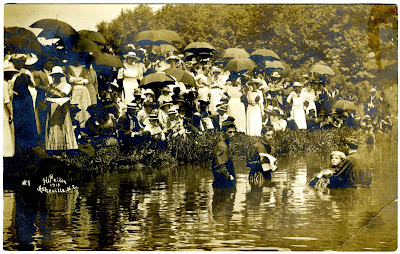

This sounds like a foaf story, but my friend Sue got an e-mail from her daughter-in-law whose friend's husband Jim Linderman of Grand Rapids, Michigan, donated a collection of photographs of river baptisms (1st image, I added the 2nd and 3rd), one over a yard long.
Who: The tradition flourished from 1880 to 1930 among traditional Protestants. Charismatic preachers led the ceremony before entire fundamentalist rural communities.
What: "Take Me To the Water"
When: The donor will be there for the opening of the exhibit Thursday, 1/20/11. Linderman describes the collection, "Over the course of 10 years, I collected every photograph I could find of people participating in the ritual of immersion baptism. Initially, I found my baptism photos at flea markets and such. If I spotted one while browsing through boxes and baskets of photographs, I treated it like a prize and filed it away at home..."
Where: International Center of Photography in New York City (please contact ICP for details)
Why: The rite of baptism signified purity or cleansing from sin and devotion to God. In the Old Testament (John 1:33), John was directed by God to baptize those who accepted his message.
How: I paraphrase an article by Annie Staten and Susan Roach:
"As late as the 1950s, outdoor baptism was common. Even though the majority of churches had indoor baptismal pools, some chose to maintain the earlier, natural setting for this rite of passage, a symbolic ritual purification and initiation. Baptisms were generally held during the summer or early fall so the water would be warm enough. A 2-week-long revival meeting featuring prayer meetings and a guest minister would be followed by an outdoor baptism. A suitable spot in waist-deep water was chosen and the participants were lined up by age and clothed in traditional robes, and the service (hymns, scripture reading, and prayer) was begun. With sermons before and after, the minister baptizes the candidates one by one with a ritual statement, and immersed them. They were brought out of the water with embraces, songs, and applause, and helped to dry off. Inside the church, they are administratively pledged into the congregation, and they remove their headgear."
Tuesday, December 7, 2010
Good Samaritan

You hear the phrase in the news all the time, associated with selfless and heroic acts. Just this past Tuesday, for instance, a passerby was considered a good Samaritan for alerting a deaf family in Indianapolis that their house was on fire. On Sunday night, a Michigan woman saved a life by stopping to aid a man who had left the car he had just crashed to seek help and collapsed by the side of the road. And a week ago Sunday, a Washington man rescued a 3-month-old puppy (pictured) that had been thrown from a truck. The phrase "good Samaritan" comes from a parable in the Bible in which a presumably Jewish traveler is beaten, robbed, and left for dead. Two Jews - a priest and a Levite - pass by without helping him, but a 3rd man - a Samaritan - gives him aid. Samaritanism is closely related to Judaism, but the members of the 2 religions strongly disagreed with each other, so the story was meant to illustrate the admonition to "Love thy neighbor." Sometimes people doing just that become victims of the very situations in which they try to help. Early on Sunday, a man in California attempted to stop a thief from taking his neighbor's car and was shot and killed for his efforts. On Friday in Melbourne, Australia, an 83-year-old man was assaulted and robbed when he responded to the cries of a woman who then attacked him with her accomplice. While they can't be protected during the incidents, good Samaritans are usually protected by the law after they do intervene.
Thursday, December 2, 2010
Doppelgänger


A doppelgänger is a living person's ghostly double. In folklore, this double is ominous and sinister. British poet John Donne (1572-1631) is said to have seen his pregnant wife's doppelgänger in Paris just before she miscarried. The doppelgänger of British admiral George Tryon (1832-1893) appeared before several guests at a party in his London home the night he went down with his ship in the Mediterranean Sea.
Doppelgänger has since come to mean a living lookalike, and French artist François Brunelle has matched up several all over the world - and sometimes in the same city (see examples here and in 1st image). Occasionally they are reluctant to meet, but sometimes they have already been mistaken for one another. "It's a little bit of a nightmare to meet oneself with no warning....They come in, they open the door and there is an expression of uncertainty in their face. They're not sure they're doing the right thing....Because these people are not the same. They were raised in different countries, sometimes -- different families, different religions, different backgrounds, different everything, and yet they look the same. I'm playing with reality in my own little way," says the photographer.
The Polk County Sheriff's Office played with University of Florida student Zachary Garcia's reality recently, as you may have heard on the news. When he did an ego search recently, he learned that he was wanted for murder. The police mistakenly posted his photo in place of that of another young man whose name differed by one character and whose birthday differed by one year. Said the innocent Garcia, "I was just very shocked to find my picture and the article saying that I was convicted of a felony murder charge, and I was just very shocked and angry that someone put my name up there and said I did something I didn't do. Everybody makes mistakes. I work at Publix and I might get somebody's sub wrong. But [this is] not a sandwich, it's somebody's life you're playing with."
If you've found your double, you may want to participate in Brunelle's project. If not, this website (which I haven't tried) offers to find your doppelgänger for you.
Saturday, November 20, 2010
Fish tales


The legends, fairy tales, and romantic accounts of rings being found inside fish are sometimes true! “This was the craziest story we’d ever heard but 100% true," says British jeweler Steve Gallagher, whose boss (2nd image), holds up a gold ring discovered in 2009 inside the belly of a fish caught off Fort Victoria, near Yarmouth. "The ring holds very little monetary value but it is gold. The stones are not diamonds but are very sparkly, which obviously attracted the fish. Goodness knows how long it had been in its belly.” In 2008, a man fishing on Sam Rayburn Lake in Texas found a tarnished blue-stoned class ring from Houston's Universal Technical Institute inside his catch - an 8lb bass. It was engraved with the student's name, so an Internet search helped him track down 41-year-old mechanic Joe Richardson of Buna. "My first reaction was — you gotta be kidding," said Joe, whose mother was irate in 1987 when he lost the $200 ring just 2 weeks after she had given it to him as a graduation gift.
Other "returned ring" stories do not involve fish, but do involve the water. A man using a metal-detector at Lake Michigan found the 1955 Ludington High School class ring that Jan Pedersen had lost in a park some 12 miles away, and returned it to her in 2008. A family in Bend, Oregon, recently found a wedding band in the Metolius River near the fish hatchery, but despite the inscription - "Rolf and Birgit Eternal Love" - have been unable to trace the owner. More exotically, a German man diving off the coast of Africa in 2007 found a 1976 Notre Dame College class ring in an underwater cave and tracked down its owner, a former undercover officer for the CIA who was stationed in Mauritius 20 years ago, and mailed it to her in Ohio. A Massachusetts man was more local when he lost his wedding ring on a dive in 2008: it was found several months later in the giant fish tank at the New England Aquarium on a piece of finger coral. As you can imagine, some of the tales are a bit more prosaic. Just this month, one of the workers who had helped search unsuccessfully through 12,000 gallons of sewage 2 years ago for the antique diamond ring that British widow Joan Spiers had accidentally flushed down a hotel toilet saw it sparkling up at him at the sewage works and returned it to her. The Paso Robles High School class ring lost 15 years ago turned up under similar circumstances, and the California sewer worker returned it to Cindy Koontz Woodhead in time for her to wear it to her 25th reunion.
The French inscription on the vintage April Fool's Day postcard I've cropped above (1st image) was kindly translated by my friend Kristina:
"Sweet fish, faithful host
Of the water that gave you life,
Will you know to tell the unfaithful
That my heart will keep its love."
The site uses the card to illustrate a narrative in which a man proposes to a woman with a netful of fish. She rejects the offer as a poor substite for an engagement ring, but another woman gladly accepts, since a fish can at least be eaten. Kristina notes that the holiday is translated as "poisson d'avril" and that as children they used to stick paper fish on fellow classmates' backs.
Sunday, October 31, 2010
Happy Halloween!

While we Americans have raised pumpkin carving to a fine art, the Jack o'lantern originated in Ireland. The carving of a lantern is associated with the ancient Gaelic harvest festival of Samhain, where it served to ward away evil spirits. The craft was not associated Halloween until the mid-19th c. and was more easily practiced in the U.S., where the native pumpkins were much easier to carve up than the rutabagas (Swedish turnips) the Irish had used. "It took me about 2 hours to hollow out and carve the little turnip and I got a nasty blister on my finger due to the force that was needed to gouge out the flesh," writes a blogger who replicated the experience.
Have a Halloween holiday full of scares, treats, and laughs! Click here for a look at our family portrait this year~
Saturday, October 30, 2010
"La Llorona" deconstructed

This close to Halloween, it's time for a ghost story. I was unaware of this one until my friend Sheila's husband Troy brought it to my attention. In my own peculiar way, I have tried to incorporate a few of the variations and some of the history, so you may want to follow one of the links for a more fluid reading...
La Llorona (1)
A baby christened "Maria" was born to a peasant family in a humble village. She grew into a woman of startling beauty who captured the attention of men rich and poor. They awaited her entrance in a flowing white gown at the local dances and paid her plenty of attention, and she reveled in it.
A. To attend the events, however, she had to leave her 2 young sons home alone. Then one day the boys were discovered drowned in the river. Maria was accused of having neglected her children, resulting in their accidental drowning, or worse, actively drowning them to remove the obstacle to her social life.
B. A wealthy man lavished her with gifts and attention, and she bore him 2 sons. But he soon returned to his former habits of drinking, gambling, and womanizing. He was gone for months at a time, returning only to visit the boys, which caused Maria to resent them. The man threatened to leave Maria for a wife of his own class and goaded her by riding past her in a carriage seated next to an elegant lady. This sent Maria into a rage. She grabbed the children and threw them both into the river.
C. Maria and the son of a Spanish aristocrat fell in love, but kept their relationship a secret because they were of such different social castes. After they had several children, the grandee arranged for his son to marry a Spanish woman of equal social standing. Obediently, the son broke the news to Maria, telling her that he could never see her again. Enraged and jealous, Maria stabbed the children one by one and dropped them in the rushing river.
As her children floated away, Maria realized what she had done and hurried to save them, but it was too late. She broke down into inconsolable grief, screaming and wailing as she ran down the road. They were lost and their weeping mother mourned them day and night, walking back and forth along the riverbank looking for them. She refused to eat, and the gown she wore became soiled and torn. Already looking like a specter, she finally died at the river's edge, but her ghost continued to haunt the banks at dusk. She was heard weeping and wailing, and was seen drifting between the trees along the shoreline or floating on the current with her long white gown spread out upon the waters. Maria became known as La Llorona, the weeping woman. To this day, children are warned (2) against going out in the dark for fear La Llorona might snatch them and throw them to their deaths in the river.
Don’t go down to the river, child,(1) The legend of La Llorona (pronounced "LAH yoh ROH nah"), Spanish for the Weeping Woman, has been a part of Hispanic culture in the Southwest since the days of the conquistadores.
Don’t go there alone;
For the sobbing woman, wet and wild,
Might claim you for her own.
(2) "La Llorona" is a cautionary tale told in many variations from the Southwestern U.S. to Central America to keep children away from the river at night. It is thought to have originated in Mexico and is possibly pre-Colombian in origin, since there are similar tales in Aztec, Toltec, and Mayan lore. The spooky tale has inspired oral legend, prose, verse, film, and music.
A word about the illustration: I usually avoid using images that are unattributed or can't be linked back to the original source, but I have made an exception today because the image is so compelling. If you are the artist of this work - or know who is - please contact me!
Saturday, October 9, 2010
American Gothic


My Mom has been working on her garden and paused with her pitchfork, reminding us both of the iconic 1930 painting "American Gothic" (1st image) by Grant Wood (1891-1942). She was unaware - as you may be - that the image depicts a man and his daughter, not his wife. After a house in his native Iowa (2nd image) caught his eye, Wood had his dentist and his sister pose as a farmer and his unmarried daughter to create the work that brought him instant fame, and has been parodied ever since. Intended as an expression of the moral virtues of the Midwest, it has been criticized from its early dissemination as a caricature of rural America. "Any look beyond 'American Gothic,' or even a close look at that familiar image of man, woman, house and pitchfork, will dispel the notion of Wood as a harmless, mainstream champion of patriotic Americana," writes Janet Maslin in her review of a biography of the painter's life released just last week. The painting used on the cover of the book, for instance, looks naive but actually shows the vehicles on a collision course with each other. His other paintings are also deceptively simple and reveal Wood's mischievous character. In "Portrait of Nan," his sister who had modeled for the daughter in "American Gothic" and was known for her cruel personality, the ties to her blouse read as bats. In "Victorian Survival," the neck of Wood's Aunt Tillie is elongated and sliced through by a black choker. And in "Daughters of Revolution," he retaliates against the D.A.R.'s outspoken objection to his having a commissioned stained glass window made in Germany, so recently an enemy, by painting 3 members in front of a painting they hold sacred when in fact it was painted by a German. According to his biographer, Wood had a morbid sensibility and once used a coffin lid as his studio’s front door, so I imagine he would be pleased at his inclusion in Quigley's Cabinet.
Sunday, September 19, 2010
3 icky round things


1st image) Rat king The "rat king" forms when a number of rats become entwined by their tails - either knotted or tangled together with blood and excrement. The resulting cluster is said to have been observed since the 16th c. and was associated with the plague. There have been several dozen sightings of as many as 32 rats joined like this and a handful of specimens preserved in museums, with the most recent report out of Estonia in 2005.
2nd image) Snake ball An anaconda breeding ball forms when as many as 12 males up to 30' long entwine themselves around a fertile female. Their attempts to impregnate her and to thwart their rivals from doing so may last 4 weeks.
3rd image) Ant circle This ant vortex is also called a death spiral and is an example of circular milling. The phenomena has been observed in army ants since 1944 and occurs when each ant simply follows the ant in front of it and they all get locked into a circular pattern that may last days and results in suicidal death. Here are some more examples.
Sunday, September 5, 2010
Quasimodo


"Oft in the night time, there would be a glimpse caught of a hideous form rambling along the frail balustrade of openwork which encircled the towers and bordered the roof - still again it was the Hunchback of Notre Dame. Then, said the neighbors, the whole building assumed something horrible and supernatural; eyes and mouths open here and there; barks and growls came from the dogs, griffins, and dragons of stone that watch day and night with outstretched neck and gaping jaw around the giant cathedral."~Victor Hugo, The Hunchback of Notre Dame (1831)
Some documents in the Tate Archive have revealed that Victor Hugo's fictional character of Quasimodo was in fact not fictional at all. There really was a hunchback of Notre Dame! The evidence for this was found in the 7-volume memoirs of 19th c. British sculptor Henry Sibson, which were discovered in a Cornwall attic in 1999. Sibson was in Paris in the 1820s working on repairs to Notre Dame. They show that the head sculptor had a humped back, as described in diary entries including this one: "The government had given orders for the repairing of the Cathedral of Notre Dame, and it was now in progress....I applied at the Government studios, where they were executing the large figures and here I met with a Mons. Trajan, a most worthy, fatherly and amiable man as ever existed – he was the carver under the Government sculptor whose name I forget as I had no intercourse with him, all that I know is that he was humpbacked and he did not like to mix with carvers." In later entries, Sibson indicates that the reclusive sculptor was nicknamed Monsieur Le Bossu. Hugo had a strong interest in - and outspoken opinions about - the restoration of the cathedral, and its architecture is a major theme in the book. His close links with the cathedral make it likely that he knew Le Bossu.
Tate archivist Adrian Glew describes making the find, "When I saw the references to the humpbacked sculptor at Notre Dame, and saw that the dates matched the time of Hugo's interest in the Cathedral, the hairs on the back of my neck rose and I thought I should look into it." And a distant relative of Sibson's, Gerry Croydon, exclaims, "Henry's diaries are fascinating, as he travelled the length and breadth of Europe and came across some amazing characters. The discovery that his diary may reveal the inspiration behind one of literature's great characters, is quite amazing."
Monday, August 30, 2010
Credit where credit is due


 Reading about my fondness for miniatures, follower Chase kindly sent along links to the microscopic art of Mykola Syadristi and a website about micro-miniatures. The 1st paragraph of the latter referenced a Sing Sing inmate named A. Schiller who, when he died in the 1800s, was found with 7 pins in his pocket on which he had carved the entire text of the Lord's Prayer. A search for more details yielded countless repeats of the anecdote verbatim. One comment suggested that the story of Schillerhoax, so I pressed on. Snopes was no help, but I found a site stating that the engraving was done by Charles A. Baker. As it turns out, that too was incorrect - a factual error promulgated by Ripley's Believe It or Not! - but it contained the detail I needed: that the pin was displayed at the 1915 world's fair in San Francisco (4th image). So after another successful attribution, I am pleased to share the verified details.
Swedish immigrant Godfrey Emanuel Lundberg (1879-1933), a noted engraver in Spokane, took on a personal and professional challenge in 1912. Five years earlier, Paul P. Wentz had engraved the Lord's Prayer on a brass pin head (3rd image) with a diameter of 2mm (.079"). Lundberg (1st image) hoped to better this by engraving the 65 words on the head of a corrosion-resistant gold pin with a diameter of less than 1.2mm (.047"). He conditioned himself by exercising and avoiding coffee and tobacco, had an extremely fine tempered steel tool manufactured, and devised a means of clamping his arm and hand rigid to steady everything but the tips of his fingers. Working late at night or early in the morning to avoid the vibrations of trolley cars and traffic, Lundberg still went through more than 200 pins before achieving his objective (5th image). "I came near giving up the job....I wouldn't undertake a feat like that again for any amount of money," said Lundberg, who suffered a nervous breakdown afterward. His 2 brothers had the pin authenticated and exhibited in the Palace of Liberal Arts at the Panama-Pacific Exposition (2nd image), where it was greeted with praise and amazement. Even Wentz, the engraver of the earlier and larger pin, took his hat off to Lundberg. The gold pin received a gold medal in engraving and prompted an offer from the Bureau of Engraving and Printing to work on plates for U.S. currency. (When he declined, the Department of the Treasury surveilled him to make sure he was not using his talents as a counterfeiter!) After thousands had seen it at the fair, it was displayed around the country and photographed through a microscope. After the tour, the pin was secured in a bank vault, where it has been seen by only a few people since 1917.
Click here for further details and more photos.
Saturday, August 14, 2010
Arnolfini wedding portrait

The biggest misconception about this Renaissance painting is that the woman depicted is pregnant. She's not. The subject is thought to be a wedding portrait of Giovanni di Nicolao Arnolfini and his wife Giovanna Cenami, but the 2 weren't married until 13 years later and Giovanna in fact died childless. She appears in the painting dressed in the style of women at the time - a style often used to depict female virgin saints. And as a Tuscan cloth merchant, Arnolfini would have been knowledgeable about fashion. The wife's gesture with her left hand may be merely an indication of the couple's strong desire for an heir. The work was painted by Flemish artist Jan van Eyck (c. 1395-c. 1441) in 1434 and is considered one of the most complex paintings in Western art history. Here are some details about it:
The figures: Their placement suggests conventional 15th century views of gender roles. The man stands near the open window, symbolic of his role in the outside world, and looks directly out at the viewer. The woman stands near the bed, symbolic of her role as the caretaker of the house, and gazes obediently at her husband - though not looking down at the floor may indicate more equality than a lower-class woman would have. The hand-holding suggests a contract, like a marriage, and the man's raised hand suggests taking an oath - though it also symbolizes his commanding position of authority.
The clothing: Both subjects are richly dressed in enormously expensive outfits trimmed with fur despite the season. He wears a plaited straw summer hat and a short coat of silk velvet with a doublet of damask underneath. She is wearing a dress that has decorative dagging on the sleeves and a long train, with a blue underdress. The wearing of a headdress may indicate that the couple is already married. The slippers in the corner were a traditional gift from a husband to his bride and may also symbolize domestic tranquility.
The room: Although it contains a bed, this would have been typical of a reception room. The painting does not, however, show the usual fireplace. The elaborate bed-hangings, the carvings on the chair and bench, and the Oriental rug were signs of wealth, and the oranges on the table would have been a luxury. The carved finial on the bedpost may be St. Margaret, patron saint of pregnancy and childbirth, or St. Martha, patron saint of housewives. The brush hanging from the bedpost may suggest domestic care or chastity, and the brush and the rosary hanging on the wall could allude to the dual Christian injunctions to work and pray.
The chandelier: A probable pulley and chain mechanism to lower the elaborate brass chandelier for managing the candles has been omitted. The single candle may allude to the one used in traditional Flemish marriage rituals.
The mirror: The convex mirror is shown larger than such mirrors could actually be made at this time. The reflection shows 2 figures just inside the door the couple is facing; one of these is assumed to be the artist, but the pair may refer to the requirement that 2 people witness a wedding.
The window: A fruiting cherry tree outside indicates it is early summer.
The dog: The dog is an early form of the breed now known as the Brussels griffon. Also a traditional gift from husband to wife, the lap dog may signify loyalty, the desire for a child, or simply wealth.
But what to make of the gargoyle above the clasped hands? "The problem I sometimes feel is that the more you focus on the detail, the more the picture itself fades from view. You no longer see the whole image," says Renaissance scholar Evelyn Welch. Noting that the details of dress and setting may not have been a true likeness, but the way Arnolfini wanted to be seen, the narrator of a BBC documentary adds, "We have been tricked into thinking that Van Eyck is showing us reality, but Van Eyck's greatness doesn't lie in his ability to recreate reality, but in his ability as an illusionist. And the tricks of Van Eyck will always keep his most famous painting a mystery. The more we try to pull it apart, looking for answers, the more we realise that only faint echoes of the past remain."
Subscribe to:
Posts (Atom)


