Showing posts with label grave. Show all posts

Tuesday, June 21, 2011

An eviction and an exhumation


Leather Man, New England, 19th c. (1st image, another image here)
A man of unknown identity and uncertain age was a well-known itinerant in Connecticut and New York for 50 years. Referred to as the "Leather Man" because he was clad in hide year-round, the vagabond traveled a never-changing 365-mile loop through at least 41 towns, but moved on as soon as anyone probed him about who exactly he was. He was not Jules Bourglay, as it reads on the headstone which had been placed in 1953 over his grave in Ossining's Sparta Cemetery. The Leather Man had received a pauper's burial in 1889, when his lifeless body was found in one of the caves in which he slept. In 2011, a team of historians, geneticists, archaeologists, and anthropologists will examine and investigate the remains of the Leather Man, which are being exhumed to move them to a more central location within the cemetery. Connecticut state archaeologist Nicholas Bellantoni explains, “We’re trying to do right by this man; he deserves better than a stone with someone else’s name in the pauper’s area. We’re never going to solve all the mysteries of the Leather Man, but if he couldn’t speak, or chose not to, maybe his biology will have the chance to teach us about him — not through legend, but through actual scientific knowledge.” North Haven middle school teacher Don Johnson holds the opposite opinion, feeling that the best tribute to the man who kept so much to himself is to leave his secrets buried with him: “If anyone’s actions spoke louder than words, it was his....If there’s any place left where you can keep your secrets, with the Internet and everything out there, it should be your bones.” As the Leather Man may have wished, those bones had long disintegrated when his grave was opened last month.

David Burgess, England, 21st c. (2nd image, additional images here)
David Burgess, 63, has been squatting in a remote shack in Exmoor National Park in Somerset for the past 26 years. He shored it up with timber found on the adjacent beach, added a tarpaulin for a roof, and outfitted the interior with hammocks fashioned from salvaged fishing nets, furniture crafted from driftwood, and a floor of dried leaves. Unable to keep deer from eating the food he has tried to grow himself, Burgess works as a landscape gardener to afford the canned and dried food that he heats on a stone grill. Officials of the park want him out of the building, which he has damaged by altering it. The 17th c. bark-drying house is part of a complex of structures that includes a limekiln and the remains of two other buildings. In his defense, Burgess says, “We belong to the land, the land doesn’t belong to us....I am not doing any harm and I pick up rubbish.” The park responds, "[W]e would be happy to discuss with him some arrangement whereby he could continue to enjoy the area.”

Wednesday, May 4, 2011

Intact Celtic tomb


An intact Celtic tomb estimated to be 2,600 years old (640-475 B.C.) has been found, but the most interesting thing is the method of excavation. The 12' x 15' oak burial chamber weighing 80 tons has been removed from the site en bloc (4th image) for transport to the State Office for the Preservation of Monuments in Stuttgart. They hope to avoid exposure of fragile organic material like cloth and food to the air. The chamber was found at Heuneburg in Baden-Württemberg, Germany, near a well-known chieftain's burial, which may have been a key trading site between Celts, Greeks, and Etruscans. Ornamentation and grave goods - which include gold, amber, and bronze jewelry (1st, 2nd, and 3rd images) - suggest that the burial is that of a noblewoman and her child. Results of the analyses of what dig leader Dirk Krausse refers to as a “milestone for the reconstruction of the social history of the Celts”- including for the 1st time a precise dating of an ancient Celtic site - are expected as early as next month.

Saturday, September 4, 2010

Shaman burials


shaman, n.

[a. G. schamane, Russian sha{sm}man, a. Tungusian samân (Castren Tung. Sprachl.). Cf. F. chaman. The Persian shemen, idol, idol temple, sometimes cited as the source, is unconnected. Evidence seems to be wanting for the plausible suggestion that the Mongolian word is an adoption of Chinese sha mên, an ordained member of a Buddhist fraternity, a. Skr. çrama{ndotbl}a, Pali samana Buddhist monk or mendicant.]

n. A priest or priest-doctor among various northern peoples of Asia. Hence applied by extension to similar personages in other parts, esp. a medicine-man of some of the north-western American Indians. Occas. in wider sense: an adherent of shamanism. Also more recently, with recognition of the widespread similarity of primitive beliefs, the term denotes esp. a man or woman who is regarded as having direct access to, and influence in, the spirit world which is usu. manifested during a trance and empowers them to guide souls, cure illnesses, etc. Also fig.~Oxford English Dictionary

Israel ~ Natufian culture (4th and 5th images)
11,500-15,000 years old
Contents: Skeleton of a 45-year-old female, 50 arranged turtle shells, tail vertebrae from an auroch (an extinct type of cattle), skulls of 2 stone martens (members of the weasel family), bony wing parts from a golden eagle, the forearm of a wild boar, a nearly complete leopard pelvis, and a human foot.
  • "...another view into a society that didn't leave behind a written record.... It's almost equivalent to a textual record."~Ofer Bar-Yosef, anthropologist, Harvard University
  • "What was unusual here was there were so many different parts of different animals...that were clearly put there on purpose."~Natalie Munro, zooarchaeologist, University of Connecticut
China~Puyang (3rd image)
7,000 years old
Contents: Mosaics in the form of a dragon and a tiger that were oriented along a north-south axis and intended to be star maps. Round and square shapes in the tomb suggest a cosmography that bears a striking resemblance to modern feng shui devices and formulas.

China~Gushi culture (1st image)
2,700 years old
Contents: Disarticulated skeleton of a 45-year-old man with skull and bones of possible female sibling at his feet, earthenware pots, horse bridle and halter, bows and arrows, leather medicine bag, leather make-up bag, woolen fabric, harp, wooden wimble tool (to untie knots), and a wooden bowl and leather bag containing nearly 2lbs. of cultivated marijuana.
  • "To our knowledge, these investigations provide the oldest documentation of cannabis as a pharmacologically active agent..."~Ethan B. Russo,Visiting Professor, Institute of Botany, Chinese Academy of Sciences (et al.)
Siberia~Old Bering Sea culture (2nd image)
2,000 years old
Contents: The skeleton of a woman in her 40s or 50s with a wooden mask at her knees, wood dance goggles, a walrus ivory chain, drum handles, gut scrapers (to clean the sea mammal intestines used to make waterproof clothing), pottery paddles, knives, food containers, lance points, and harpoons.
  • "Dorian Sergeev, himself a native anthropologist, offered to finish the excavation and take on all the evil that might be present in the mask. He was the one who reached in and cleared the burial mask off, then drew it out of the ice encrusted bottom of the grave, and brought it up into daylight for the first time in 2,000 years."~William W. Fitzhugh, Director, Arctic Studies Center
  • "There are certain kinds of artifacts that are exactly the same as those used by modern peoples of Bering Strait...and our Russian colleagues feel that perhaps this is one of the only archaeological examples known in the world where an ethnic group can be traced in detail for as long as 2,000 years."~William W. Fitzhugh, Director, Arctic Studies Center
Peru~Lambayeque culture
800 years old
Contents: A fan-shaped shell for smoking, 500 nectandra seeds (considered aphrodisiacs), gourds, textiles, a ceramic jug, and a wooden staff.
  • "Director of the Brüning Museum in Lambayeque, Carlos Wester, states that the discoveries of the curandero and the person of medium authority indicate the intense level cultural, artistic, technological and religious activities that were taking place in the Mochumí sector of the vast archaeological region...located in one of the ancient world’s most important but relatively unheard-of centres of civilization."

Monday, February 8, 2010

Plague pits and potter's fields

1st image) Rikers Island inmates burying babies' caskets at Potter's Field on Hart Island, New York, 1991. 2nd image) Grave on Hart Island covered over with plywood until it contains 150 caskets, at which point it is closed and marked with a single stone. 3rd image) Excavation of a mass grave of victims of the Black Death in 17th c. London. 4th image) A stone marking the common grave of 149 plague victims at All Saints Church in Isleworth, U.K.

In my post on Morgue overcrowding, I mentioned the possibility of unclaimed remains ending up in Potter's Field. This generic term for a piece of ground designated for the burial of the unknown and indigent dates back to the Bible. In Matthew 27: 3-8, the chief priests decide to spend the 30 pieces of silver that Judas received for betraying Jesus on a "burying place for strangers." It is thought that they chose the Valley of Hinnom for this purpose, which was a source of potter's clay. Potter's fields underlie many locations in today's cities: Lincoln Park in Chicago; Washington Square in Philadelphia; and Washington Square Park, in New York City, just to name a few. Hart Island now serves as New York's potter's field, and with 800,000 burials since the 45-acre plot was first used in 1869, it is the largest cemetery in the U.S.

Greater London is the site of many common graves, but these are in the form of plague pits. During plagues - notably the Black Death of the mid-14th c. and the London Plague of the late 16th c. - the volume of deaths precluded individual burial. Bodies were added to large pits from wheelbarrows and carts. As Vanessa Harding, senior researcher at Birkbeck College, University of London, explains:
"Burial during the plague certainly has to change, simply because of the pressure of numbers. Probably the first thing to change is that they're burying people more quickly if they possibly can. You can't afford to wait two or three days, because in two or three days, there'll be another dozen bodies to bury, so they're certainly burying people more quickly. The plague orders suggest they should be buried at night – I think because of the fear of infection if there are funerals going through the public street. As the parishes begin to dig pits to bury their local dead, that obviously is quite a change from the way in which people had been buried in single graves before. The parishes stopped burying people inside churches, which had always been an option for the better off. They also probably stopped burying in coffins – or a much larger proportion are buried in shrouds rather than in coffins – partly because of space, partly because of cost."
Slightly more decorum could be maintained by using (and reusing) a casket with a hinged end. Despite the wealth of information that can be gleaned by physical anthropologists and paleopathologists from the excavation and examination of the skeletons in a plague pit, one study suggests that data from a single such assemblage of remains is no better than a conventional cemetery for determining the demography and pattern of disease of a population.

Monday, August 10, 2009

Victor Noir


The mayor of the village of Arodes on Cyprus, Greece, has called in the island's antiquities department to determine how best to preserve and protect the tomb of Saint Agapitikos. The saint's name means "lover" and dust from the tomb is believed to attract the objet d'amour if mixed in a potion. The story, featured in the weird news, reports that so much of the stone has been taken away by the lovelorn that 1/4 of the monument is missing! I could not find a single image of the tomb in question, but did recall seeing (but not touching) the shiny crotch of Victor Noir (1848-1870) on his tomb sculpture in Pere Lachaise cemetery in Paris. When I found the photograph of him, I learned that Noir was famous in death for another reason. "Victor Noir" was the pen name of French journalist Yvan Salmon, who worked for La Marseillaise. That newspaper sided with another against the actions of Emperor Napoleon Bonaparte (1769-1821). Prince Pierre, great nephew of Napoleon I and cousin of reigning Napoleon III demanded a duel to clear his family's name. Noir was sent to fix the terms, and the offended prince slapped him and shot him dead. The acquittal of the prince provoked a huge public outcry and 100,000 protesters accompanied Noir's funeral procession to the cemetery. The sculpture portrays Noir realistically, as if he had just fallen in the street. Women who hope for love or fertility place a flower in the upturned tophat, kiss the statue's lips, and give him a rub. Other statues with anatomical parts that are stroked for luck include Juliet's breasts in Verona, Italy, and Lincoln's nose on the bust outside his tomb in Springfield, Illinois (I have touched that one more than once!).

Monday, June 8, 2009

Arms and legs


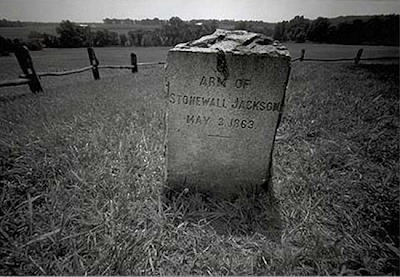
Sometimes a gravestone is not what it looks like. There are a handful that mark remains - but not a complete set! The photo at the top is the multi-purpose marker of William and Desire Tripp's infant children Wait (d. 1780) and William (d. 1784), but also of Desire's arm, which was amputated in 1786. The second photograph depicts the stone marking the burial of the arm of Stonewall Jackson (1824-1863) on the Wilderness Battlefield in Virginia. Other examples of limb burial include the leg of Captain Samuel Jones, lost in a construction accident and laid to rest in Washington, New Hampshire, in 1804, and the leg of Confederate general Richard S. Ewell, lost and buried at Groveton, Virginia, in 1862. According to one account, a belief existed that properly arranging and aligning a severed limb would ensure less pain in the stump. This account from Vermont doesn't mention the orientation, but does describe the careful placement of a leg lost to a logging accident. After his leg was hit by a cannonball in battle and amputated in 1842, Mexican president General Santa Anna (1794-1876) buried it with full military honors and entombed it in the Pantheon of Saint Paula - but it was stolen during riots 2 years later and never turned up. Centuries earlier, Scottish knight Sir William Wallace (1272-1305) was drawn and quartered for treason in London, after which his head and limbs were displayed separately as an example; Aberdeen got an arm, and a star on the wall of St. Machar's Cathedral marks the spot where it was interred. But perhaps the strangest story was reported by the New York Times in 1899: the burial of a city resident's amputated leg required a death certificate signed by the undertaker and the surgeon stating that "Peter Conroy's remains" had died a natural death - which left some question regarding the rest of Mr. Conroy, who was recuperating at Bellevue Hospital!

Wednesday, May 20, 2009

Mortsafes


These photographs were taken by my follower Carrie, who visited Greyfriar's Kirkyard in Edinburgh over the weekend. The wrought iron contraption over the grave is a mortsafe, installed at the time of burial so that the grave would not be robbed. Plunderers were not after valuables, but the corpse itself. If fresh enough, it could be sold to one of the local surgeons for demonstration in their dissection classes. Edinburgh was a center for anatomy education in the 19th c. Carrie observes, "The cemetery looks like a zoo in some parts due to the precautions made to bar up the entrances to tombs for fear of the bodysnatchers." The second photo depicts the memorial to Scottish surgeon and Indologist John Borthwick Gilchrist (1759 - 1841) - complete with surgical instruments. Lastly, the Edinburgh Vaults under the South Bridge, which Carrie tells us were a favorite of the bodysnatchers to store corpses and also host to many other underground, illegal activities. Greyfriar's Kirkyard, by the way, was mentioned in my earlier post on Greyfriar's Bobby.

Friday, January 16, 2009

Plague coffin

Steve and I were talking about common graves the other night (yes, such a topic is not atypical at my house!). He was curious when I told him that during the Great Plague, the dead were carried to the common grave in a coffin with a hinged end, so that the body (wrapped in a winding-sheet) could be slid into the pit and the coffin reused. I have come up with the photo above, courtesy of a great site I discovered recently, Curious Expeditions. And I also found two references, one in Buried Alive By Jan Bondeson and the other in The Impact of Plague in Tudor and Stuart England By Paul Slack.

Friday, September 19, 2008

Jimi Hendrix gravesite


I also paid my respects to Jimi Hendrix while in Washington State. My sister and I listened to the classics on the way to his gravesite in Renton, then made a pilgrimage to a life-sized statue in downtown Seattle.

Labels