Scientists at the University of Nottingham have found that a 1,000-year-old Anglo-Saxon treatment for eye infections works as an antibiotic against one of today’s most notorious bacteria, Methicillin-resistant Staphylococcus aureus (MRSA). After being introduced to cultures and infected mice, the recipe – which calls for 2 species of garlic and onions, wine, and bile from a cow's stomach brewed in a brass cauldron and let sit for 9 days – killed all but one in 1,000 bacteria. Says Viking scholar Christina Lee, "We were genuinely astonished at the results of our experiments in the lab."
Showing posts with label Medicine. Show all posts
Showing posts with label Medicine. Show all posts
Wednesday, April 8, 2015

 Posted with Blogsy
Friday, March 20, 2015
Malarial marrow
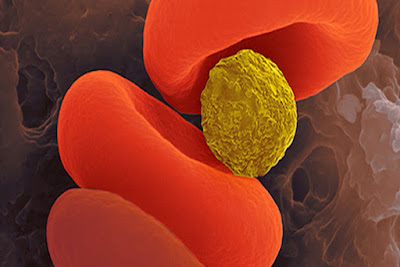
A Yale University team has developed a new method to identify malaria in the bone marrow of ancient human remains. It is the first time researchers have been able to establish a diagnostic, human skeletal profile for the disease, which still infect millions of people a year. Identifying hemozoin, the polymer produced by the parasite that causes malaria, may allow scientists to track the spread of malaria back to its first appearance in human populations. Jamie Inwood, team leader and graduate student in archaeology, explains, “The data set we build with this will be revolutionary for establishing the epidemiological curve for malaria in ancient societies. By understanding how this parasite reacted to societal shifts in the past, we can aid in predicting its future behavior. We can understand the way it has evolved.”


Thursday, January 29, 2015
Blackbeard's booty
"Treating the sick and injured of a sea-bound community on shipboard was challenging in the best of times," says archaeologist Linda Carnes-McNaughton, who is working with the Queen Anne's Revenge Project to recover artifacts from infamous pirate Blackbeard's flagship, run aground off the coast of North Carolina, U.S., in 1718. Among the items stocked onboard to keep the crew in fighting shape were a number of medical instruments: a mortar and pestle and a graduated series of weights used to prepare medicine, a urethral syringe used to treat syphilis, a silver needle and a pair of scissors possibly used during surgery, and a clyster pump (IMAGE ABOVE) used to quickly rehydrate the body by introducing liquids into the rectum.

Monday, January 12, 2015
Not-so-gross anatomy
General Electric has developed and field-tested a new, superfast scanner called Revolution CT at Florida's West Kendall Baptist Hospital that allows doctors to obtain high-resolution images of blood vessels, soft tissue, organs, and bones. The machine, which exposes patients to only a low dose of radiation, can image the hard within a single heartbeat. Hospital CEO Javier Hernández-Lichtl proclaims, "The advanced design definitely makes for a less intimidating, more comfortable patient experience, while yielding amazingly accurate and detailed images.” (FOLLOW LINK FOR STILL AND MOVING IMAGES)

Saturday, October 18, 2014
Back to back
When 27-year-old Dominic Smee saw images of the crooked skeleton of Richard III, discovered in 2012, he felt as if he were looking at x-rays of his own back. Smee had been diagnosed at the age of 11 with the same condition – idiopathic adolescent onset scoliosis– from which the king suffered. When he contacted the research team at Leicester University, he was recruited to participate in a documentary which has just aired on British TV. With Smee as a stand -in (IMAGES HERE), they confirmed that Richard III would have been able to accurately wield a sword and lance while riding a medieval warhorse and wearing a 66 lb. (30kg) suit of armor. Smee was given the customized suit of armor afterward, which has elevated his status when he participates in his hobby. Appropriately, he takes part in reenacting historic battles and gloats, "The guys who do the reenactments are very envious."
Sunday, October 5, 2014
Fertility first
From a very different kind of wandering womb, a baby has emerged. More than 35 years since the birth of the first "test tube baby," a child has been carried by his biological mother in a transplanted uterus. The baby was delivered by cesarean section in the 31st week of pregnancy when the mother developed preeclampsia. If the parents, a Swedish couple, decide to increase their family, the womb will be left in place. Otherwise, it will be removed so that the anti-rejection medicine – which carries an increased risk of cancer – can be halted. The proud father comments, "He’s no different from any other child, but he will have a good story to tell. One day he can look at the newspaper articles about how he was born and know that he was the first in the world to be born this way."

Tuesday, September 23, 2014
Maisy matures
In a milestone no one thought she would achieve, 4-year-old Maisy Vignes has started school. Doctors were baffled at her birth because she had only a bit of plasma in her circulatory system and no blood at all. The first of her transfusions during her 2-week stay in intensive care had to be given through her umbilical cord. Maisy's mother describes, "It was an unbelievable situation - none of the consultants had ever heard of something like it happening before. There were previous cases of children being born with tiny amounts of blood, but Maisy had a haemoglobin level of a flat zero. There were cases recorded of people surviving with a haemoglobin level of four, but for any human to survive after having no blood at all was unheard of." Fears of brain damage due to oxygen deprivation in the womb were laid to rest when she met all subsequent developmental goals. This bodes well for "ghost babies" Olivia Norton (born in 2012 in Witham, Essex, U.K.) and Hope Juarez (born in 2014 in Irvine, California, U.S.).

Tuesday, August 12, 2014
Rotating ribs
Back in the 1950s, stilyagi (hipsters) in the Soviet Union went to great lengths to bootleg jazz and rock 'n' roll music. It was before the advent of the tape recorder and vinyl was scarce, so they salvaged radiographs from hospital waste bins to press records. They would use manicure scissors to cut the x-ray into crude circles of 23-25 cm in diameter and use a cigarette to burn a hole in the middle of each. Russian musicologist Artemy Troitsky explains that a special machine – for instance a modified phonograph – was needed to cut grooves in the disks. The quality of the so-called bone music was awful, but the black-market price was low. Says author Anya von Bremzen, “You’d have Elvis on the lungs, Duke Ellington on Aunt Masha’s brain scan — forbidden Western music captured on the interiors of Soviet citizens.”

Tuesday, April 1, 2014
Whale well
A strange local custom grew up in 19th c. Australia which is documented in a special exhibit on whales at the Australian National Maritime Museum. Strangely enough, it is said to have started with a drunk man stumbling into the carcass of a whale in the southern whaling town of Eden. When he sobered up and emerged, he no longer suffered from rheumatism. Soon, others demanded the "cure" for their own aches and pains and the head of one of them is shown peeking out a hole in the middle of the whale in the photo above. The incident and the practice that arose were reported in an 1896 addition of the Pall Mall Gazette: "The whalers dig a sort of narrow grave in the body and in this the patient lies for two hours, as in a Turkish bath, the decomposing blubber of the whale closing round his body, and acting as a huge poultice." It was believed that the heat and gases created by putrefaction created a pain-relieving environment, and that the longer one stayed in the whale the longer the cure would last. But the unlikely folk remedy doesn't seem to have spread too far. Curator Michelle Linder offers, "I don't know there was scientific evidence per se but there was hearsay at the time that they felt better after being in the whale. It was done elsewhere but I don't think it was a really popular thing to do. It would have been an isolated thing to do.''

Saturday, March 22, 2014
Giraffe's gesture
When I was a child, I woke up from a dream complaining that a giraffe was licking my toes and tickling them. What you see here is a giraffe nuzzling a dying man. Mario, a 54-year-old mentally disabled maintenance man, had worked at the Diergaarde Blijdorp Zoo in Rotterdam for almost 25 years. Volunteers at the Ambulance Wish Foundation transport terminally ill patients in specially designed ambulances to allow them to carry out their last wishes. While many choose to go to the beach for the last time (VIDEO HERE), Mario wanted to say goodbye to his colleagues and the animals he had cared for at the zoo. At his request, he was wheeled into the giraffe enclosure and within minutes was being approached and kissed by the animals. AWF founder Kees Veldboer and staff noted Mario's difficulty speaking: "However, his face spoke volumes....You saw him beaming."

Saturday, March 15, 2014
Monster soup
After the turn of the 19th c. and the invention of the microscope, people realized that the water they were drinking was full of harmful organisms. In the cartoon above, a British woman is dropping her teacup in horror upon discovering the monstrous contents of a magnified drop of Thames water. These pathogens are still harming billions of people in developing countries, and causing a million deaths a year from malaria alone. Microscopic examination of blood samples goes undone because facilities either do not have the heavy and expensive (and fragile) microscopes or do not know how to use them. But this will soon change with a brilliant invention called the FoldScope. With the help of his students, bioengineer Manu Prakash of Stanford University has developed a low-cost microscope that magnifies up to 2000X; will fit in a pocket; weighs less than 10 grams; can withstand rough treatment; can be used for bright-field, dark-field, polarization, and fluorescence microscopy; and can even work as a projector. The device uses an LED battery with a life up to 50 hours. The body of the instrument is cut and folded from a sheet of heavy paper that includes a piece of conductive copper tape or glass and a sapphire ball lens. Only a short training lesson is needed to construct it in 10 to 20 minutes and to use it immediately. The cost of the FoldScope when mass-produced is $.97. Wow. (WATCH TED TALK HERE.)

Wednesday, January 8, 2014
Stonehenge man

One of the highlights of the new visitor center built on the site of Stonehenge in Wiltshire, England, is the face reproduced from a skeleton found nearby. The Neolithic skeleton, discovered in an elaborate tomb in the 1860s, actually predates the stone monument by 500 years. The facial reproduction (TIME-LAPSE VIDEO HERE) was prepared by Swedish sculptor Oscar Nilsson based on information deduced from the bones by human skeletal biologist Simon Mays from the University of Southampton, U.K. The man was between the ages of 25 and 40, muscular, and had a well-defined chin and jaw. Archaeologist Alistair Pike, also at the University of Southampton, was a bit disappointed that more could not be learned from Stonehenge man's teeth. Isotopes extracted from the teeth and their enamel indicated that he had moved to the area from Wales when he was about 3 years old and that he ate more meat than his contemporaries. There was a little wear, indicating a soft diet, but there were no revelations to be made by analysis of plaque, because his choppers were unusually clean. Pike laments, "If we had been able to analyse his tartar, we could have identified species he was eating by sequencing proteins in trapped fragments, while bacteria could have revealed the health of his gut."
Thursday, December 12, 2013
Digitized diseases
Diseases which we thought we had conquered are rearing their ugly heads. This includes polio, which is currently spreading in Syria. Martha Ann Lillard of Oklahoma offers herself up as a living reminder that an outbreak of polio anywhere in the world is a danger everywhere. Paralyzed at the age of 5 in 1953, she has survived ever since in an iron lung. If that's not scary enough, there is now an online resource that shows what happens when diseases are left unchecked. The 1,600 historical specimens of formerly incurable or untreatable diseases – including syphilis, rickets, and leprosy – have been digitized by the Royal College of Surgeons in London. The Digitized Diseases database is intended for archaeologists, interested laypersons, and medical clinicians who do not see such advanced cases in their practices. Andrew Wilson of the University of Bradford, who served as lead researcher on the project, notes, "If the vivid evidence of these bones flags up the importance of taking these conditions very seriously and tackling them early, so much the better."

Friday, November 1, 2013
Bloody

Scientists have finally hit upon a formula that they hope will end blood supply shortages and prevent infections through donations. The critical ingredient added to the mixture of water, salt, and albumin is a protein extracted from marine worms which enables the artificial blood to resist the chemical and mechanical stresses placed upon it. Other proteins have proven toxic, but this one has so far not provoked a rejection reaction. If further testing on mice is successful, the recipe for the universal artificial blood will be patented and the transfusions will be performed on people. “Tests on humans are a very delicate topic, we need some very serious licenses and they represent an enormous risk,” says lead researcher Radu Silaghi-Dumitrescu of Babes-Bolyai University. No one has yet pointed out the irony of the research team being based in Romania, the home of bloodthirsty 14th-century ruler Vlad the Impaler (IMAGE ABOVE) and origin of many vampire legends…
Saturday, September 7, 2013
Brrrth

Under other circumstances, the 19-month-old baby in the image above would have been born in 1985, the 3rd child of a couple in Oregon who already had twins. Instead, he was born in 2012 to a woman in Hampton, Virginia. After 2 unsuccessful attempts at in vitro fertilization, Kelly Burke decided to adopt – not a living child, but a frozen embryo...an embryo that has been stored in dry ice for the better part of 2 decades. The adoption is an open one, so little Liam will meet his college-age siblings and any future brothers or sisters resulting from the implantation of the Oregon couple's 2 remaining frozen embryos. Burke, who happens to be a researcher at NASA, is a proud parent, happy that science has allowed her to give birth to the second oldest cryopreserved human embryo in history. "Technology is my world," she says.
Monday, May 20, 2013
Alligator snags
Five years ago, chemists at Louisiana State University found that blood from the American alligator can successfully destroy 23 strains of bacteria – including strains known to be resistant to antibiotics – and significant amounts of HIV. Now an international team of scientists is studying alligator jaws in hopes of applying the secrets of their tooth regeneration to people. Like us, alligators have a layer of epithelial cells called dental lamina, but unlike ours the stem cells within it grow new teeth repeatedly. They hope to identify the cellular and molecular mechanisms that will allow them to stimulate the growth of a replacement tooth when an adult tooth is lost. “Alligator teeth are implanted in sockets of the dental bone, like human teeth. They have 80 teeth, each of which can be replaced up to 50 times over their lifetime, making them the ideal model for comparison to human teeth,” explains team lead Ping Wu of the University of Southern California.

Saturday, May 18, 2013
Female sperm
It has been possible in rare circumstances for a woman to give birth without being impregnated by a man. Parthenogenesis or asexual reproduction is more common among plants, insects, and animals like lizards. For human females to have a "virgin birth" requires them to be chimeras, developed from 2 different zygotes that merged in the womb. If the zygotes are different genders, resulting in an ovary on one side of her body and a testis on the other, a woman can fertilize herself. But now there is a new possibility on the horizon. Stem cell biologist Karim Nayernia of Newcastle University in the U.K. has created primitive sperm cells from female human embryonic stem cells. Irina Kerkis of the Butantan Institute in Saõ Paulo, Brazil, has reportedly made eggs from male mouse embryonic stem cells. This raises possibilities that gay and lesbian couples could have their own biological children. The bone marrow of one woman could be used to fertilize an egg from her partner and a man's skin cells could be used to make eggs, which could be fertilized by his partner’s sperm and implanted into the uterus of a surrogate mother. Although geneticists are skeptical that the reproductive cells will be able to divide properly, and the genetic makeup would mean that the offspring would be the same gender as the parents, the experiments hold the promise of future same-sex human reproduction.

Friday, May 10, 2013
No breath, no pulse – but alive
Researchers at Boston Children’s Hospital have designed a liquid solution that can be injected directly into the bloodstream to quickly oxygenate the blood. Suspended in the solution are tiny, gas-filled microparticles, each surrounded by a membrane of fat and containing 3 to 4 times as much oxygen as a red blood cell. Cardiologist John Kheir explains, “This is a short-term oxygen substitute—a way to safely inject oxygen gas to support patients during a critical few minutes. Eventually, this could be stored in syringes on every code cart in a hospital, ambulance or transport helicopter to help stabilize patients who are having difficulty breathing.” The injection is able to keep a patient alive for up to 30 minutes after respiratory failure.
I remember the headlines generated in the summer of 2012 when the former Vice President of the U.S. had an assistive device implanted to help his failing heart. The New York Times explains, "His new mechanical pump, a partial artificial heart known as a ventricular assist device, leaves patients without a pulse because it pushes blood continuously instead of mimicking the heart’s own beat. Most pulse-less patients feel nothing unusual, but the devices do pose significant risks of infection. They are implanted as a last resort either for permanent use or as a bridge to transplant until a donor heart can be found." A year later, 5 patients are living with a new complete continuous-flow artificial heart designed by cardiologists Bud Frazier and Billy Cohn. Turbines replace the heart, which is removed, and keep blood circulating without mimicking the organ's pumping rhythm. Says Cohn, “I think we’re on the verge, right now, of solving the artificial-heart problem for good. All we had to do was get rid of the pulse.”
I remember the headlines generated in the summer of 2012 when the former Vice President of the U.S. had an assistive device implanted to help his failing heart. The New York Times explains, "His new mechanical pump, a partial artificial heart known as a ventricular assist device, leaves patients without a pulse because it pushes blood continuously instead of mimicking the heart’s own beat. Most pulse-less patients feel nothing unusual, but the devices do pose significant risks of infection. They are implanted as a last resort either for permanent use or as a bridge to transplant until a donor heart can be found." A year later, 5 patients are living with a new complete continuous-flow artificial heart designed by cardiologists Bud Frazier and Billy Cohn. Turbines replace the heart, which is removed, and keep blood circulating without mimicking the organ's pumping rhythm. Says Cohn, “I think we’re on the verge, right now, of solving the artificial-heart problem for good. All we had to do was get rid of the pulse.”
Friday, May 3, 2013
Boneless
About a month ago I had a bone density test. I had been diagnosed with osteoporosis many years ago, a result of treatment with Solu-Medrol for countless MS exacerbations. The IV steroid robs the bones of calcium, so I took Fosamax weekly until the newer annual and semi-annual medications became available. My previous doctor told me my bones were like chalk. When the results of the recent bone scan were sent to my current doctor, they had the word "yikes" scrawled across them... Shortly thereafter, I read an interesting article (HERE, WITH VIDEO) about a 2-year-old girl in Tennessee enrolled in a clinical trial conducted by Dr. Michael P. Whyte, a metabolic bone disease specialist at Washington University School of Medicine in St. Louis. The experimental drug being tested is saving her life. Little Jannelly has the most severe form of hypophosphatasia, a genetic disorder that prevents the skeleton from mineralizing. Babies diagnosed with the disease are usually stillborn or die in infancy because they have no ribs to support their breathing. I was struck by one sentence in the article: "Her bones didn't even show up on X-rays." Wow, what would that look like?, I wondered. As you can see in the image above – which shows minimal ossification of the skull and facial bones in a newborn infant with the severe lethal form of hypophosphatasia – the radiographs can be as haunting as the disease is devastating. I'm happy to report that I have a Prolia shot scheduled for next week.

Friday, April 19, 2013
Yesterday's ingredients
In 1865, Dr. Alonson B. Howard transformed a tiny clapboard schoolhouse on his property in Tekonsha, Michigan, to use for his medical practice. He partitioned it into 3 rooms: a waiting room, a laboratory, and an office with a dispensary (PICTURED). In addition to seeing patients there, he made house calls and made rounds miles in every direction by train, getting paid sometimes in cash and sometimes in kind. The cost of any medicine was included in his fee, and he was well-versed in herbal remedies, inspired in his youth by the local Indians. When Dr. Howard died in 1883, his wife padlocked the building and it remained untouched until 1956, when their great-grandson donated it to the Henry Ford Museum. It was relocated to their Greenfield Village, and its shelves likely contain some of the Museum's hundreds of patent medicines. The contents of 50 of these – including Dr. Tutt’s Liver Pills, Dr. F.G. Johnson's French Female Pills, and Dr. Comfort's Candy-covered Cathartic Compills – were analyzed by Mark Benvenuto of the University of Detroit Mercy and his students. The boxes listed the components and old newspapers included the costs and the ailments they were supposed to cure, but it took the nondestructive technique of energy dispersive X-ray fluorescence spectroscopy to detect the signatures of specific elements. As the team reported at the recent meeting of the American Chemical Society, these included beneficial ingredients like calcium, iron, and zinc, but also potentially toxic heavy metals like arsenic, mercury, and lead, in addition to cocaine, heroin, and high concentrations of alcohol. The remedies were promoted as much as a century before the creation of the Food and Drug Administration, and "patent" only meant that the seller had given a name to it. Benvenuto explains, "I don't know if people were in it just to sell stuff or actually thought they had something that would solve a problem. But if you stop and think about this, what we were analyzing here is kind of a first step into where we've come to today. If you go back to the year 1800, the way people got rid of ailments was a lot of home remedies. You and I might say they didn't really do a controlled study on this sort of thing, but no one had really conceived of controlled studies back then. That doesn't mean they cured nothing.

Subscribe to:
Posts (Atom)


