Behold the earliest known example of twins in the archaeological record, dating back almost 8,000 years to the Neolithic Era. Sad to say, it is also the oldest example of death by dystocia, or obstructed labor. The skeleton of the 20- to 25-year-old mother– with the bones of 2 infants, one in a breech position, in her pelvic region – was discovered in a prehistoric cemetery called Lokomotiv, near present-day Irkutsk in Russia, and her burial was indistinct from others at the site. As Canadian archaeologist Angela Lieverse of the University of Saskatchewan points out, "It suggests either they didn't know she had twins or that dying during childbirth wasn't so out of the realm of possibility that it would be considered unique."
Showing posts with label skeletons. Show all posts
Showing posts with label skeletons. Show all posts
Wednesday, February 25, 2015

 Posted with Blogsy
Tuesday, August 19, 2014
His Majesty's meals
Discovery of the remains of Britain’s last Plantagenet king, Richard III, in 2012 has allowed the commission of a facial reconstruction (ABOVE) from his skull. It has also provided the British Geological Society with evidence to reconstruct the medieval monarch's diet over time. The chemicals in the teeth allow insight into his early childhood and confirmed his move from Fotheringay Castle in eastern England by the age of 7. The rate at which the femur renews itself represents an average of the 15 years before death and shows that Richard moved back to eastern England as an adolescent or young adult, and had a diet that matched the highest aristocracy. From the ribs, which renew themselves in 2 to 5 years, they determined that once he ascended the throne in 1483 the king began to drink more wine and enjoyed lavish foods including swan, crane, and heron. Lead archaeologist Richard Buckley of the University of Leicester Archaeological Services remarks, “This cutting edge research has provided a unique opportunity to shed new light on the diet and environment of a major historical figure – Richard III. It is very rare indeed in archaeology to be able to identify a named individual with precise dates and a documented life."


Tuesday, August 12, 2014
Rotating ribs
Back in the 1950s, stilyagi (hipsters) in the Soviet Union went to great lengths to bootleg jazz and rock 'n' roll music. It was before the advent of the tape recorder and vinyl was scarce, so they salvaged radiographs from hospital waste bins to press records. They would use manicure scissors to cut the x-ray into crude circles of 23-25 cm in diameter and use a cigarette to burn a hole in the middle of each. Russian musicologist Artemy Troitsky explains that a special machine – for instance a modified phonograph – was needed to cut grooves in the disks. The quality of the so-called bone music was awful, but the black-market price was low. Says author Anya von Bremzen, “You’d have Elvis on the lungs, Duke Ellington on Aunt Masha’s brain scan — forbidden Western music captured on the interiors of Soviet citizens.”

Sunday, August 10, 2014
Ben's bones
The title of this post does not refer to the bones of American statesman Benjamin Franklin (he died and was buried in Philadelphia), but to the bones discovered buried in the basement of the London house he lived in from 1757 to 1775. As ambassador for the American colonies, he occupied an elegant 4-story Georgian house at No. 36 Craven Street. Friends of Benjamin Franklin House raised money to convert the building into a museum in 1998, by which time it had become dilapidated. A construction worker was the first to discover skeletal remains in a pit in a windowless basement room. Excavation revealed some 1,200 pieces of bone, representing the remains of 10 bodies, 6 of them children – and they would have been deposited while Franklin was in residence. Because the bones bore the marks of a saw, a scalpel, and a drill, it was deduced that these were not murder victims but subjects of anatomical study by Ben's friend William Hewson. "Researchers think that 36 Craven was an irresistible spot for Hewson to establish his own anatomy lab. The tenant was a trusted friend, the landlady was his mother-in-law, and he was flanked by convenient sources for corpses. Bodies could be smuggled from graveyards and delivered to the wharf at one end of the street, or snatched from the gallows at the other end."

Tuesday, August 5, 2014
Bawdy bones

Local author Kicki Karlén was exploring the Kläckeberga church in southern Sweden when she was outraged at the site of several Ikea bags full of human remains and merely covered with a tarp. She learned from the parish that the bones were found beneath the floorboards in 2008 when they were renovating the church to provide wheelchair access. Archaeologist Ludvig Papmehl-Dufay, who was on the excavation team, says that they represent about 80 individuals, consist mainly of skulls and long bones, and may be as old as 500 years. He has no idea why reburial on church grounds was never carried out, but says that the storage method – while it may be disrespectful – is not harmful to the remains. Karlén is bringing attention to the issue and, as an erotic novelist, just may feature them in her next book. She confesses, "You know, I just might put them in. I have to say I'm tempted."
Tuesday, July 8, 2014
Dig Down

The earliest and youngest example of an individual with Down syndrome in the archaeological record has been studied and described by French scientists. The skeleton, found at Saint-Jean-des-Vignes, Saône-et-Loire, is that of a 5–7 year old and dates from the 5–6th c. A.D. While the intellectual disabilities of this genetic disorder cannot of course be seen in the bones, the osteological abnormalities are consistent with the diagnosis and include brachycrany, metopism, hypodontia, periodontitis, a flattened occiput, vault thinness, and an open cranial base angle. In layperson's terms, the child (who was too young for the scientists to determine gender from the skeleton) has a short and broad skull, a flattened skull base, and thin cranial bones. The burial, consistent with others in the church cemetery, hints – but does not prove – that Down syndrome was not stigmatized in medieval France.
Wednesday, April 9, 2014
Duckworth
When I researched my book Skulls and Skeletons, I managed to miss a collection of more than 18,000 human remains. The Duckworth Laboratory at the University of Cambridge houses the skulls of Iron Age warriors and 17th c. plague victims, mummy heads and overmodeled skulls, and death masks, ámong other things (VIDEO HERE).

Sunday, March 30, 2014
Ancient acromegaly
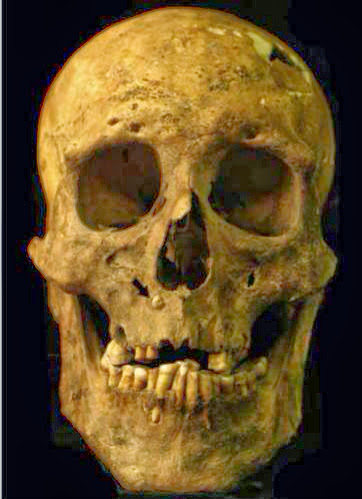
About 3,800 years ago, members of a hunter-gatherer culture known as the Windmiller buried one of their own near what is now Elk Grove, California, U.S. They daubed the 30-something-year-old man's body with red ochre, festooned him with beads, and added other shelf ornaments. But unlike others who were buried face-down with their heads oriented to the west, this man was interred face-up and headed north. His skull did have some unusual features: a protruding brow, a lantern jaw, a protruding chin, and very crowded teeth. Its width and height suggested hypergrowth in adulthood. Physical anthropologist Eric Bartelink of California State University, Chico, has now confirmed his condition to be acromegaly. Unlike gigantism, in which the pituitary gland releases excessive amounts of growth hormone during childhood, acromegaly – a rare endocrine system disorder – doesn't begin until early adulthood. By then the body’s long bones have finished growing, so the exaggerated growth only affects areas like the face, hands, and feet where bone development is still possible. The skeleton is the earliest and one of the most complete to be diagnosed with acromegaly, but Bartelink is unsure from the grave whether the individual had been singled out. “I would expect that the person would have been treated differently, but it’s hard to say, The physical expression of the disease takes about 10 years to become fully noticeable, so it would have taken a bit for other members of the society to take notice.”
Friday, March 28, 2014
Beads adorning bones
In 2004, Siberian archaeologists uncovered the remains of a 25-year-old woman in a remote burial mound in the Altai Mountains. She had died between 2,300 and 2,400 years ago and was a kinswoman of the famous Princess Ukok, as well as a possible priestess. Her high status is based on the necklace she was wearing, which is made of 17 brightly-colored laminated glass beads (IMAGE ABOVE, MORE PHOTOS HERE). Until then, only single beads of the sort were found in the area and the jewelry may have come from as far as ancient Egypt. It was made by the later-named Millefiori technique in which glass rods are produced that show a multicolored pattern on cross-section when cut into beads. Andrey Borodovsky of the Institute of Archeology and Ethnography of the Russian Academy of Sciences comments, "The necklace has a striking variety of colours, beautiful shades of deep and light yellow and blue. I have worked with Altai antiquities for more than 30 years, and this necklace is probably the most beautiful find I've ever seen."

Wednesday, March 19, 2014
Riddled remains

Michaela Binder, a doctoral student at Durham University in the U.K., has made a momentous discovery at the Amara West site in northern Sudan. The young adult male skeleton that she excavated (IMAGE ABOVE) dates to around 1200 B.C.E. and is riddled with disease (IMAGE HERE) in the vertebrae, ribs, sternum, clavicles, scapulae, pelvis, and humeral and femoral heads. Radiographic, microscopic, and scanning electron microscopic (SEM) imaging shows multiple, mainly osteolytic, lesions pointing to a diagnosis of metastatic carcinoma secondary to an unknown soft tissue cancer. The skeleton is therefore the earliest complete example in the world of a human who suffered metastatic cancer to date – predating the previous confirmed instance by 2,000 years. And why is this so important? Cancer in ancient populations proves that it is not, in fact, a modern-day disease spurred on by today's unhealthy lifestyles, including smoking, poor eating habits, and stress.
Thursday, March 13, 2014
Fra femurs
This was the sight that appeared to Mandy Ewington as she was hiking in Monknash, South Wales, U.K. She sent a photograph to coastal archaeologist Karl-James Langford of Archaeology Cymru, who recognized what was happening because of previous archaeological digs, the depth of the bones in the cliff, and the history of the area. In the Middle Ages, the place had been a burial ground for a community of Cistercian monks. Langford's initial assessment suggested that the bones were those of a man in his late 20s. As a monk, he would have been buried in nothing but a winding sheet, fastened at the head and feet with shroud rings. The ring at his missing lower legs and feet is no doubt lost to the sea. Because of heavy rains which have caused large stretches of the coastline to collapse, British archaeologists are losing sites faster than they can excavate and document them. As Langford says, "It's like watching archaeology going like the pages of a book and the history is being revealed with every turn of the page."

Friday, February 21, 2014
Vodka visage
These days, facial reconstruction can be done digitally. But forensic artist Nigel Cockerton used the tried-and-true method of applying clay to a skull to achieve the representation above (SEE SERIES OF PHOTOS HERE). In this case, the skull was not that of a long-dead historical figure whose remains had been unearthed, but the sculpted bottle of Crystal Head Vodka. The result of this exercise? A drunken fool, of course.

Sunday, February 9, 2014
Skeptical about skulls
Make of this what you will. The Paracas skulls are a group of more than 300 elongated skulls discovered by Peruvian archaeologist Julio Tello in 1928 in the Pisco Province on the southern coast of the country. Their strange shape gave rise to the idea that the members of this culture, which died out some 3,000 years ago, had interbred with space aliens. Subsequent theories assumed that the shaping of the skull was the deliberate result of cranial deformation, through head flattening, or head binding. However, this doesn't account for the fact that the cranial volume is up to 25% larger and their weight up to 60% heavier than conventional human skulls and that they contain only one parietal plate, rather than two. Independent researcher Brien Foerster (PICTURED ABOVE WITH ONE OF THE SKULLS), who has studied, written about, and offered tours to see the skulls for years, has taken the next step in their analysis. Museum director Juan Navarro of the Paracas History Museum, which houses a collection of 35 of the Paracas skulls, allowed Foerster to take samples of skin, hair with roots, a tooth, and bone for DNA testing by an as-yet-unnamed geneticist. After the initial sequencing of mitochondrial DNA, the scientist revealed that it had mutations unknown in any human, primate, or animal yet on record. If the Paracas people were so biologically different, they would not have been able to breed with other ancient humans such as Neanderthals or Denisovans. In his report to Foerster, the anonymous geneticist wrote, “I am not sure it will even fit into the known evolutionary tree."

Wednesday, January 29, 2014
Bones and scones

Not long after bones exhumed from a parking lot in Leicester, England, were confirmed to be those of King Richard II, the lost remains of England's first monarch, Alfred the Great (PICTURED ABOVE IN A BYZANTINE ICON), may have been found. The Anglo-Saxon king (849-899 A.D.) had initially been buried in Winchester Cathedral, but was later moved with his son Edward and his wife Alswitha to Hyde Abbey nearby. The location of his remains was lost to history when a prison was built over the Abbey in the 18th c. In an attempt to find them, archaeologists exhumed an unmarked grave at Saint Bartholomew's Church in Winchester, but the results were disappointing. They then "excavated" storage boxes from the archives of the Winchester City Museum that contained items excavated from Hyde Abbey in the 1990s. There the scientists from the University of Winchester may have found what they were looking for: a fragment of a pelvis bone (PHOTOS HERE). The radiocarbon date is right (895-1017 A.D.), the gender is right (male), and the age at death matches (between 26 and 45+ years). Another suggestive detail is that the bone was found near the monastery's High Altar, where only Alfred and Edward had been buried. The discovery of the 1,000-year-old pelvis is interesting enough, but a phrase in the headlines piqued my interest. Alfred is "best known in British history for his inability to make cakes." Click on the link for the story, unfamiliar to me but well-known to English schoolchildren and Anglophiles like my friend Sue.*
*Happy Birthday and thanks to you and David for the tip!
Wednesday, January 8, 2014
Stonehenge man

One of the highlights of the new visitor center built on the site of Stonehenge in Wiltshire, England, is the face reproduced from a skeleton found nearby. The Neolithic skeleton, discovered in an elaborate tomb in the 1860s, actually predates the stone monument by 500 years. The facial reproduction (TIME-LAPSE VIDEO HERE) was prepared by Swedish sculptor Oscar Nilsson based on information deduced from the bones by human skeletal biologist Simon Mays from the University of Southampton, U.K. The man was between the ages of 25 and 40, muscular, and had a well-defined chin and jaw. Archaeologist Alistair Pike, also at the University of Southampton, was a bit disappointed that more could not be learned from Stonehenge man's teeth. Isotopes extracted from the teeth and their enamel indicated that he had moved to the area from Wales when he was about 3 years old and that he ate more meat than his contemporaries. There was a little wear, indicating a soft diet, but there were no revelations to be made by analysis of plaque, because his choppers were unusually clean. Pike laments, "If we had been able to analyse his tartar, we could have identified species he was eating by sequencing proteins in trapped fragments, while bacteria could have revealed the health of his gut."
Thursday, December 12, 2013
Digitized diseases
Diseases which we thought we had conquered are rearing their ugly heads. This includes polio, which is currently spreading in Syria. Martha Ann Lillard of Oklahoma offers herself up as a living reminder that an outbreak of polio anywhere in the world is a danger everywhere. Paralyzed at the age of 5 in 1953, she has survived ever since in an iron lung. If that's not scary enough, there is now an online resource that shows what happens when diseases are left unchecked. The 1,600 historical specimens of formerly incurable or untreatable diseases – including syphilis, rickets, and leprosy – have been digitized by the Royal College of Surgeons in London. The Digitized Diseases database is intended for archaeologists, interested laypersons, and medical clinicians who do not see such advanced cases in their practices. Andrew Wilson of the University of Bradford, who served as lead researcher on the project, notes, "If the vivid evidence of these bones flags up the importance of taking these conditions very seriously and tackling them early, so much the better."

Sunday, November 24, 2013
Sponsor a skull

My favorite Mütter Museum, part of the College of Physicians of Philadelphia, in Pennsylvania, U.S., has launched a fundraising campaign. The collection of 139 skulls they purchased from Viennese anatomist Joseph Hyrtl in 1874 for 6,410 Austrian thalers (about $4,800 at the time) is in need of conservation. By adopting a skull for an annual subscription of $200, your name will appear on a small plaque next to it. The skull of your choice will be cleaned, conserved, and remounted – important because the original cast-iron mounts are transmitting vibrations caused by visitors walking past the cases and damaging the contents. Each of the skulls has a story: a Moravian shoemaker's apprentice who killed himself out of remorse at the age of 17, a Tyrolean maidservant who died of meningitis, a Hungarian soldier who died of pneumonia, a Viennese prostitute, a notorious Thai criminal, and a tightrope walker who broke his neck. The skulls were originally obtained from poorhouses and prisons, and in one case from a graverobber. While some of the standouts have already been chosen, there are roughly 100 skulls still awaiting adoption...
Tuesday, November 19, 2013
Dark Age deformation

The other morning, my friend Sue showed me a photograph of a skull with cranial deformation in a book she was reading. She asked me which culture I thought it was from, and I answered, "Native American or possibly African." The book was Barbarians by Terry Jones and she pointed out that Huns were known for the practice, a fact new to us both. Well, an example has surfaced in a large necropolis discovered in the Alsace region of France. The 7.5-acre burial site contains 38 tombs that span more than 4,000 years, from the Stone Age to the Dark Ages. One area housed 18 tombs from either the late Roman period or the early Dark Ages (about 1,650 years ago), and one of the occupants was an aristocratic woman with a deformed, flattened forehead (IMAGE ABOVE, MORE IMAGES HERE). "The deformation of the skull with the help of bandages (narrow strips of cloth) and small boards is a practice coming from central Asia. It was popularized by the Huns and adopted by many German people. In France, Germany and eastern Europe, these deformed skulls appear in tombs rich in objects," explains archaeologist Philippe Lefranc of l’Institut national de recherches archéologiques préventives (Inrap). Evidence of the woman's wealth includes gold pins, belts known as chatelaines, pearls, a comb made of a stag antler, and a bronze mirror that likely came from the Caucasus region or central Asia. It is unlikely that this highborn woman would have put up with being called a "conehead."
Tuesday, November 5, 2013
Royal rondels
My friend Sue picked up on something I left out of my post about identifying the skull first believed to be that of King Henry IV of France. When I explained that I had done so deliberately, we decided the fact – new to us both – needed a post of its own. Lending his support to the theory that the mummified head is not that of the king, French historian Philippe Delorme pointed out that it showed no signs of craniotomy, which would have been typical for the time. The surgery would have been performed on a royal suffering from infection, head trauma, or other ills. Trepanation on the living would show signs of healing like this 5,000-year-old Chinese craniotomy (IMAGE ABOVE). But removal of a disk of bone that had sharp edges would indicate that a "rondel" had been harvested from the dead king. These coin-sized plugs were apparently worn around the neck as amulets. The only information I could find about this was from an Italian medical journal. G. Sperati writes in 2007, "According to the most popular theory, the very first cases of craniotomy were probably performed, by prehistoric man, for reasons related to magic or religious rituals, or...as part of a ritual related to exorcism, to offer a way of escape to the demons and malignant spirits whom they believed had infested the person. As proof of the great religious importance attached to those who had been subjected to drilling, it is worthwhile recalling that, from some of these skulls, diskettes of bony tissue were removed post mortem, which were then worn as amulets around the neck (the so-called “rondelles”, described for the first time, by Prunières, in 1783)."

Thursday, October 3, 2013
Crossrail crossbones
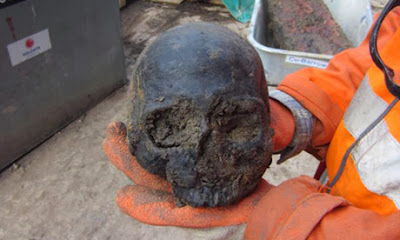
Actually it's just the skulls and not the crossbones which have come tumbling out of a Crossrail tunnel being excavated near Liverpool Street in London. Blackened Roman skulls - 20 of them – discovered in clumps. If they do find the long bones, it will be somewhat of a disappointment because a Roman cemetery was known to exist upriver on the long-vanished Walbrook. Without that evidence, the skulls lend support to the idea that they belonged to the beheaded victims of Boudicca, warrior queen of the Celtic Iceni tribe, slung without ceremony into the river during her 61 A.D. rebellion. That would be what lead archaeologist Jay Carver calls "an unexpected and fascinating discovery that reveals another piece in the jigsaw of London's history."
Subscribe to:
Posts (Atom)


