Showing posts with label garden. Show all posts

Tuesday, June 19, 2012

Carnivorous plants go vegan!


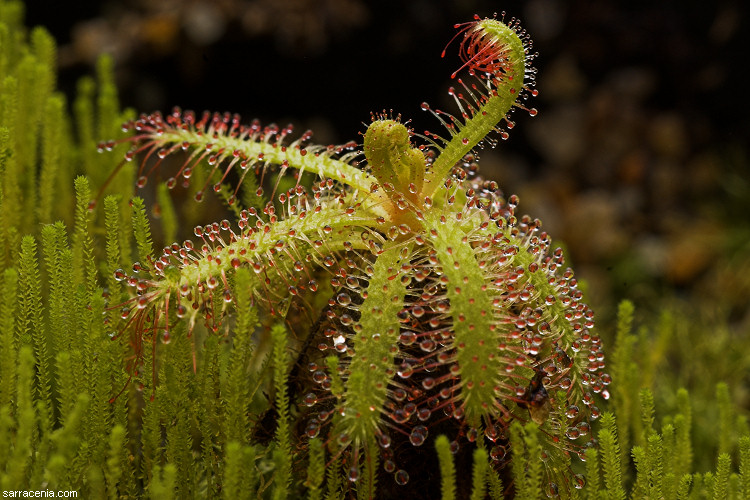
The carnivorous common sundew (Drosera rotundifolia) traps insects by attracting them with its bright red color, getting them stuck to the glistening drops of mucilage on its leaves, and then curling around them (see it in action here and magnified here) and dissolving them with enzymes. Because it lives in habitats that are poor in nutrients, it has to eat bugs to supplement its diet. But Dr. Jonathan Millett of Loughborough University in Leicestershire, UK, has determined that pollution has caused the sundew to lose its appetite for meat. "If you've got enough food in the fridge, you don't go to the shops to buy some more," the plant ecologist analogizes. He studied the sundews growing in the bogs of Sweden and has found that, due to the burning of fossil fuels, the rain that falls now contains enough nitrogen to sustain the plants without catching flies and midges. Millett and coauthors have published their study in New Phytologist, showing that plants in lightly-polluted areas got 57% of their nitrogen from their insect prey, while those in more heavily-polluted areas got only 22% from insects. How do they shift their diet? When they absorb the nitrogen through their roots, they make their leaves less sticky, trapping fewer prey, and they tone down their bright color, so fewer bugs are drawn to them. How did the scientists identify the sources of the nitrogen in the plants' diet? They did an isotopic analysis of the sundews, the insects, and the moss growing in the area, which allowed them to work out the proportions, since nitrogen of biological origin (bugs) has a different atomic weight than nitrogen deposited in the rain. Although the ability to make this change in their diet allows the sundews to take advantage of the artificial rain of fertilizer that has disturbed their specialized ecosystem, it does not spare them possible extinction. Carnivorous plants have to spend lots of energy on their specialized equipment, so even if they are using the adaptations less, "...they still have to bear the residual costs of being carnivorous, and other plants without these will be better able to survive. So it’s quite likely we’ll see less abundance and perhaps local extinctions from carnivorous species. The individual plants get bigger and fitter, but the species as a whole is less well adapted to high-nitrogen environments and will lose out over time,” explains Millett. Because sundew is so widespread it is unlikely to be killed off by nitrogen pollution, but the same cannot be said of other carnivorous plants existing in smaller populations.
__________
Previous posts about plants:

Monday, June 11, 2012

Stinky

A Titan Arum (Amorphophallus titanum) blooms in January 2011 in Cairns, Australia, for the 1st time in 5 years. Below are some of the other so-called "corpse flowers" that have bloomed since then.
 
July 2011

September 2011

September 2011

March 2012

April 2012
April 2012

May 2012

May 2012

May 2012

June 2012

June 2012

June 2012

Tuesday, February 21, 2012

Pleistocene plant


Like me, you may have seen this on the news last night (video here, scroll down), but the brief report left me wanting more details. And here they are:

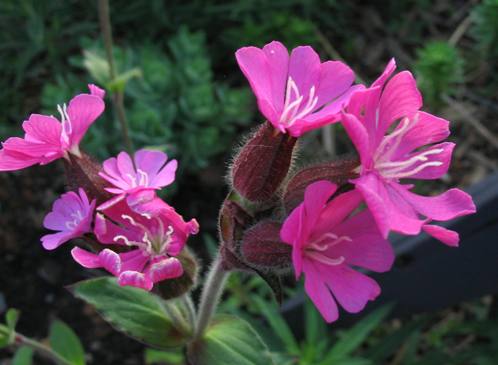
The plant above has been grown from a seed buried by a Siberian ground squirrel 31,800 years ago, give or take 300 years. It is a previously unidentified species of Silene (other species include Silene antirrhina, Silene variegata, and Silene Vulgaris), commonly known as campion. The seed was recovered from a burrow found in permafrost at a depth of 65'-130'. A Russian research team, led by Svetlana Yashina and David Gilichinsky, investigated 70 fossil burrows on the banks of the Kolyma River. Because the sediments were firmly cemented together and often completely filled with ice that never melted, the burrows were fully isolated from the surface. “The squirrels dug the frozen ground to build their burrows...putting in hay first and then animal fur for a perfect storage chamber. It’s a natural cryobank,” says Stanislav Gubin, a co-author of the study published in Proceedings of the National Academy of Sciences. The plant, Silene stenophylla, was revived from the frozen cells using a technique called “clonal micropropagation,” which involved extracting "placental tissue" from immature seeds, germinating it in a special nutrient solution in petri dishes, and planting the resulting mature seeds. After a year of nurtured growth in a conventional pot under controlled light and temperature, they blossomed, bore fruit, and dropped seeds. The regeneration of the flower, which grew in the Pleistocene Era according to radiocarbon dating, proves that seeds remain viable in long-term cold storage. The previous record for reviving old plant tissue* used historic seeds, but this seed was prehistoric. Not only did woolly mammoths walk by this flower, they may have stopped for a snack.

*2,000-year-old date palm seeds from Israel.

Friday, January 13, 2012

New carnivorous plant


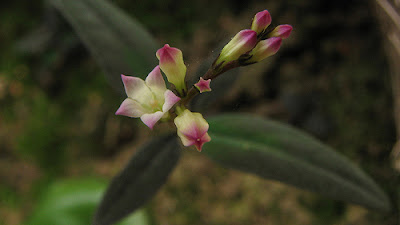
Remember the genuflecting plant I blogged about in September? Well, this newly discovered one has an even neater trick. It may not look like much above the savannahs of its Brazilian habitat (1st image), but beneath the sand the Philcoxia minensis extends sticky leaves (2nd image) that ingest nematodes (3rd image, microscopic view, more here). Yes, ladies and gentlemen, this plant eats worms! Though this article suggests that it gobbles up earthworms, nematodes are typically less than 2.5mm long and the underground leaves are only about the size of a pinhead. But this is enough to qualify Philcoxia minensis as a carnivorous plant in the ranks of the Venus flytrap, the pitcher plant, and the bladderwort. Like the Venus flytrap, P. minensis lives in nutrient-poor soil and has leaves equipped with stalk-covered glands that help detect prey, so researchers suspected that it was using its subterranean leaves to capture animals. "We usually think about leaves only as photosynthetic organs, so at first sight, it looks awkward that a plant would place its leaves underground where there is less sunlight. Why would evolution favor the persistence of this apparently unfavorable trait?" asks plant ecologist Rafael Silva Oliveira. He and his colleagues at the State University of Campinas in Sao Paolo, Brazil, used chemical analysis to determine that the plant was absorbing nutrients directly from the worms rather than from the surrounding soil. Their study proves that P. Minensis is among the mere .2% of flowering plant species known to digest meat.

Friday, December 23, 2011

Frankincense & myrrh

"And when they were come into the house, they saw the young child with Mary his mother, and fell down, and worshipped him: and when they had opened their treasures, they presented unto him gifts; gold, and frankincense and myrrh." (Matthew 2:11)

Frankincense
Frankincense is tapped from the Boswellia tree by slashing the bark (1st image) and allowing the exuded resins to bleed out and harden into what are known as "tears" (2nd image). The resin differs between species of the tree, which is so hardy it can grow out of solid rock, and even within species due to differences in soil and climate. The trees are native to the Arabian Peninsula and North Africa. The frankincense they produce is eaten raw in traditional Asian medicines, burned as incense, and distilled into essential oils for use in perfumes and aromatherapy.

Myrrh
Myrrh is tapped from the Commiphora tree (3rd image) by wounding the sapwood and allowing the resin to bleed out and become hard and glossy (4th image). The small, thorny trees grow in dry, stony soil and are native to Yemen, Somalia, and eastern Ethiopia. Myrrh is used as an ingredient in traditional Chinese and Ayurvedic (Indian) medicine, a salve or antiseptic in Western medicine, and an incense in Christian and other religious rituals.

The Network for Natural Gums and Resins in Africa estimates global demand for frankincense and myrrh at about 2,500 tons per year. Solid frankincense resin currently sells for up to £37.33 per kilo, according to the International Centre for Research in Dry Areas, with myrrh roughly twice as expensive and prices volatile. In fact, the supply of frankincense may be in jeopardy. A study out of Wageningen University in the Netherlands and published this week in the Journal of Applied Ecology finds that adult Boswellian trees are being attacked by longhorn beetles* and are not being replaced because cattle are eating all the seedlings. In addition, overtapping of the trees causes them to produce smaller fruits with seeds of lower weight and reduced vitality. Where they do grow, they are being systematically cut down or encroached upon by other species. Researcher Frans Bongers says, "Current management of Boswellia populations is clearly unsustainable. Our models show that within 50 years, populations of Boswellia will be decimated, and the declining populations mean frankincense production is doomed. This is a rather alarming message for the incense industry and conservation organizations." Myrrh may also be suffering from droughts, grazing, and political instability - making both plants vulnerable to extinction - but has not been the subject of such an eye-opening study.

*Note that although this site is called The Backyard Arthropod Project, the URL is http://somethingscrawlinginmyhair.com!

Thursday, November 17, 2011

Imprisoned pears


Thanks to another e-mail* making the rounds, I learned that the full-size pears in pear brandy are grown inside the bottle. Curious, I went in search of images and information. Growers place a bottle over a tiny bud and allow the fruit to mature on the tree (2nd image, another photo here). "It may be easier than putting a ship in a bottle but requires just as much patience," writes the Telegraph. After harvest, the bottle and pear are carefully groomed and cleansed by hand, and then the alcohol is added (1st image) and the bottle is sealed and labeled (narrated slideshow here). DIY instructions are offered by Ghislaine Coulon, a landscape designer who works part-time at Leeds Castle in Kent, U.K. She remembers the traditional French technique from her childhood in Normandy, and also recalls the fate of the pear after the bottle was drained: "My grandfather had a very thin-bladed knife - he used it to cut slivers from the pear and picked them up on the point of the knife." Known in France as "poire prisonnière," the pear brandy is marketed in the U.S. as Pear-in-the-Bottle brandy by Clear Creek Distillery (Portland, Oregon), Pear and its Spirit at Black Star Farms (Traverse City, Michigan), and La Captive Poire Williams at the Boisset Family Estate (St. Helena, California). At Carl Schmitter's Chateau Buffalo (Buffalo, New York), the pears are confined in their vessels in the orchards of Blackman Homestead Farm (Lockport, New York) before those vessels are filled with a 21% alcohol brandy and hard cider concoction. At last, they are allowed a modicum of freedom. Schmitter says, “I’ve found that most of them do float, but occasionally we do get a sinker." So the pears remain captive their entire lives, but at least they do not suffer the torture and indignity of these watermelons!

*from Barbara!

Sunday, September 25, 2011

Geocarpy a.k.a. genuflecting


A new word for today:

Geocarpy n. Botany. A method in which some plants distribute their fruit by injecting the ovary into the soil though the actions of a unique and complicated flexure of the stalk.

Peanuts do it. So does this teensy plant (pictured above) from the strychnine family, first singled out by José Carlos "Louro" Mendes Santos, a handyman in rural northeastern Bahia, Brazil. He found the inch-high plant 2 years ago in the backyard of Alex Popovkin, an amateur botanist, and brought it to his attention. Popovkin networked through the Internet with Lena Struwe, of Rutgers University, and others to determine that the plant is a new species, which they named Spigelia genuflexa. Struwe comments, "This discovery shows that the most amazing living things can be found when you least expect it, during times and places when you really aren't looking for something new, and suddenly it is right there in front of you." The genuflecting plant, as it is becoming known, is distinguised by a rare and unusual characteristic: after fruits form, the branches bend down and deposit the seed-containing capsules on the ground - even burying them in the soft cover of moss - to ensure that the seedlings end up as close to the mother plant as possible, facilitating its propagation the following season. I await the time-lapse video!

All images by Alex Popovkin.

Monday, September 19, 2011

Proud gardener


So says the prizewinner of the competition at the recent Harrogate Autumn Flower Show for the heaviest onion, weighing in at 17lb 15.5oz (8.150kg). Peter Glazebrook, 67, of Newark, Nottinghamshire, U.K., has laid claim to growing the world's heaviest onion, smashing John Sifford’s 2005 record of 16lb 8.37oz (7.495 kg). The retired surveyor, who stands by John Innes Compost No. 3, has also raised the world's heaviest potato, heaviest parsnip, and longest beetroot. Doesn't Mr. Glazebrook look like a guy you'd want to live next door? We had a neighbor like that growing up in Illinois, U.S.A. Mr. Jack Lanach, long since gone, talked gardening with my Mom and gave my sister and I the occasional gift. The Fannie May chocolates* are also long since gone, but the fossil is still in my permanent collection.

*Melissa, don't these jog your memory and give you a craving?!

Monday, August 8, 2011

Some SEM seeds


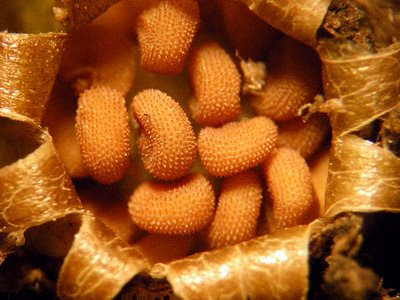
Do you remember the Sesame Street song "One of these Things is Not Like the Others..."? Appropriately enough, the rendition I have linked to is Big Bird singing about bird seed. Why? Because the yummy-looking morsels in the 1st image are wildflower seeds, photographed under the scanning electron microscope (SEM). But only 5 of the other images are actual seeds - 2 of the images show models of micrographed seeds. Scroll down to read the details.

1st image) Seeds of wild flowers photographed by Yanping Wang of Beijing, China, 9th place in the 2010 Olympus BioScapes International Digital Imaging Competition.*

2nd image) Micrograph of a seed from the book Seeds: Time Capsules of Life by Rob Kesseler and Wolfgang Stuppy (out-of-print, but you can buy a used copy here or here).
3rd image) Hairs on seed of Rochelia persica. I haven't been able to source this SEM photo, which appears on the site AboveTopSecret.com.

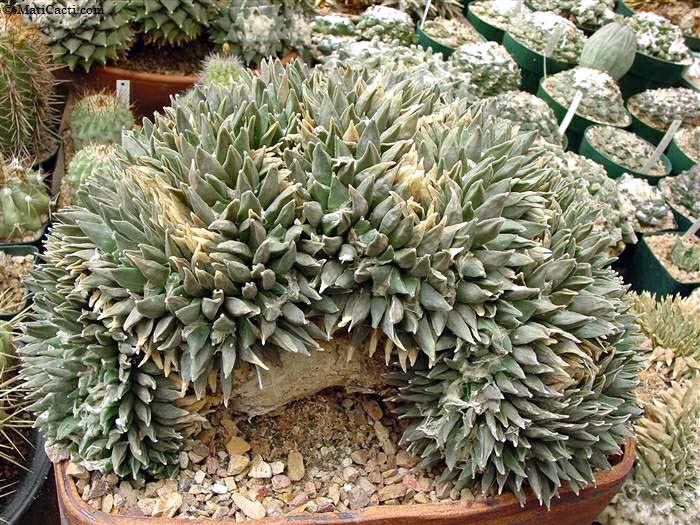
4th image) Microscopic seed images inspired by Seeds: Time Capsules of Life (new copies available here) and recreated by Nancy Hall and other Australian artists as 3D sculptures using knitting, felt, and clay: Parnassia fimbriata (green), Pholistoma auritum (purple), and Ariocarpus retusus (yellow).

5th image) Seed of a Strelitzia reginae photographed at 10x magnification by Viktor Sykora of Prague, Czech Republic, 5th place in the 2010 Nikon Small World Contest.

6th image
) The ripe seed capsule of Silene dioica which has just split open at the tip, with the segments at the apex rolling back to form a ring of teeth with the seeds inside. Microscopic photo taken by Phil Gates in Durham, UK, and featured on his blog Beyond the Human Eye.

7th image) Micrograph of a seed from the book Seeds: Time Capsules of Life by Rob Kesseler and Wolfgang Stuppy (buy a used copy here or here).

8th image) Microscopic seed images inspired by Seeds: Time Capsules of Life and recreated by Nancy Hall and other Australian artists as 3D sculptures using knitting, felt, and clay: Castilleja flava (light yellow), Orthocarpus luteus (yellow), Scutellaria orientalis (purple), and Drosera cistiflora (pink).

How did you do?

*Thanks, Barbara!

Sunday, July 31, 2011

Heart-shaped potatoes


"Buh-day-duhs," as my maternal grandfather John P. Dunne (1911-1994) used to pronounce them, grow in many anomalous shapes - which makes heart-shaped potatoes less rare than you would think. The cook at Tina's Cafe in Nebraska found one, and so did the staff at K's Cafe in Wales (4th image). On a slow news day, it seems that just a good photo of a the finder clutching his or her prize will suffice. Here is Pennsylvania woman Linda Greene with her potato and South Carolinian Melissa-Sylvia Maggart with hers. Some people post their own photos of heart potatoes before they eat them: Marta found one at a Brooklyn food coop (2nd image), and Lauri Rantala shared one that she snapped at her kitchen sink in Finland (3rd image). Often, mention in the news requires a combination of coincidences. Last week, a Serbian farmer and a Chinese grocer discovered heart-shaped potatoes on the same day (5th image). Last year, a Florida woman found a heart-shaped potato in her grocery bag on Valentine's Day. In 2009, a British woman sold a heart-shaped potato on Ebay to raise money for charity, suggesting that the spud "could be cooked and then frozen to be given as a Valentine's gift." But perhaps the most newsworthy heart-shaped potato was the tiny one featured on "Late Night with David Letterman" on the evening when newly-elected President Barack Obama appeared (1st image). Obama joked with the host about the reason for his appearance on the show saying, “The main reason I’m here? I want to see that heart-shaped potato.” The president was said to have been upstaged by the tuber, which was presented to him by its owner. "Mary Apple? Is your name really Mary Apple? And you carry heart-shaped potatoes around?," he asked. Though they basked in their 15 minutes of fame, Mr. and Mrs. Apple - who considered the shriveled keepsake a good luck charm - regretted giving it away, even to the head of state: “We were afraid he might just toss it. I’m a little sad. It’s like when one of your children grows up and sprouts wings.”

Sunday, June 12, 2011

Our garden


Despite a lot of greenery to choose from, I have decided which of the plants in our luscious garden is my favorite: the canna lily. There it is behind me, with 2 red-orange blooms on top (1st image). Canna grows so fast (time-lapse here) that you can almost hear it (to me, it should sound like this). It's in the back of the house (3rd image) where I do my yoga and strengthening exercises in the morning (that's a yellow theraband under my hand) surrounded by the aromas of a sweet almond tree and night-blooming jasmine. Also in back is the succulent garden containing another of my favorites: devil's backbone! My stepfather and my Mom each have an outbuilding - a garden shed (2nd image) and an art studio (4th image). My room opens onto a deck (5th image) with a good view of the lake across the street and easy access to the herb garden from which my Mom adds rosemary or sage to the evening's cuisine. The windows to the south (6th image) overlook the scented garden, and those to the east look out at the weeping bottle-brush trees and at part of the paved driveway, beyond which is a locally-owned orange grove, which also gives off a strong perfume in March. Nice.

I was ready to publish this post much earlier in the day when my Mom gave me access to her gardening file to give you a better idea of the yard's vegetation. Here's a partial list: abelia kaleidoscope, African iris, allamanda, beach daisy, beach sunflower, bleeding heart vine, blue daze, blue fortune anise hyssop, boxwood, cape honeysuckle, Carolina jessamine, cilantro, clock vine, coleus, common blue violet, crape myrtle, duranta, dwarf garden juniper, euphorbia diamond frost, ferns, fig tree, fountain grass, holiday kalanchoe, holly bushes, honeysuckle vine, hypoestes, impatiens, ivy, juniper procumbens nana, lantana, lily of the Nile, lily turf, loropetalum, Mexican bush sage, Mexican flame vine, Norfolk Island pine, oakleaf hydrangea, oleander, peace lily, peacock ginger, perennial peanut, periwinkle, Philippine violet, pineapple sage, plumbago, podocarpus, polka dot plant, portulaca grandflora, purple queen, queen's wreath, ruellia, sandpaper vine, scarlet sage, snowbush, sprenger asparagus fern, sweet olive, sweet-potato vine, sweet viburnum, thryallis, tropical red sage, variegated sinensis privet, and woodsorrel.

Quoted in a local magazine in 2007 when her garden was on the tour, she said, "Most of my plants are drought resistant and frost resistant. That way my garden remains beautiful throughout the year. I try to use as many native Southern plants as possible to conserve water and eliminate the need for pesticides." Thanks to my Mom for the photos, and to her and Del both for putting so much hard work into keeping our private park such a place of beauty!

Labels