
Showing posts with label war. Show all posts
Showing posts with label war. Show all posts
Sunday, February 15, 2015
Dentures from the dead


Friday, January 30, 2015
Prehistoric PTSD

The first description of post traumatic stress disorder, in which soldiers sometimes hallucinate about the ghosts of men they have killed in battle, was often attributed to Greek historian Herodotus. But now a team from Anglia Ruskin University has found references in texts from the Assyrian Dynasty in Mesopotamia dating back 7 centuries earlier to 1300 B.C.E. British clinical psychologist James Hacker Hughes says, "As long as there has been civilisation and as long as there has been warfare, there ha[ve] been post-traumatic symptoms. It's not a 21st Century thing."
Wednesday, November 19, 2014
Napoleon's hat
In the 1801 painting "Napoleon Crossing the Alps” (IMAGE HERE), Jacques Louis David depicts the French emperor in his trademark bicorn hat. He actually wore the 2-cornered, black felt hat sideways so that he could be recognized on the battlefield. Alexandre Giquello of the Osenat auction house in Fontainebleau, France, says of Napoleon, "He understood at that time that the symbol was powerful. On the battlefields, his enemies called him ‘The Bat’ because he has that silhouette with this hat.” During his 15-year reign, Napoleon reportedly went through about 120 hats, 19 of which of are still extant. One of these (PICTURED ABOVE), in the possession of Prince Albert II of Monaco, just sold at auction to an unnamed South Korean collector for $2.4 million (£1.5 million).

Friday, November 7, 2014
Pushing Cushing
When 94-year-old Delafield, Wisconsin, resident Margaret Zerwekh found herself living on property once owned by the family of 1st Lt. Alonzo Cushing (IMAGE ABOVE), she spent the next several decades lobbying to have him awarded the nation's highest military honor. Cushing fought bravely in the Civil War, was wounded several times during the Battle of Gettysburg, and died on the battlefield at the age of 22 on July 3, 1863. Her efforts – which included pushing Congress to pass legislation suspending the time limit by which a person can posthumously be awarded the Medal of Honor – have only just been rewarded. After pointing out Zerwekh's determination and persistence, President Obama joked during the ceremony, "And what’s more, she even managed to bring Republicans and Democrats together to make this happen. Margaret, we may call on you again sometime in the next several months."

Saturday, October 18, 2014
Back to back
When 27-year-old Dominic Smee saw images of the crooked skeleton of Richard III, discovered in 2012, he felt as if he were looking at x-rays of his own back. Smee had been diagnosed at the age of 11 with the same condition – idiopathic adolescent onset scoliosis– from which the king suffered. When he contacted the research team at Leicester University, he was recruited to participate in a documentary which has just aired on British TV. With Smee as a stand -in (IMAGES HERE), they confirmed that Richard III would have been able to accurately wield a sword and lance while riding a medieval warhorse and wearing a 66 lb. (30kg) suit of armor. Smee was given the customized suit of armor afterward, which has elevated his status when he participates in his hobby. Appropriately, he takes part in reenacting historic battles and gloats, "The guys who do the reenactments are very envious."
Sunday, August 24, 2014
Tabbies in the trenches
While they didn't have as prominent a place in World War I as dogs and horses, cats served admirably in the ranks. Some half a million did their duty in the trenches and onboard ships. Proverbially difficult to herd, the cats were given the run of their area and kept it free of the mice and rats that would eat provisions, chew through ropes, and spread disease. In addition to their "official" duties – which in some cases included being gas detectors – the cats were embraced as mascots. The soldiers and sailors of America, Canada, Britain, Belgium, France, and Australia gave them nicknames like Togo, Spark Plug, Ching, Pincher, and the famous Pitouchi (IMAGES HERE).

Monday, May 26, 2014
Papa's pension
"I didn't care for neither one of them, to tell you the truth about it. I wanted to get away from both of them. I wanted to get me a house and crawl in it all by myself," says 84-year-old Irene Triplett of her parents. She had it rough growing up in North Carolina. She started chewing tobacco in the 1st grade and only made it to the 6th grade, constantly teased about her father (SECOND FROM THE RIGHT IN THE PHOTO ABOVE) being a traitor. Pvt. Mose Triplett (b.1846) had fought with both the Confederate and Union troops during the Civil War. Irene's mother, Mose's second wife who was 50 years his junior, lost 3 babies before Irene and her brother were born. Irene inherited her mother's mental disabilities, and shortly after Mose died at the age of 92, they both ended up in the workhouse for the next 17 years. When it shut down, they ended up in a private nursing home, with Irene continuing as a resident decades after her mother's death in 1967. It was only last year after she broke her hip that she was transferred to a skilled nursing facility in Wilkesboro. The cost, borne by Medicaid, is offset by the pension of $73.13 that she still receives monthly from the Department of Veterans Affairs for her father's military service in the 1860s.

Monday, April 21, 2014
Flaming felines
Last year, the University of Pennsylvania digitized some 16th c. German artillery manuals. Much was made of the illustrations of the "rocket cats" in the manuscripts (DETAIL ABOVE, MORE IMAGES HERE) and the web was rife with speculation that they foreshadowed modern jetpacks. But the translation from the original German by scholar-in-residence Mitch Fraas sets the story straight:

"Create a small sack like a fire-arrow ... if you would like to get at a town or castle, seek to obtain a cat from that place. And bind the sack to the back of the cat, ignite it, let it glow well and thereafter let the cat go, so it runs to the nearest castle or town, and out of fear it thinks to hide itself where it ends up in barn hay or straw, it will be ignited."Yes, sad to say, the kitties were intended as Molotov cocktails…with tails.
Monday, March 17, 2014
Mongol monsoons
Often my posts about past weather patterns are based on evidence from prehistoric times that lends further credence to global climate change. But scientists at West Virginia University have discovered tree-ring data that explains in part a series of historic events. Amy Hessl and her colleagues in the Department of Geology and Geography have found evidence of an unusual stretch of warmth and wetness in Mongolia that lasted from 1211 to 1225 A.D. That span matches exactly the time when the founder of the Mongol Empire, Genghis Khan (1162?-1227), was successfully conquering an area stretching from East Asia to Eastern Europe, and including parts of northern India and the Middle East. The mild temperatures and unprecedented rain would have promoted the growth of abundant grass on the Mongolian steppe, which would have increased the number of grazing animals. It would have supported the great herds of livestock that fed the members of Genghis Khan's army and the number of horses – 5 apiece – that his soldiers (IMAGE ABOVE) were said to have had. Observes Hessl, "Nature set the table, and Genghis Khan came to eat."

Wednesday, February 5, 2014
Melancholy marbles
When 83-year-old Toosje Kupers was moving last year, she found some toys she had kept for decades in a cupboard. The book, tea set, and collection of marbles (IMAGE ABOVE) had belonged to her little playmate on the Merwedeplein in Amsterdam and were left in Toosje's care when the girl's family announced they were leaving for Switzerland. She remembers the concern of her childhood friend when she turned them over: "'I'm worried about my marbles, because I'm scared they might fall into the wrong hands. Could you keep them for me for a little while?'" The marbles remain safe – it was the girl and her family who fell into the wrong hands, and she was never able to reclaim them. Her fate is well-known and her name is Anne Frank.

Monday, January 13, 2014
Impervious pillar

The Iron Pillar in Delhi, India (DETAIL ABOVE), is at least 1,500 years old and bears inscriptions dating back to about 400 A.D. The 24' (7 m) pillar was dedicated and rededicated to rulers and victors in battle. In addition to its historical significance, the Pillar of Delhi has a scientific claim to fame: its mpenetrability to corrosion is something modern technology cannot match. Professor A.P. Gupta, Head of the Department of Applied Sciences and Humanities at India's Institute of Technology and Management, has been studying the metallurgy industry in ancient India that was able to produce something that was 99.72% iron and – unlike that of today – contains absolutely no manganese or sulfur. The monument is also coated with a protective oxide film that researchers have been unable to recreate. The result is that even though the pillar has withstood 1,000 monsoons, it has never rusted.
Thursday, October 3, 2013
Crossrail crossbones
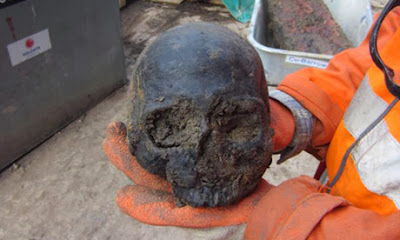
Actually it's just the skulls and not the crossbones which have come tumbling out of a Crossrail tunnel being excavated near Liverpool Street in London. Blackened Roman skulls - 20 of them – discovered in clumps. If they do find the long bones, it will be somewhat of a disappointment because a Roman cemetery was known to exist upriver on the long-vanished Walbrook. Without that evidence, the skulls lend support to the idea that they belonged to the beheaded victims of Boudicca, warrior queen of the Celtic Iceni tribe, slung without ceremony into the river during her 61 A.D. rebellion. That would be what lead archaeologist Jay Carver calls "an unexpected and fascinating discovery that reveals another piece in the jigsaw of London's history."
Tuesday, July 2, 2013
Right arm reunion
American doctor Sam Axelrad was serving in Vietnam in 1966. When an enemy soldier was shot in the hand by U.S. troops and brought to the hospital, he dutifully operated on him. Axelrad had to amputate the arm, and afterward kept the bones. He brought the grizzly souvenir home as a reminder that when a wounded North Vietnamese soldier was brought to him, he did the right thing and treated him. The partial skeleton stayed hidden in the closet for decades until 2 years ago. That's when Axelrod, curious about the patient's identity, decided to track him down. He succeeded. Axelrad met Nguyen Quang Hung in Vietnam and returned the arm, with which Hung now plans to eventually be buried. A surprised Hung says, "I’m very glad to see him again and have that part of my body back after nearly half a century. I’m proud to have shed my blood for my country’s reunification, and I consider myself very lucky compared with many of my comrades who were killed or remain unaccounted for. I can’t believe that an American doctor took my infected arm, got rid of the flesh, dried it, took it home and kept it for more than 40 years. I don’t think it’s the kind of keepsake that most people would want to own."

Tuesday, April 16, 2013
Mass grave simulation

The anthropological research facility at the University of Tennessee, more commonly known as the "Body Farm," is embarking on a new and ambitious project. For more than 30 years, researchers have been exposing individual donated human corpses to the elements to discern decomposition rates under various conditions and make it easier to solve crimes. Now they are burying multiple bodies in a single grave to make it easier to solve crimes against humanity. Led by anthropology professor Amy Mundorff, students dug 4 graves: the first contains the remains of 6 people, the second contains 3, the third contains a single body, and the fourth was refilled with dirt as a control for the experiment. For the next 3 years, UT scientists will monitor the burial sites from the sky, from the ground, through sampling, and in different light spectrums to determine whether and how they can be detected from afar. “Mass graves are the most profound example of evil, and you may not be able to get away with it much longer if we can make this work,” says Mundorff's colleague Michael Medler at Western Washington University, who helped conceive the project. The remote sensing technologies they refine – such as identifying subtle changes in satellite images – will allow investigators to locate clandestine graves around the world and to prosecute the killers. After the project wraps up, the University of Tennessee anthropologists will offer a seminar for international workers on excavating mass graves, which has previously only been demonstrated on animal remains. But the advances in the forensic science will hopefully go beyond discovering and examining the remains after the crime has been committed, and begin to undermine the confidence of the mass killers. “The most exciting part of the project is conceptually making it harder for people to feel like they can get away with these things, even decades later,” says Medler. “Because we will see it.”
Tuesday, May 22, 2012
The living photos of Arthur Mole

- Statue of Liberty, 1918 (18,000 soldiers at Camp Dodge, Des Moines, Iowa)
- Uncle Sam, 1918 (21,000 troops at Camp Lee in Richmond, Virginia)
- U.S. Shield, 1918 (30,000 officers and men at Camp Custer in Battle Creek, Michigan)
- American Eagle, 1918 (12,500 officers, nurses, and men at Camp Gordon in Atlanta, Georgia)
- Liberty Bell, 1918 (25,000 soldiers at Camp Dix, New Jersey)
- Living Emblem of the United States Marines, 1919 (100 officers and 9000 enlisted men at the Marine Barracks at Parris Island, South Carolina)
__________
Previous presidential posts:
Sunday, February 12, 2012
In the trenches


 German soldiers of the 6th Company, 94th Reserve Infantry Regiment hunkered down in an underground shelter on the Western Front in the Alsace region of France during World War I. Their basic needs were met - they had wood stoves for heat, telephone connections, furniture, electricity, rudimentary plumbing, and even a goat to provide fresh milk - but they had no peace of mind. The soldiers had taken refuge in the trench (which was 125m long and up to 6m deep) on March 18, 1918. That morning, the German artillery had pounded the front lines with gas shells and by early afternoon the French were responding. The 1.1m x 1.7m tunnel was hit 3 times and then, shortly after noon, collapsed at its weakest point. When the Germans attempted a rescue under cover of darkness, they found 2 survivors among the 34 who were trapped by the cave-in, but both later died. They removed 13 of the casualties, but were unable to continue because of continued collapse and continuing combat. It was not until Nov. 2011 that the bodies of the 21 remaining soldiers were recovered. Archaeologist Michael Landolt describes, "It's a bit like Pompeii. Everything collapsed in seconds and is just the way it was at the time. Here, as in Pompeii, we found the bodies as they were at the moment of their death. Some of the men were found in sitting positions on a bench, others lying down. One was projected down a flight of wooden stairs and was found in a fetal position." Landolt is leading the team that began excavating the trench (2nd and 4th images) after it was discovered while a road was being built. The Interdepartmental Centre of Archaeology Rhinelander (PAIR) archaeologists are finding well-preserved personal effects including boots, helmets (1st image), rifles (3rd image), wine bottles, glasses, wallets, pipes, and still-legible newspapers (more photos here). "The collapsed shelter was filled with soil. The items were very well preserved because of the absence of air and light and water. Metal objects were rusty, wood was in good condition....Leather was in good condition as well, still supple," continues Landolt. The bodies - including that of Musketeer Martin Heidrich, 20, Private Harry Bierkamp, 22, and Lieutenant August Hutten, 37 - have been handed over to the German War Graves Commission. Unless surviving relatives request repatriation, they will be interred in the nearby German war cemetery of Illfurth, where their names - known now for nearly a century - were inscribed on a monument 50 years ago.
Sunday, January 29, 2012
Birds and bombs
 Beatrice Harrison (1892-1965) was a British cellist who studied at the Royal College of Music in London and made her debut in the Bechstein Hall in Berlin. Beatrice was from a very musical family and had 3 sisters: May (a violinist), Monica, and Margaret (a pianist).
 "The Harrisons were very much part of the London social life when they lived in Cornwall Gardens from 1901 to 1920. After their move to Foyle Riding in Oxted, Surrey, in 1922 their music room was visited by most leading musicians of the day. Their garden was the scene of many social charity garden parties, and received visitors from all over the world to see `The Garden of the Nightingales'. These included coach parties of all kinds of people from London who were always served tea by the sisters. None of the sisters ever married," writes David Candlin, Chairman, The Harrison Sisters' Trust.
 Beatrice was important in musical circles for being the 1st to perform several important English works, but became popular among the public because of recordings of her cello-playing accompanied by the sound of nightingales that were broadcast in the early days of sound radio (listen to the 1st link here) from Beatrice's garden in Foyle Riding, Surrey.
 Transmitted by the BBC. The broadcasts - with or without the cello music - became an annual event, even after Beatrice moved in 1936. To quote Retronaut, "On May 19th, 1942, as BBC engineers were recording the bird-song prior to transmission, a faint hum gradually became audible, slowly increasing in volume, as 197 bombers flew overhead on their way to raids in Mannheim. Realizing the security risk, the broadcast was halted. But not the recording…" (listen here).
  Mannheim 197 aircraft - 105 Wellingtons, 31 Stirlings, 29 Halifaxes, 15 Hampdens, 13 Lancasters, 4 Manchesters. 11 aircraft - 4 Halifaxes, 4 Stirlings, 3 Wellingtons - lost. 155 aircraft reported hitting Mannheim but most of their bombing photographs showed forests or open country. A concentrated group of about 600 incendiaries in the harbour area on the Rhine burnt out 4 small industrial concerns. Only light damage was caused elsewhere. The only fatal casualties were 2 firemen. Minor Operations: 65 'freshmen' crews to St Nazaire but bombing results were poor, 9 aircraft minelaying off Lorient and near Heligoland, 13 aircraft on leaflet flights to France. 1 Wellington lost on the St Nazaire raid. Total effort for the night: 284 sorties, 12 aircraft (4.2 per cent) lost.~Campaign diary of the Royal Air Force Bomber Command for the night of May 19, 1942
 Beatrice gave the 1st performance of Edward Elgar's Cello Concerto outside London in 1921 and it became the work with which she was most closely identified. Less than a year after she performed it with the London Symphony Orchestra in 1940, the old Queen's Hall in which they had played was destroyed by German bombing. In fact, during the performance itself - during which Beatrice's style was particularly animated - there was a rattle of gunfire outside and plaster fell inside the hall.
Reminders of war indoors and out...
Saturday, January 14, 2012
Doughboy dog tags


 Frenchmen Michael Jean Toussaint and Claude Fonderflick have been using metal detectors to search for artifacts on World War I battlefields (1st image, troops who fought in the Meuse-Argonne Offensive). When they turn up military ID tags, they attempt to return them to the soldier's family. They have succeeded in some instances and are still researching others:
Kent Potter
Unit 139, of the 134th Infantry Division, Company M, U. S. Army
Found: Liverdun, Lorraine, France
Returned: Cottonwood Falls, Kansas, U.S.
A ceremony was held at the Chase County Historical Museum on Thursday to restore the dog tag of Infantryman Kent Potter (3rd image) to his family 94 years after it was lost. Potter did not lose his life on the battlefield, but possibly while hauling supplies when - according to family legend - he put his gas mask on his mule to protect it from a mustard gas attack. Potter returned to his home state to tell such stories, marry, and raise a family. His son, Dale Potter (2nd image, examining a photo with Doris Archer), accepted the medal (photo here), who said, "I'm amazed that these 2 people in France still remember and appreciate what the United States did for their country....My dad didn't die there, he came home. There were so many who did not get to come home."
Leonard Stoltz
Found: A field near the village of Vaxainville, France
Returned: Montezuma, Ohio
Audrey Stoltz (photo here) and her siblings Jack Stoltz (photo here) and Joyce Ann Kiser claimed the military ID of their father from the 2 Frenchmen and received it by mail. They were glad to have it, even though they remember very little about him. One day in the 1930s, Leonard Stoltz - who was a deputy sheriff at the time and had served in the military before he married - went to the grocery store and never came back. They had only learned in 1987 that their father had died in 1968 at a veterans hospital in Miami and had been buried in a veterans cemetery in Andersonville, Georgia. The dog tag only answers a few of the many questions they are left with. Says Jack, "When he left, we went to live with our grandparents. Unfortunately, the house burnt up, and all the pictures were lost. The dog tag is the only thing we have."
The dog tag of Walter Renfro was returned to a descendant in El Paso, Illinois. "When they first called, my husband and I thought it was some kind of scam. No one is that nice anymore," said Renfro's granddaughter, Rita Drake, who is helping Toussaint and Fonderflick search for relatives of 2 other soldiers, Frank Kubas (Kansas City, Kansas) and Charles R. Thomas (home state uncertain).
Wednesday, August 31, 2011
Oxbringa från 1940


There is eating aged beef and then there is eating "oxbringa från 1940" (click for translation), as Swedish senior citizen Eskil Carlsson did earlier this month. The choice cut of beef had been jarred by his in-laws during wartime shortages and retained after the war in case the hard times returned. Carlsson married into the family in the 1950s and tells a reporter, "By then the family had developed respect for the jar, that it had stayed sealed. We talked about it from time to time and it became like a member of the family." His wife has since passed away, and he decided that the time had come to see how well the 70-year-old meat had fared. He invited the neighbors to his garage for the ceremonial opening of the brisket jar (video here). It took some doing to get it open, but after they tested it on the cat, some of those present sampled it with Carlsson. It didn't smell too bad, said the old man, but "it was no delicacy."
According to the only source I could find, the situation in Sweden during World War II was at its worst in 1942. At that time, the daily ration of meat was only 22 grams of meat or pork, which was supplemented by the occasional brooding hen too old to lay eggs. Like fowl, game was not rationed, but it was restricted by the hunting season. "[B]utchers became very skilled in producing mincemeat of various birds and hares and rabbits, that people brought up in parks and inner house yards to add to the meager meat ration." The phrase "Smörgåsbordet försvinner" on the vintage poster (1st image) translates as "Smorgasbord disappears."
Kristina, let me know if the translations are authentic!
Monday, May 30, 2011
Happy Memorial Day!


Do you remember this photograph? Back in May 2009, Army Spc. Zachery Boyd - a 19-year-old from Fort Worth, Texas - did not stop to put his pants and boots on when the Taliban ambushed his fellow platoon members at firebase Restrepo in Afghanistan's Kunar Province (1st image). The world would not have known he wore pink "I love New York" boxer shorts except for Associated Press photographer David Guttenfelder embedded with his unit of the U.S. Army First Battalion, 26th Infantry. Next thing you know, his butt is on the front page of the New York Times (3rd image)! The candid image drew worldwide attention and elicited comment from Defense Secretary Robert Gates, who said, “Any soldier who goes into battle against the Taliban in pink boxers and flip-flops has a special kind of courage.” Upon his return to Texas on a 4-day pass to visit his family in July 2009, Boyd (2nd image shows his face) said of his
 fellow soldiers, "They gave me a lot of grief about it, but out there they use anything they can to give a guy some grief." He had actually bought the boxers during a New York layover before deploying and chose pink because he thought his friends would laugh. Imagine the additional teasing Boyd received when they learned that the now-famous pink underwear was to be displayed in the 1st Infantry Division museum at Fort Riley, Kansas!
Subscribe to:
Posts (Atom)


