Dating back 7,000 years – earlier than the Egyptians, the oldest mummies in the world are those of the Chinchorro, who lived along the coasts of northern Chile and southern Peru. Hundreds of them have been unearthed, with more being excavated regularly. Usually, the challenge is to conserve them after they are removed from their dry conditions under the desert sand. But these days, almost certainly due to climate change, they are deteriorating where they lay. Archaeologist Marcela Sepulveda of the Universidad de Tarapacá, observes, "When you excavate mummies you can see that degradation is already there."
Showing posts with label Environment. Show all posts
Showing posts with label Environment. Show all posts
Monday, March 16, 2015

 Posted with Blogsy
Tuesday, February 24, 2015
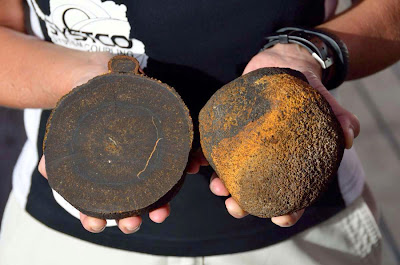
Manganese in raw form
Members of the German research organization GEOMAR Helmholtz Centre for Ocean Research Kiel were on a research expedition looking for deep-sea organisms in the Atlantic Ocean when they stumbled upon natural deposits of the rare earth metal manganese. The mineral accretes over millions of years into nodules that range in size from golf balls to bowling balls. Lead scientist Colin Devey explains the rarity of the find, "Manganese nodules are found in all oceans. But the largest deposits are known to occur in the Pacific. Nodules of this size and density in the Atlantic are not known."


Monday, February 16, 2015
Remote rumors

This puffin-hunting lodge, with no electricity or indoor plumbing, was built in 1953 and is now trumpeted as the most isolated house in the world. It is located on the island of Elliðaey, part of the Vestmannaeyjar archipelago south of Iceland. While native pop singer Björk may or may not have considered buying the property, and Iceland may or may not be interested in selling the islands off its coast, the fact is that it was not presented to her as a gift by the government of the country grateful for the attention she has brought it.
Tuesday, December 16, 2014
Gravity potato
I had no idea there was something called the Potsdam geoid – a.k.a. the "gravity potato" – let alone news about it. It has been revealed that the terrestrial gravity that the potato (IMAGE ABOVE) represents changes with time. The model, based on ground-based and satellite measurements compiled by the GFZ German Research Centre for Geosciences, now includes seasonal fluctuations of water balance on the continents and climate-related variations including melting and growing ice masses. German researcher Frank Flechtner explains, "This allows the measurement of gravity in inaccessible regions with unprecedented accuracy, for example in Central Africa and the Himalayas."

Saturday, December 13, 2014
Taj tarnished
The most beautiful tomb in the world, India's Taj Mahal, requires routine cleaning to maintain its visual brilliance. A collaboration of Indian and American scientists have determined exactly what particulates are causing the gleaming white marble to take on a dingy brown cast. Air sampling and electron microscopy reveal that the discoloration is caused by the carbon coming from a variety of sources: fuel combustion, cooking and brick-making, trash and refuse burning, agricultural dust, and vehicle exhaust. The government has already taken steps to reduce vehicle and industrial emissions in the area. Michael Bergin, professor of earth and atmospheric sciences at Georgia Institute of Technology, notes, "Some of these particles are really bad for human health, so cleaning up the Taj Mahal could have a huge health benefit for people in the entire region. The health of humans and the health of the Taj Mahal are intertwined.”

Thursday, December 11, 2014
Nazca no-no

Peru is seeking criminal charges against members of Greenpeace, who staged a publicity stunt on Monday intended for delegates from 190 countries attending U.N. climate talks being held in Lima. The government claims that the activists left footprints adjacent to the ancient Nazca lines after entering a prohibited area next to the figure of a hummingbird. They laid big yellow cloth letters reading, “Time for Change! The Future is Renewable.” The government does not disagree with the message. The issue is the way Greenpeace drew attention to it. Deputy Culture Minister Luis Jaime Castillo declares, "It’s a true slap in the face at everything Peruvians consider sacred."
Wednesday, December 10, 2014
Build a better fogtrap?
In remote areas regions of countries including Chile, Peru, Guatemala, Namibia, Eritrea, Oman, and Nepal, fog collection is a relatively cheap and environmentally friendly source of water. Standard fog collectors using mesh have been proven to be very efficient in parts of America's Big Sur by Daniel Fernandez, a fog researcher at California State University, Monterey Bay (LINK TO TED TALK HERE). Another scientist, doctoral student Xin Heng at the University of Texas at Arlington, Is working on a new design based on a bird's beak. But climatologist Otto Klemm of the University of Münster, who has been interested in fog for the past 30 years, points out that innovation in this instance has some disadvantages. A solid apparatus may not be able to withstand the strong winds that mesh can. In addition, they may be more expensive and harder to maintain in remote regions. As he puts it, "The more engineering there is, the less is the chance that these will be applicable for poor people in semi-desert regions."

Monday, November 24, 2014
Worked turf

Friday, November 21, 2014
Cold crater
After ruling out that huge crater on the Yamal Peninsula in northern Siberia was not a hoax, the work of aliens from outer space, or the result of a meteorite or stray missile, a group of Russian scientists has descended into the recently formed hole to research it further. Igor Yeltsov of the Trofimuk Institute believes that the crater – along with 2 others – has resulted from global climate change: heating from above the surface due to unusually warm conditions, and from below due to geological fault lines, led to a huge release of gas hydrates that caused an eruption. Mission leader Vladimir Pushkarev of the Russian Centre of Arctic Exploration said, "They did radiolocation tests at a depth of 200 metres, took probes of ice, ground, gases, and air. Now they all went back to their institutes and labs and will work on the material. The next stage is processing of the gathered information." (FOLLOW LINK FOR MORE IMAGES)

Monday, October 20, 2014
Blue goo

Saturday, October 18, 2014
Norski
A receding glacier in Norway has revealed an almost complete ancient wooden ski. It measures 68" (172 cm) in length and 5.7" (14.5 cm) in width and has leather straps for securing the foot. The ski is estimated to be 1,300 years old, but the history of skiing dates much further back. Another ski found in Norway dates to 3200 B.C.E. and a ski found in Sweden dates to 3300 B.C.E. But even those are trumped by a ski found in Russia which may be 8,300 years old!
Tuesday, September 30, 2014
Cold stronghold

The government of Norway is coming under pressure to stop the sale of land within the Arctic Circle to a Chinese real estate developer. Tycoon Huang Nubo, who attempted unsuccessfully last year to buy land in Iceland,was interested in a large waterfront plot near the northern city of Tromso and now has his eyes on a much bigger and even more northerly property on Spitsbergen, the main island in the Svalbard archipelago. The vehement outcries are about the possibility that China is seeking a permanent foothold in the Arctic, since its geopolitical and economic importance has grown. Global warming has opened new and cheaper shipping routes from Asia and expanded prospects for exploiting the region’s natural resources, which are estimated to include 13% of the world’s undiscovered oil and 30% of its natural gas. Christin Kristoffersen, mayor of Longyearbyen, Svalbard’s administrative center, states, "We should own this island. This is not anti-Chinese, but pro-Norwegian.”
Monday, June 9, 2014
Litter to littoral
Yet another negative legacy of our tenure on earth has turned up. Geologist Patricia Corcoran of the University of Western Ontario in London, Canada, and Capt. Charles Moore, of the oceanographic research vessel Alguita, stumbled upon a new type of rock on Kamilo Beach on the Big Island of Hawaii. These weren't igneous, metamorphic, or sedimentary. They were cobbled together from volcanic rock, beach sand, seashells, coral, and plastic. When they went looking, they found the stones in all 21 of the area sites they surveyed. The scientists dubbed them “plastiglomerates,” and explain that they can form anywhere there is abundant plastic debris and a heat source, such as a forest fire or lava flows. Melting allows the plastic to cement together the natural fragments and flow into larger rocks to fill in the cracks. The mass of plastic produced since 1950 is close to 6 billion metric tons, and none of it has yet decayed.

Wednesday, April 2, 2014
Sunsets
British landscape artist J. M. W. Turner (1775-1851) painted some spectacular sunsets, including the image above, entitled The Lake, Petworth: Sunset, Fighting Bucks. The reason the lighting in this painting is so dramatic is that the air was filled with volcanic ash and gas that had been spewed from halfway around the world in Indonesia. The Tambora volcano – the largest in recorded history – had erupted in 1815, killing 10,000 people directly and over 60,000 indirectly due to the starvation and disease that followed. The aerosol particles scattered the sunlight, producing bright red and orange sunsets in Europe for up to 3 years. Scientists have now realized that they can plumb master paintings for clues to the composition of the atmosphere in the past. A team of Greek and German researchers has just published in Atmospheric Chemistry and Physics the results of their analysis of hundreds of sunset paintings completed between 1500 and 2000, a period during which more then 50 large volcanic eruptions occurred around the globe. Skies more polluted by natural aerosols like ash or desert dust and modern manufactured aerosols scatter sunlight more, so the sky appears redder. The scientists measured the ratio of red to green along the horizon of each painting and discovered that it correlated with the amount of aerosols regardless of the painter or the school of painting. Atmospheric physicist and lead author Christos Zerefos of the Academy of Athens in Greece says, “Nature speaks to the hearts and souls of great artists. But we have found that, when colouring sunsets, it is the way their brains perceive greens and reds that contains important environmental information.”

Monday, December 23, 2013
Cold comfort

On remote Ward Hunt Island in the Canadian Arctic, biologist Warwick Vincent of Laval University in Quebec City and his colleague found a message in a bottle buried under a cairn. On a piece of ruled paper was a pencilled message. It was not a final communiqué from stranded explorers. Instead, it was a scientific request. The note asked anyone venturing that way to measure the distance from the cairn and another that had been piled up to a nearby glacier and to send the information to the address indicated. The bottle had been lying in wait for more than 50 years. The note had been written by a brilliant young geologist named Paul Walker of Ohio State University in 1959. Walker had to be airlifted from the island shortly thereafter for medical reasons and died that same year. But the data he left on the note has assisted Vincent in documenting the break-up of the Ward Hunt ice shelf, the largest in the Arctic and at some points measuring as thick as a 33-storey building. What had been a 1.2 m gap in 1959 has widened to 101.5 m today because of the glacier's shrinkage. The point of comparison is extremely valuable and rare in such an isolated place, and Vincent credits Walker's talents as a scientist for having the forethought to leave the message. “Because in the ’50s, it was unthinkable that this would melt.”
Monday, December 16, 2013
Anachronistic Osage orange
I don't remember what we called them when I was growing up in Illinois (hedge apples?), but I do remember some mischievous boys throwing the fruit of the Osage Orange at our car as we drove by. "In the fall, Osage-orange trees hang heavy with bright green, bumpy spheres the size of softballs, full of seeds and an unpalatable milky latex. They soon fall to the ground, where they rot, unused, unless a child decides to test their ballistic properties," reads an article with the tantalizing title "The Trees That Miss the Mammoths." The article goes on to explain that fleshiness and aromatic properties of the fruit entice large animals to eat them, pass through the seeds they contain, and deposit them – along with natural fertilizer – away from the parent tree. This evolutionary strategy worked beautifully in the age of the mammoths. Giant ground sloths and gomphotheres, one of the elephant's many interesting ancestors, gobbled up the fruit of the Osage apples and facilitated their propagation. But today, with the extinction of most megafauna, scientists were left with the "riddle of the rotting fruit," which remained on the ground beneath the tree or rolled downhill, sometimes carried away by water. Tropical ecologist Dan Janzen of the University of Pennsylvania and paleoecologist Paul Martin of the University of Arizona developed the concept of ecological anachronisms, organisms which persist despite their outdated adaptations. The pace of evolution is slow, but the disappearance of mammoths (at the hands of humans, according to many) was quick. The article concludes, "For a tree that lives, say, 250 years, 13,000 years represents only 52 generations. In an evolutionary sense, the trees don’t yet realize that the megafauna are gone."

Monday, September 30, 2013
Franklin's goal finally met
British Royal Navy officer Sir John Franklin and the 128 men of his expedition lost their lives in 1847 attempting to find a way through the Canadian Arctic from the Atlantic to the Pacific Ocean. The elusive Northwest Passage remained unbreached – except by icebreakers, tugs, and small cargo ships – until just now. The Danish-owned commercial bulk carrier Nordic Orion (IMAGE ABOVE) passed through from Vancouver, British Columbia, where it was loaded up with coal on September 6th, to Baffin Bay in the North Atlantic, which it reached early last week. The 225m 75,000-ton vessel was strengthened for the voyage and bound for Finland, where the metallurgical coal will likely be used to make steel. By bypassing the usual route through the Panama Canal, the ship was able to carry about 25% more coal and trim about 1,000 nautical miles from its journey. But as Wendy Stueck reports in The Globe and Mail, "While shipping agents in Vancouver and around the world are mulling potential implications for shipping commodities, others have voiced concerns about the lack of environmental and safety infrastructure in Canada’s North." Rather than a historic milestone, the accomplishment represents the potential for another environmental disaster.

Sunday, September 29, 2013
Pakistani pop-up
On Tuesday, the Baluchistan province of northwestern Pakistan was jarred by a 7.7 magnitude earthquake, which killed at least 350 people and left more than 100,000 homeless. The destruction occurred in minutes, and only a half hour later a new landmass had surfaced in the bay near Gwadar. "I stepped out, and was flabbergasted. I could see this grey, dome-shaped body in the distance, like a giant whale swimming near the surface. Hundreds of people had gathered to watch it in disbelief," relayed local journalist Bahram Baloch from a witness. The new island, confirmed by satellite images from NASA, arose roughly .6 miles (1 km) offshore. It stands 60' to 70' (15 to 20 m) above the water line and measures an estimated 250' to 300' (75 to 90 m) across. The rough surface is a mixture of mud, fine sand, and solid rock. The island is being visited by sightseers (IMAGE HERE), and Baloch reports that they have already left it strewn with litter...

Thursday, September 19, 2013
Cetacean cerumen

In science-speak, the title of this post means whale ear wax and that is, in fact, a man holding a plug of it harvested from a blue whale that washed up on the beach! Not only can its layers be counted – as in dendochronology – to determine the age of the whale, but they can be chemically analyzed – as in ice core sampling – to reconstruct the concentrations of mercury and organic pollutants the whale has been exposed to over its lifetime. Plus, they reveal hormone levels which indicate sexual maturity and stress level over the years. “For a majority of the species on the planet, lifetime profiles such as these are simply unattainable,” writes the research team, led by environmental scientist Sascha Usenko of Baylor University.
Monday, September 16, 2013
Honolulu harbor horror

The latest environmental disaster occurred a week ago today. A pipeline running from storage tanks at Hawaii’s last sugar plantation to ships heading for California leaked 233,000 gallons of molasses into a lagoon, killing thousands of fish and other marine creatures. Roger Smith, owner of Cool Blue Scuba, dove down, recorded a video, and describes what he saw:
Officials have decided to let nature take its course, which will take years.
Subscribe to:
Posts (Atom)


