A Yale University team has developed a new method to identify malaria in the bone marrow of ancient human remains. It is the first time researchers have been able to establish a diagnostic, human skeletal profile for the disease, which still infect millions of people a year. Identifying hemozoin, the polymer produced by the parasite that causes malaria, may allow scientists to track the spread of malaria back to its first appearance in human populations. Jamie Inwood, team leader and graduate student in archaeology, explains, “The data set we build with this will be revolutionary for establishing the epidemiological curve for malaria in ancient societies. By understanding how this parasite reacted to societal shifts in the past, we can aid in predicting its future behavior. We can understand the way it has evolved.”
Showing posts with label Archaeology. Show all posts
Showing posts with label Archaeology. Show all posts
Friday, March 20, 2015

 Posted with Blogsy
Monday, March 9, 2015
Princely pottery
I have seen a lot of Grecian urns, but never one pictured in situ. This gold-lipped one – decorated with scenes of Dionysus – was excavated from the tomb of a Celtic prince in what is now Marseille, France. The lavish 2,500-year-old burial mound also contained a chariot and a beautifully decorated copper cauldron. Some of the items may have been bestowed as diplomatic gifts by Mediterranean merchants hoping to open new trade channels, explains Dominique Garcia, president of France's National Institute of Preventive Archaeological Research (IMAGES HERE).


Wednesday, February 25, 2015
Twins immemorial
Behold the earliest known example of twins in the archaeological record, dating back almost 8,000 years to the Neolithic Era. Sad to say, it is also the oldest example of death by dystocia, or obstructed labor. The skeleton of the 20- to 25-year-old mother– with the bones of 2 infants, one in a breech position, in her pelvic region – was discovered in a prehistoric cemetery called Lokomotiv, near present-day Irkutsk in Russia, and her burial was indistinct from others at the site. As Canadian archaeologist Angela Lieverse of the University of Saskatchewan points out, "It suggests either they didn't know she had twins or that dying during childbirth wasn't so out of the realm of possibility that it would be considered unique."

Saturday, February 7, 2015
Homo who?
An international team from the Chinese Academy of Sciences and Spain’s National Research Center on Human Evolution (CENIEH) have taken a new look at some ancient teeth – 9 from 4 individuals – that were discovered in 1976. Their reanalysis of the fossils, which were recovered from the early Late Pleistocene site of Xujiayao in northern China, indicates that the teeth either belonged to hybrids of known populations or in fact represent a whole new species of human ancestors that we never knew about. That much information can be gleaned from the specimens because, as study author María Martinón-Torres of CENIEH tells the BBC. "Teeth are like landscapes in miniature. Each of those slopes, grooves, valleys define a pattern or combination of features that can be distinctive of a population."

Thursday, January 29, 2015
Blackbeard's booty
"Treating the sick and injured of a sea-bound community on shipboard was challenging in the best of times," says archaeologist Linda Carnes-McNaughton, who is working with the Queen Anne's Revenge Project to recover artifacts from infamous pirate Blackbeard's flagship, run aground off the coast of North Carolina, U.S., in 1718. Among the items stocked onboard to keep the crew in fighting shape were a number of medical instruments: a mortar and pestle and a graduated series of weights used to prepare medicine, a urethral syringe used to treat syphilis, a silver needle and a pair of scissors possibly used during surgery, and a clyster pump (IMAGE ABOVE) used to quickly rehydrate the body by introducing liquids into the rectum.

Saturday, January 24, 2015
Scorched scrolls

A technique used in mammography and other medical applications to distinguish details from a similarly composed background has been used to decipher scrolls of a classical library destroyed by the eruption of Mount Vesuvius in 79 A.D. The scrolls were excavated from Herculaneum (sometimes called "the other Pompeii") In the 18th c. and attempts to unroll them were abandoned because of the destruction it caused. "X-ray phase-contrast tomography" has now been shown to work when even infrared cameras and CT scans have failed. A team led by physicist Vito Mocella from the National Research Council's Institute for Microelectronics and Microsystems in Naples, Italy, has identified a handful of Greek letters within a rolled-up scroll for the first time and explains that the technique (VIDEO HERE) works because the carbon-based ink never penetrated the now carbonized papyrus: "So the letters are there in relief, because the ink is still on the top."
Sunday, January 4, 2015
Minimummy
After 30 years of excavating a 300-acre Roman Era cemetery in Egypt, a team from Brigham Young University in Provo, Utah, U.S., has uncovered 1,700 of the million mummies it is estimated to contain. The inhabitants were not of high status and most mummified naturally and were buried without grave goods. Still, there are surprises and indications that families laid their loved ones out with care. Project Director Kerry Muhlestein and the other archaeologists found a man over 7' (2.1 m) tall, and describe the mummy of a child wrapped in a tunic wearing a necklace and 2 bracelets on each arm: "There was some evidence that they tried much of the full mummification process. The toes and toenails and brain and tongue were amazingly preserved."

Wednesday, December 24, 2014
Dagger diggers
Archaeologist Stuart Needham, formerly of the British Museum and an internationally renowned expert on bronze age metalwork, thought he was familiar with all British dagger burials... until a chance conversation with a colleague. After being discovered in the corner of a Sussex field by a metal detector in 1989, "Racton Man" had been excavated by archaeologist James Kenny of the Chichester district council and displayed in the local museum (IMAGE ABOVE). The tall warrior died of a slashing sword wound at his elbow and was buried 4,200 years ago holding his dagger, which was sharpened to a fine edge and therefore no ceremonial object. New analysis has shown that the find was an important one and the dagger is in fact the oldest bronze object ever found in Britain. Exclaims Needham, “Dagger burials of any kind are rare, and these daggers are hens’ teeth rare, it was a very short-lived fashion, certainly no more than a few generations. To find one with the skeleton, giving it a secure and such an early date, makes it a find of national and indeed European importance.”

Wednesday, December 17, 2014
Doctor Syntax
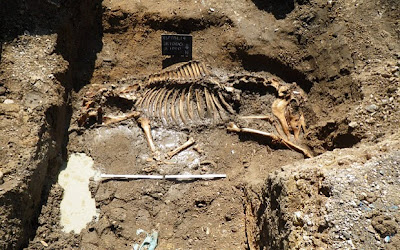
British horse-lovers are hoping that the intact skeleton discovered during the excavation for the new National Heritage Centre for Horseracing and Sporting Art in Newmarket, Suffolk, U.K., are the bones of legendary racehorse Doctor Syntax. On the one hand, this former site of the Royal stables of King Charles II was where the animal was euthanized in 1838, the skeleton matches his height (15 hands). the wear and tear on its joints indicates that it was ridden, and the horse was buried carefully in a specifically dug grave. On the other hand, the smashed skull does not give evidence of the shotgun blast that killed the horse, there is no trace of any other injuries on the skeleton, and the teeth show that the buried horse was 18 to 20 years old whereas Doctor Syntax is believed to have died at the age of 28. Archaeologist Chris Faine of Oxford Archaeology states, "It was certainly a racehorse, all the evidence points to that. I don't think it could be Doctor Syntax, but you would have to carry out DNA tests to make sure."
Thursday, December 11, 2014
Nazca no-no

Peru is seeking criminal charges against members of Greenpeace, who staged a publicity stunt on Monday intended for delegates from 190 countries attending U.N. climate talks being held in Lima. The government claims that the activists left footprints adjacent to the ancient Nazca lines after entering a prohibited area next to the figure of a hummingbird. They laid big yellow cloth letters reading, “Time for Change! The Future is Renewable.” The government does not disagree with the message. The issue is the way Greenpeace drew attention to it. Deputy Culture Minister Luis Jaime Castillo declares, "It’s a true slap in the face at everything Peruvians consider sacred."
Friday, December 5, 2014
Zigzag
It was just 7 years ago that Dutch archaeologist Josephine Joordens of Leidens University noticed the scratchings in the mussel shell above. The faint etching of zigzags was found among a trove of fossils excavated in 1891 by Dutch paleoanthropologist Eugène Dubois and dated to at least 430,000 years old. The implications of this are huge! Based on discovery of South African cave paintings made 70,000 to 100,000 years ago, the ability to create geometric art was thought to have begun with Homo sapiens and to mark behavioral modernity and cognitive uniqueness that later blossomed into creativity. But the markings on the shell were deliberately scratched by Homo erectus. Remarks American paleoanthropologist Pat Shipman of Pennsylvania State University, "This raises the big, hairy question of what is 'modern human behavior' all over again."

Friday, November 14, 2014
Fishermen's footprints
This image, which would otherwise be a beautiful piece of abstract art, is actually evidence of Stone Age activity in what is now Denmark. It contains two sets of ancient human footprints discovered during a construction project. Roughly 5,000 years ago, when the coastline was a series of inlets and rivers, a pair of fishermen repaired a post-and-wattle fish-trap that had been damaged in a storm. Archaeologist Terje Stafseth of the Museum Lolland-Falster believes these may be the first Stone Age footprints identified in Denmark.

Monday, November 3, 2014
De-iced diary
Global climate change is causing snow melts at the frozen huts of the early 20th c. Antarctic explorers, revealing Ernest Shackleton's whiskey and photographic negatives from Robert F. Scott's ill-fated Terra Nova expedition. British photographer, surgeon, and zoologist George Murray Levick was a surviving member of that expedition that took Scott's life. Now, more than a century later, the notebook he left behind has been recovered from the melting snow. While it doesn't contain his observations on the sex lives of penguins, it does include lists of dates, subjects, and exposure details that historians can now use to cross-reference with the images in the Scott Polar Research Institute collection at Cambridge. The notebook, which is still remarkably legible, is being conserved by the Antarctic Heritage Trust. After it is digitized, it will be sent back to join other artifacts – which it is thought would have remained frozen forever– in Scott's hut, the most southerly and least visited museum in the world.

Sunday, November 2, 2014
Teotihuacan tunnel
From a site located roughly 30 miles (50 km) northeast of Mexico City are emerging thousands of sacred objects leading archaeologists to believe they have discovered the entrance to a royal burial chamber. The 1,800-year-old tunnel beneath the ancient city of Teotihuacan is being excavated by remote-control robots and human researchers. They are hoping the wooden and obsidian artifacts – an estimated 50,000 of them – will provide clues about how the priests and rulers conceived the underworld, especially in the absence of written records. Archaeologist Sergio Gomez of Mexico's National Anthropology and History Institute is confident he and his colleagues will find a royal tomb at the end of the tunnel: "Due to the magnitude of the offerings that we've found, it can't be in any other place."

Monday, October 27, 2014
Terrible hands
In 1965, paleontologists excavating a 70-million-year-old sandstone formation in the Gobi desert found the arms of a new species of dinosaur. Beause they each measured 8' (2.4 m) long and ended in 8" (20 cm) claws, they named the beast Deinocheirus mirificus (Greek for “terrible hand, which is unusual”). After 50 years, a team of paleontologists led by Yuong-Nam Lee of the Korea Institute of Geoscience & Mineral Resources has made discoveries that allow them to piece together this creature – and have found it to be as strange as its arms are long. Its broad and lengthy duck-like snout and cavernous lower jaw housed a huge tongue. Inside the gullet were more than 1,400 gizzard stones, which it had swallowed to grind up its food like a bird. It was the size of a tyrannosaur, but couldn't move quickly and had no teeth. The ligaments growing from the spine worked like the cables of a suspension bridge to support the animal's huge abdomen and legs. And fused bones at the end of the tail indicate that it supported feathers (RENDERINGS HERE). Paleontologist Stephen Brusatte of the University of Edinburgh observes, "This alien creature was a monstrous omnivore, a garbage-disposal type of dinosaur that fed on fish, small vertebrates, plants, and probably about anything it could get its hands on.” Its terrible hands...

Thursday, October 23, 2014
Unmasked
Researcher Marleen De Meyer of the University of Leuven in Belgium was excavating Old Kingdom cave graves in Dayr al-Barsha, Egypt, when she turned over what she thought was a potsherd on the way to the storage tent. What she held in her hands was a rare 4,000-year-old death mask. Similar masks have long believed to have been modeled after the deceased, but the texturesof textile strips (IMAGE ABOVE, MORE HERE) suggested that the plaster had been applied to the face. But no traces of the face on the inside were visible, just clay. The archaeologists reasoned that the plaster mask was made and removed, then the body was mummified and clay applied to the face, after which the mask was pressed into that clay. They performed experimental archaeology, with a member of the team volunteering to be the corpse, and determined just that. They are now awaiting permission to carry out a CT scan of the artifact which will show the exact form of the ancient Egyptian's face sandwiched between the plaster and the clay.

Wednesday, October 22, 2014
Sphinx found
An Egyptian-style sphinx has been excavated… from the sands of Guadalupe, California, U.S. It is one of 21 that flanked the set of Cecil B DeMille's 1923 silent film "The Ten Commandments" (not the 1956 remake with Charlton Heston as Moses). After 90 years beneath the dunes, the sphinx needed special handling, which was good practice for the archaeology volunteers. To keep the paper-thin plaster of Paris from cracking, they wrapped it in cheesecloth soaked in a preservative chemical; funneled the sand out of the hollow statue and replaced it with expanding insulation foam; and allowed it to dry and shrink to its normal size (IMAGES HERE). That normal size of 15' (4.6 m) tall was dwarfed by the 12-story set. Executive director of the Guadalupe-Nipomo Dunes Center Doug Jenzen, who oversaw the excavation, explains that in the era before special effects, the movie required constructing one of the largest sets ever made: "...anything that they wanted to look large, they had to build large."

Sunday, October 19, 2014
Whether weather worshipped
A massive 3,300-year-old cult complex has been uncovered at the Tel Burna site in Israel. The courtyard alone measures 52' x 52' (16 x 16 m). Inside, researchers have discovered – among other things – a cylinder-shaped seal, goblets and chalices, broken figurines that look part-human and part-animal, and the noses of masks which were worn. The complex held huge jars likely imported from Cyprus and an Egyptian scarab (IMAGES HERE), with the possibility that they were used in the worship of the Canaanite storm god Baal. Says Israeli archaeologist Itzhaq Shai of Ariel University, "From the finds within the building, we can reconstruct the occurrence of feasts, indicated by several goblets and a large amount of animal bones. Some of these animal bones are burnt, probably indicating their use in some sacrificial activity. The presence of the pithoi [large jars] may indicate the collection of tithes, or at a minimum, the storage of foods for later use in cultic activities. Finally, the masks may suggest ceremonial processions that arrived or left from the complex, possibly before or after the conducting of feasts."
NOTE: I have been unable to upload photographs, so please follow the links to see the images.
Saturday, October 18, 2014
Norski
A receding glacier in Norway has revealed an almost complete ancient wooden ski. It measures 68" (172 cm) in length and 5.7" (14.5 cm) in width and has leather straps for securing the foot. The ski is estimated to be 1,300 years old, but the history of skiing dates much further back. Another ski found in Norway dates to 3200 B.C.E. and a ski found in Sweden dates to 3300 B.C.E. But even those are trumped by a ski found in Russia which may be 8,300 years old!
Indonesian images
For decades, archaeologists have known about cave paintings (IMAGES HERE) on the island of Sulawesi east of Borneo. They were believed to have been created either by the region's first farmers a few thousand years ago or by hunter-gatherers around 8,000 years ago. But recent testing proves that they rival the images in Spain and France as the oldest cave art. Archaeologist and geochemist Maxime Aubert of Australia's Griffith University explains, "It was previously thought that Western Europe was the centerpiece of a 'symbolic explosion' in early human artistic activity, such as cave painting and other forms of image making, including figurative art, around 40,000 years ago. However, our findings show that cave art was made at opposite ends of the Pleistocene Eurasian world at about the same time, suggesting these practices have deeper origins — perhaps in Africa before our species left this continent and spread across the globe."
Subscribe to:
Posts (Atom)


