Scientists from the University of Massachusetts Amherst have just conclusively proven that the 4.2 ounce (12 g) white-throated, black-capped blackpoll warbler flies non-stop the 1,700 miles (1056 km) from New England to South America during its autumn migration. Not only that, it can do so with a .02 ounce (.57 g) geolocator on its back.
(I'm sorry I don't have the energy to correct the font.)
Showing posts with label animals. Show all posts
Showing posts with label animals. Show all posts
Friday, April 3, 2015

 Posted with Blogsy
Wednesday, April 1, 2015
Spiky croaker

"I was so mad at myself! I thought I had brought back the wrong frog," says biologist Katherine Krynak, who was surveying amphibian species in the Reserva Las Gralarias in Ecuador. The marble-sized creature was spiky when she spotted it, but smooth when she examined it back at the labr. In fact, she had discovered the first vertebrate species known to change its skin texture.t


Saturday, March 28, 2015
Fey ray
Diver Josh Stewart was trying to photograph the belly of a 15' (4.6 m) manta ray off the coast of Peru as part of a long-term identification project for Manta Trust when he found himself being tucked up and somersaulted. He describes, "I was just swimming down as I usually do to capture a manta ID shot and before I knew it, I was engulfed in the wings of this massive manta as I tumbled through the water. I suffered no injuries but it was certainly a big surprise.” (VIDEO HERE)

Friday, March 27, 2015
Quadruplet cows
A one in a million birth has occurred in Dekalb, Texas, U.S. The actual odds of a cow giving birth to four live calves is one in 11.2 million, but that is exactly what has happened to a run-of-the-mill red cow, as she is described by owners Jimmy and Dora Rumsey-Barling. In his 18-year career, local veterinarian Michael Baird has delivered twin, multiple, and even conjoined calves but has never seen anything like it. He remarks, "This is truly an amazing event if you are into this sort of thing.”

Thursday, March 26, 2015
Extra terrestrials
Two tiny examples of colorful Indonesian "vampire crabs" have been identified as new species, even though they have been known in the aquarium trade for many years. With bright purple or stunning orange claws and intense yellow eyes, the land crabs make popular pets, which is why competing dealers have kept the location where they find them so secret. The scientists found their habitat in Java, and as study co-author Christoph Schubart says of the dealers, "They start collecting in areas where scientists may not have made any expeditions so far, and suddenly the market is formed with some animals that no one has ever given a name.”

Wednesday, March 25, 2015
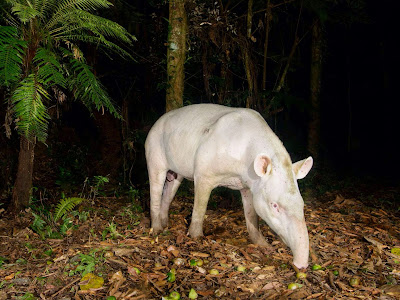
Tapir pallor
National Geographic contributing photographer Luciano Candisani set out to capture on film the legendary albino tapir said to roam the rainforest of southeastern Brazil. While unsuccessfully stalking the creature under cover of darkness, he met with success after setting up a camera trap, and describes, "My heart skipped a beat when, while reviewing the photos from one night, the white tapir suddenly appeared in one of the frames."
Tuesday, March 24, 2015
Beefy beakfuls
For reasons unknown, the rainbow lorikeets patronizing a backyard bird feeder north of Brisbane, Australia, have become carnivores. Instead of partaking in the seed meant for vegetarian birds including galahs, king parrots, and the lorikeets, they have been gorging themselves on the minced meat set out for magpies, currawongs, and kookaburras. Licensed wildlife carer Fran Sanders exclaims, "I'm absolutely amazed and horrified."

Sunday, March 22, 2015
Underserved in Amsterdam
A few years ago, Amsterdam couple Rob Hagenouw and Nicolle Schatborn started a food truck they call "Keuken van het Ongewenst Dier" (“The Kitchen of the Unwanted Animal”) to sell the meat that nobody wants in an effort to reduce unnecessary food waste. They offer up goose croquettes, pigeon rolls, and muskrat, with plans to extend the menu to include fallow deer, black crow, and parakeet. But their most popular item is the horse meat burger. Hagenouw describes. "'Ah, they have My Little Pony burgers,' little girls will say. Most of the time the girls eat the burgers; it's the mothers who don't like it."

Wednesday, March 18, 2015
Colossal creature

"For the most part they are a gentle giant," says television host Jeff Corwin (UPPER RIGHT) of the giant stingray caught in Thailand’s Mae Klong River. With the help of a team including veterinarian Nantarika Chansue (LEFT) of Chulalongkorn University in Bangkok, he measured the record-breaking ray at 7.9' (2.4 m) across and 14' (4.3 m) long, with a weight estimated at up to 800 lbs (363 kg). In addition to its size, what does this specimen have in common with the 13-footer caught by aquatic ecologist Zeb Hogan in Cambodia? They were both released back into the wild.
Friday, March 13, 2015
Turtle tummy
Professor of photographic sciences Ted Kinsman of the Rochester Institute of Technology in New York picked up a dead snapping turtle from the side of the road, x-rayed it, added false color to the 30 eggs he found inside, and won the Expert's Choice award for Photography at the 2015 Vizzies (SEE THE OTHER WINNING PHOTOGRAPHS HERE.)

Thursday, March 12, 2015
Baltimore birds
Have a bird's-eye view of Baltimore from 33 stories up on a ledge of the Transamerica Building, where the latest generation of peregrine falcons has taken up residence. The Chesapeake Conservancy has provided a live feed.

Tuesday, March 10, 2015
Bird ballet
The photo above shows a "murmurration" of starlings performing their synchronized aerial ballet in the sky above Utrecht, Netherlands. A group of statistical physicists figured out the how, but GrrlScientist explains the why: "Birds form these large flocks to protect themselves from predators, to share information regarding food sources, and to find mates for the upcoming breeding season." Follow the link for a mesmerizing video.

Sunday, March 8, 2015
Octoportrait
This is the result of an octopus turning the tables on digital media producer Ben Savard of Middlebury College in Vermont, U.S., when he was documenting the animals studied in the Neuroscience Department. He relates, "I put a GoPro in a waterproof casing, set it to take a rapid number of photos per second and, with the help of the neuroscience student behind me in the photos, placed the camera in the octopus tank. We did this a few times with different octopuses and one of the more cheeky cephalopods grabbed the camera and turned it around on me for a quick couple of pictures."

Saturday, March 7, 2015
Weasel on the wing

Amateur British photographer Martin Le-May was at Hornchurch Country Park in east London when he captured the almost unbelievable sight of a weasel riding on the back of a green woodpecker as it flies through the air. Wildlife expert Lucy Cooke explains: "This is a truly extraordinary image. The green woodpecker is a ground-feeding bird, but weasels normally attack rabbits. The woodpecker is not its usual prey. But weasels are fearless. A female weasel weighs less than a Mars Bar but is as ferocious as a lion, so this is why the woodpecker would have been able to take off with it on its back."
Saturday, February 28, 2015
Flaying frogs
It was in 1987 that a lawsuit brought by 15-year-old Jenifer Graham of Victorville, California, U.S., resulted in several states offering an alternative to the dissection of frogs in science class. But for many middle school students, it is still a rite of passage and for good reason, according to David Evans, Executive Director of the National Science Teachers Association. Not only does the anatomy extrapolate to the human body, but it's hands-on: "There's something visceral and important about the real thing. What does this particular organ feel like? How stiff is it? Is it compressible?"

Friday, February 20, 2015
Lowly limpet
The humble rock-scouring limpet, which is not as storied as the barnacle, now has a claim to fame. The teeth of the snail-like creature are believed to be the strongest natural material yet found on the planet. British researcher Asa Barber of the University of Portsmouth says of the newly announced superlative, "Until now, we thought that spider silk was the strongest biological material because of its super-strength and potential applications in everything from bulletproof vests to computer electronics, but now we have discovered that limpet teeth exhibit a strength that is potentially higher.”

Saturday, February 14, 2015
Antler amputation

When Minnesota, U.S., residents called to report 2 deer whose antlers were tangled in the woods behind their houses, the responding officers were surprised to find that one of the bucks was still alive. Policeman Ricky Syhre commented, "They must have been stuck together like that for hours." He and his colleagues used a Taser to subdue the animal, and an electric saw to quickly cut away its antler (VIDEO HERE). The successful rival walked off and will shed and grow another pair of antlers in time for the next rutting season.
Monday, February 9, 2015
Birds of (poisoned) prey
Bald eagles in Florida saved a step by eating some already dead animals at the local landfill. But this should not have caused them to sicken and die. That was the fault of shortcuts taken by the Marion County animal shelter, which by law was supposed to incinerate or bury pets that had been put down. The Ocala Post reports of one necropsy, "Test results showed the eagle had been poisoned with pentobarbital, a drug commonly used by veterinarians to euthanize animfals."

Monday, February 2, 2015
Scorpion sans sting
What is this, you ask? It is the south end of a scorpion going north, a scorpion that has ditched its tail. Biologist Camilo Mattoni of the National University of Cordoba in Argentina has found that a group of rare South American scorpions practice autotomy, that is they can voluntarily self-amputate their tails to escape danger. Mattoni has observed that up to 8% of wild Ananteris scorpions are wandering about with stumps instead of stings. They survive for about 8 months. They can get by without their main defense mechanism, but not without their anus. It is located in one of the segments which breaks off, consequently they can never defecate again and their abdomens swell up with poop. The females, with young to care for, avoid this sordid fate, but males still have the better part of year to sow their seed before they succumb.

Sunday, February 1, 2015
Hephalumps harrumphing
Residents of the Elephant Sanctuary in Tennessee, U.S., enjoying the snow (VIDEO HERE). That is all.

Subscribe to:
Posts (Atom)


