Showing posts with label skulls. Show all posts

Tuesday, January 3, 2012

Noma's negative space


Noma Bar (b. 1973 in Israel) is a London-based graphic designer whose work you may be familiar with, even if you don't know his name, since over 550 of his illustrations - including more than 60 magazine covers - have been appeared in publications including The Economist, Esquire, and The Guardian. Of his stark style, he says, “I am after the maximum communication with minimum elements.” This is demonstrated by the illustrations above: "Malaria" and "The Ultimate Spider Hunter." Bar is a master at the use of negative space, as the agency that represents him describes: "With a limited pallet he subtly and precisely manipulates shape and form where familiar symbols and pictograms evolve to form new meaning. Negative and positive spaces tessellate creating several images in one, that sometimes need a few moments to see the embedded, sometimes poignant, message." Noma Bar has published a book about his very effective technique which the publisher says "showcases Bar’s singular ability to render complex issues of public policy, global economics, race relations, politics, sex, crime and national identity with deftly selected lines and colors." I just put name and artwork (more examples here, here, and here) together after seeing Noma Bar represented in the engaging and beautifully-produced The Book of Skulls that I received for Christmas from my friend Deb - and that I'm sure will lead to further posts...

Thursday, July 7, 2011

Skull surfaces


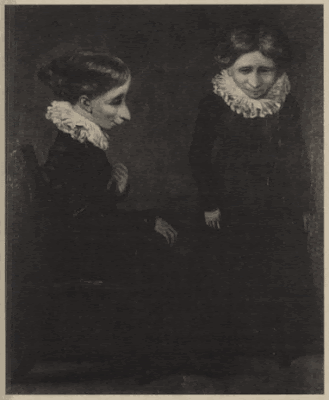
Presbyterian widow Julia Martha Thomas lived just 90m from a pub called the Hole in the Wall in the Richmond area of South London. She hired heavy-drinking Irish-born Kate Webster (3rd image), a former thief and prostitute, as a housekeeper. Webster intimidated Thomas with her size and temper, and they were heard to argue. Only 2 months after Webster came to work for her, Mrs. Thomas resolved to fire Webster and promptly disappeared. The housekeeper explained away her absence, sold off her belongings, and fled. In actuality, she had murdered her employer by throwing her down the stairs and strangling her. Webster dismembered the body, packed it in a box, and threw it into the river. The box washed up on the shore of the Thames near Barnes Bridge. Police were able to identify the victim even though her head was missing. Rumors spread that the murderess had boiled the body to make it easier to cut up, and had fed the "drippings" to 2 boys who ate it, believing it to be pig's lard. Webster was found wearing Mrs. Thomas' clothes and jewels. She was convicted and finally confessed, "We had an argument which ripened into a quarrel, and in the height of my anger and rage I threw her from the top of the stairs to the ground floor. She had a heavy fall. I felt that she was seriously injured and I became agitated at what had happened, lost all control of myself and to prevent her screaming or getting me into trouble, I caught her by the throat and in the struggle choked her." Webster claimed to be pregnant to avoid execution, but was found to be lying and was hanged in 1879 at Wandsworth prison in London.

Flash forward 132 years to the garden (1st image) of British broadcaster and naturalist David Attenborough (watch clips here). Now retired, 85-year-old Attenborough (2nd image, observing a golden frog) decided to add an extension to his £1.5million West London home. During the excavation (photo here) of an old pub in the garden, contractors discovered human remains and reported it to the authorities. A skull was handed over to the University of Edinburgh for examination. Physical anthropologists determined that it belonged to an edentulous white female of roughly menopausal age and displayed fracture marks consistent with a fall down some stairs. Testing of the damaged skull (photo here) revealed that the woman died between 1650 and 1880, and that she ate a lot of fish. Collagen levels showed that her skull had been boiled. Matching the evidence with census records of the time, West London Coroner Alison Thompson confirmed that the remains were those of Julia Martha Thomas, who had died at the age of 55 from asphyxiation and a head injury. A total of 132 years after the crime, Thompson delivered a verdict of unlawful killing. No family of Mrs. Thomas could be traced, but she can now be given a proper burial. "This is a fascinating case and a good example of how good old-fashioned detective work, historical records and technological advances came together to solve the 'Barnes mystery,'" said Clive Chalk, chief superintendent of Scotland Yard.

Wednesday, January 12, 2011

Skulls and boxes


2010: Workers cleaning out the basement of a 3-story apartment building in the Mission Hill neighborhood of Boston discovered a box containing 2 human skulls. They brought it out to the street (1st image) and notified police, who responded shortly after noon. By then, the skulls had been spotted by 22-year-old Northeastern University biochemistry student Alden Ladd, who described them as nasty and old, and revealed (unbelievably to me), “I’ve never seen an actual human skull in my life before.’’ Slightly less horrified by the sight was nearby resident Paul Hamblin, 28, an Iraq war veteran. But the least surprised of all was Massachusetts College of Art and Design student Lindsay Rougeau, 21, who noted, "We happen to be around a lot of medical schools." Police detectives and the state medical examiner’s office are examining the skulls, which may be anatomical specimens - although they don't appear to me to have been cleaned or articulated.

1974
: A human skull was found submerged in 4" of water on the Gulf Coast of Florida. The skull (2nd image) was examined by the FBI, but returned to the Bradenton Police Department when its identity could not be determined. It was wrapped in newspaper, put in a box, and placed on a shelf in the evidence locker. There it languished for upwards of 35 years until last week, when detectives rediscovered it in an attempt to crack cold cases. Although any records relating to the possible missing person case have been lost or destroyed, Deputy Chief William Tokajer asserts, “We hope to, if we can figure out who this person was, give some family closure. It won't be easy. But we're gonna try.”

1879: Coal porter Henry Wheatley and a companion were driving their horse and cart along the Thames in South London. As they reached Barnes Bridge, they noticed a wooden box lying half-submerged in the water and hauled it with difficulty on to the bank. Wheatley cut off the cord and kicked the box open. Out tumbled a mass of white flesh. Suspecting that they were the remains of a dismembered woman, Wheatley immediately reported his find to the police. The pathologist confirmed that the parts belonged to a short, stout woman whose body had been cut apart with a meat saw and possibly boiled. Missing were the head, which was not located, and a foot, which turned up 5 days later and 5 miles away. Within a few weeks, police identified the body as that of Julia Martha Thomas of Richmond. The 50-year-old had been murdered by her 30-year-old servant, an Irish ex-convict named Katherine Webster, when she returned from church to find her drunk. Webster had pushed Thomas down the stairs, strangled her, and dismembered her over the next 24 hours. Her attempts to do away with her victim's body by boiling and burning it failed, but she succeeded in assuming the older woman's identity. Webster - now going by the name of Porter - boxed up her victim's remains and threw them off Hammersmith Bridge. She then attempted to sell the house and its contents. Katherine Webster's scheme was found out by a potential buyer and she was arrested, tried, and convicted. She refused to confess until the night before she was hanged at Wandsworth Prison - but she never divulged the location of her employer's head. Another mystery...

...until 2010: Workmen British broadcaster and naturalist Sir David Attenborough had hired to build an extension on his Richmond home unearthed a skull in the garden. It is almost certainly that of the victim of the "Richmond Murder," Mrs. Thomas.

Wednesday, December 15, 2010

Head of Henri IV


Well-loved King Henri IV of France (1553-1610) narrowly escaped the death suffered by thousands of Protestants who had gathered for his wedding to his 1st wife, Marguerite of Valois (1553-1615) in 1572. The king (1st image) was on his way to the coronation ceremony of his 2nd wife Marie de' Medici (1575-1642) in 1610 when he was killed by an assassin (2nd image). Henri was laid to rest in the Basilica of Saint Denis (3rd image), but during the French Revolution in 1793, the royal graves were desecrated. Revolutionaries chopped off Henri's head before dumping his body in a mass grave with the other kings and queens. His embalmed head was snatched and has remained in private hands ever since. It is now mummified (photos here), with soft tissues and internal structures intact. Although the DNA from the few hairs remaining on his chin was too degraded to analyze, 19 researchers in France have announced that they have identified the head through other means:
  • Radiocarbon testing confirms that the head dates from the 17th c.
  • A healed bone fracture above the upper left jaw matches a stab wound the king suffered during a 1594 assassination attempt.
  • The lobe of the left ear is pierced and he is depicted wearing an earring.
  • A dark lesion observed above the right nostril is seen in many of the king's portraits.
  • Perfumers on the team used their professionally trained noses to identify specific embalming substances noted in an autopsy report written by the king's surgeon.
  • A digital facial reconstruction from all known portraits of Henry IV and his death mask matches CT scans of the skull.
Next year, France will hold a national funeral for Henry IV, after which his head will be replaced in his tomb in Saint Denis.

Sunday, January 31, 2010

Overmodeled skulls

1st image: The surviving facial portion of a Columbian overmodeled skull. Photo by Felipe Cardenas-Arroyo and the Columbian Institute of Anthropology and History (ICANH). 2nd image: Overmodeled skull from the New Hebrides island of Malakula, Vanuatu. 3rd image: Overmodeled skull from Vanuatu exhibiting intentional cranial deformation. 4th image: Overmodeled skull from Vanuatu with human hair wig anchored with vegetal cords and spider web. Photos by Rob Roy, courtesy of Andrea Kirkpatrick and the New Brunswick Museum, St. John, NB, Canada.

To overmodel a human skull is to apply a malleable substance to the bare bone of its facial aspect and to sculpt the outer surface to resemble the soft tissue and appearance of a human countenance, as has been done to the skulls in the photographs above. This turquoise skull from Mexico does not fit the definition, because it is merely decorated, and neither do death masks. Now that we've clarified that, let me tell you about a new book:

Art Auferheide, legendary paleopathologist and professor emeritus at the University of Minnesota Medical School, has examined more mummies than anyone on earth and wrote the encyclopedic The Scientific Study of Mummies. Several years ago, he turned his attention to a specific type of skull mask or trophy sometimes seen with the mummies he has studied and he has just published Overmodeled Skulls. Traveling both hemispheres, tapping the knowledge of museum curators, and seeking the contributions of archaeologists, anthropologists, and ethnologists, Dr. Aufderheide fills in the gap between the skulls from Jericho (7,000 B.C.) and those from modern Melanesia (where overmodeling has been practiced in living memory): the secular and spiritual myths behind the customs and of course the meticulous crafting of these sometimes sinister and sometimes comical objects.

The stated purpose of the book is to identify all known or reported examples of overmodeling and to gather the existing ethnological, historical, and archaeological information about each of the dozen cultures - spread apart geographically (among them Papua New Guinea, Colombia, Egypt, and Ukraine) and chronologically (Neolithic to now) – which practiced this mortuary ritual. The compilation of all this material was no mean feat. The scientific collection of specimens commodified (and therefore presumably tainted) overmodeling and probably encouraged stealing skulls from local burial grounds. In addition, procurement from non-literate societies by other than systematic excavation (for instance, by purchase, donation, or confiscation) makes the specimens difficult to interpret.

The stories of skull overmodeling involve ancestor veneration, funerary rituals, skull cults, secret societies, initiation ceremonies, exhumation and excarnation, trophy skulls, headhunting raids, and trepanation. These sculpted skulls were used to remember, to divine, to harness the powers of the dead. The general reader, who will find the size of the type very friendly and will have access to glossaries for a couple of the chapters, will be intrigued by data gathered by an anthropologist who lived with one tribe from 1876 to 1906 and by descriptions of the practice of cranial deformation, the related creation of mortuary effigies and skull puppets, and the preparation of the Chinchorro mummies of northern Chile. The scientist will have a thorough bibliography, a synopsis of the geographic and environmental motivators of the custom, the anthropological analysis of 39 of the skulls, and the results of CT scans, dental analysis, and radio-carbon dating. A majority – but not all - of the skulls are adult males, most had crudely shaped ears, many had wigs, several were meant to be worn as masks, some held the mandible in place with string and had lost teeth replaced. They were in part portraiture, as evidenced by the modeling of a harelip and the reproduction of correctly-proportioned noses.

Overmodeled Skulls is distributed by Jim Castner's Feline Press for $75 plus shipping. Its 360 pages contain 140 color photographs. Recommended, and if you want to get a discount, order it in combination with Castner's equally fascinating Shrunken Heads ($100 for both, plus shipping). Good reads – and, they'll be a provocative addition to your coffee table!

Saturday, January 23, 2010

Trepanation

An illustration by Italian physician, anatomist, and inventor Guido of Vigevano (c. 1280-1349) depicting his idealized impression of the ancient technique of trepanation.

I have been meaning to do a post about trepanation and the news article I saw this morning about removing part of the skull to facilitate better brain scans is my catalyst. Trepanation (also known as trephination) is the intentional perforation of the skull, by gouging, cutting, scraping, or drilling a hole (caution). It is the oldest known surgery, dating back 10,000 years to the Stone Age. The ancient peoples of what are now Peru and Bolivia were particularly good at it - and did it in some cases to relieve the pressure of depressed fractures received in battle and in other cases ostensibly to release the malicious spirit causing a particular illness. An hour-long documentary about the procedure is available and the website is worth checking out, even though the link to the trailer seems misdirected.

I first heard of this surgery in the context of archaeology and paleopathology. I learned that physical anthroplogists can easily tell from an ancient trepanned skull whether the patient survived by examining the bone growth at the margins of the hole. It was shortly thereafter, due to my interest in weird news, that I found out about modern trepanning and the surprising number of do-it-yourselfers. The anecdotal evidence is that the self-surgery expands the consciousness in increasing the blood flow and cures ailments like depression and chronic fatigue syndrome. The positive effects have been experienced by Robert Lund of Brooklyn, who was trepanned involuntarily in the hospital after a brutal mugging. The International Trepanation Advocacy Group (ITAG) has led the movement to study the benefits of trepanation and to make it available as a voluntary procedure by the medical establishment once they are able to document the improved cerebral circulation.

Trepanation may yet enter mainstream medicine. While it has been used for years to relieve epidural and subdural haematoma, it is now being studied as a possible treatment for dementia and Alzheimer's disease.

Saturday, January 9, 2010

Follow-ups

Good cove, bad cove 1/6/10 The Japanese are big tuna-eaters and that species is also facing extinction. A 512lb bluefin recently sold for $175,000 at a Tokyo fish market, although Japanophiles don't find that weird.

Follow-ups 12/22/09 In my last set of follow-ups, I linked to instances of birds wearing clothing, and up pops a story about members of a Welsh knitting circle who make sweaters for chickens.

Bob Waldmire 12/17/09 A follow-up about the "king of the road" in the Wall Street Journal.

Octopus achievement 12/15/09 Octopuses are inexplicably washing up dead on the beaches of Vila Nova de Gaia, Portugal.

Toenails (or lack thereof) 11/7/09 A toenail has been put up for bid at a charity auction in New Zealand that is raising money for the local food bank!

Birds in fable and fact 10/22/09 British scientists have found that fish will punish other fish for bad manners.

Lizard lore 10/17/09 Someone has invented a way for humans to walk on water like the basilisk lizard - behold the Aqua Skipper. In other lizard news, it has been getting so cold here in Florida that the iguanas are falling out of the trees.

Birthing and hoarding bunnies 6/18/09 A man in Chelsea, Massachusetts, has been convicted of animal cruelty for having sex with his roommate's rabbit.

Stain 8/6/09 Tsutomu Yamaguchi, the only person officially recognized as a survivor of both the Hiroshima and Nagasaki atomic bombings at the end of World War II, has died at age 93.

Capitol cornerstone 7/26/09 The opening of a 1952 time capsule in Virginia has been postponed indefinitely after it was found that the floor tiles surrounding it may contain asbestos.

Frogs, deformed and fanciful 6/26/09 A salmonella outbreak that affected 85 people across 31 states has been linked to the improper handling of frogs.

Skellies 4/29/09 Bone trophies from Yale University's mysterious Skull and Bones society - including a skull that was used as a ballot box - go on auction in New York this month.

Pirates 4/15/09 The state archaeologist of North Carolina has admitted that he did not follow proper procedure when he unearthed the remains of a man believed to be a member of Blackbeard’s pirate crew.

Footprints 2/28/09 Paleontologists have found footprints of the 1st marine creature to emerge from the ocean and walk on land - and they date back 20 million years earlier than previously thought.

Graduate weird news 2/5/09 The University of Victoria, Canada, will finally be allowed to evict a man from its dorms - 13 years after he graduated. Meanwhile, a proprosal by Regis College in Weston, Massachusetts, to build a senior citizen residential and educational complex - to be considered student housing - has been struck down.

Polydactyly 2/3/09 A 4-year-old Chines girl has 5 fingers on her left hand and 6 fingers on her right hand (pictured) - no thumbs.

Diagnosing the canvas 1/2/09 An Italian doctor sees signs of high cholesterol in the "Mona Lisa."

Ice swimmers 11/20/08 In contrast to ice swimmers and members of "polar bear" clubs, a man from Brookfield, Massachusetts, does his ice fishing through a hole in the floorboard of his cozy limousine.

Albinos 11/18/09 Aside from the threat to albinos in Burundi and Tanzania, there is a danger to children in Uganda, who are being snatched and sacrificed by witch-doctors.

Animal extinction 11/9/08 Here is a list of the top 10 most endangered species in the world, according to the World Wildlife Fund. On another note, researchers at Oregon State University have determined that during the Cold War, there was less species invasion.

Skulls & Skeletons
9/18/08 My very first post was about my favorite peace-loving musician John Butler, who plays a mean banjo (and looks and sounds cool doing it). This Denver man, on the other hand, used his banjo as a weapon and has been charged with second-degree assault.

Monday, October 26, 2009

Horned Moses


It is St. Jerome (1st image - painting by Domenico Ghirlandaio, 1480) who is responsible for the depiction of Moses with horns (2nd image - sculpture by Michelangelo, 1515). When he translated the Bible, St. Jerome used the basic meaning of the Hebrew word qaran, "to grow horns," rather than the derived meaning "to emit rays." The passage was intended to mean that Moses' face was radiant and "dispersed beams like many horns and cones around his head" - in other words, he had a halo. The mistake was clarified by English author Sir Thomas Browne (1605-1682) in Pseudodoxia Epidemica, a vast reference work he wrote and revised several times to refute the common errors and superstitions of his age. A little morbid trivia about Sir Thomas: (1) He also wrote a book called Hydrotaphia, or Urn Burial in which he described the discovery of a Bronze Age urn burial in Norfolk, England; surveyed ancient and contemporary funerary and burial customs; and wrote an extensive and highly-regarded meditation on mortality, and (2) His skull (3rd image) became the subject of dispute when it was accidentally disinterred in 1840, stolen, sold, put on display, and finally - in 1922 - returned to the church for reburial.

Monday, September 21, 2009

Georgia O'Keeffe and bones

I watched the premiere of a 2-hour movie about American artist Georgia O'Keeffe (1887-1986) that airs again on Lifetime tomorrow night. Like the reviewers, I had some issues with it, but it is worth watching. The film prompted me to have another look at her skull paintings and to see what she said about bones:
.
.
.
.
In the process, I found the portraits above in which O'Keeffe is depicted with vertebrae and skulls. None of these was taken by her husband, American photographer Alfred Stieglitz (1864-1946). The 1st was taken by Philippe Hausman in 1967, the 2nd by John Candelario in 1942, and the 3rd by Arnold Newman in 1968.

Wednesday, July 8, 2009

Sarah Bernhardt


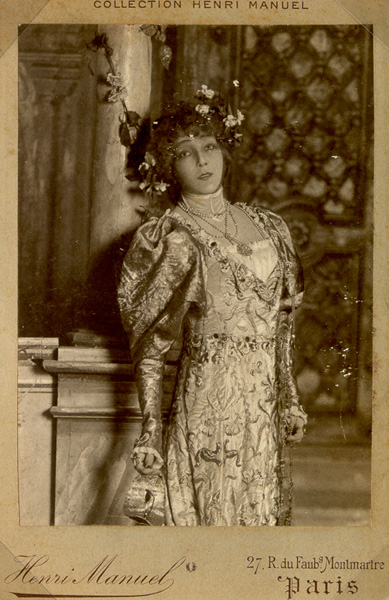
French actress Sarah Bernhardt (1944-1923) was mentioned yesterday as an early example of celebrity eccentricity. The "Divine Sarah" became famous for her stage performances - particularly her death scenes (although this one in her film debut in 1900 is said to be rather restrained). She was known to embellish the truth when talking about her own life, but her peculiarities have been documented by many biographers. She was entranced by skulls and bats. She loved wild animals and at one time had a pet lion and 6 chameleons. Early in her career, she purchased and began sleeping in a coffin to better understand her tragic roles. In fact, she preferred roles in which the character dies at the end. (When she played one such role before a boisterous American audience, she said, "If they don't keep quiet, I'll die in the second act.") She played both male and female parts, and was in fact openly bisexual. She acted without a prosthetic limb after her leg was amputated in 1915 (and refused an offer of $10,000 to exhibit the severed limb as a medical curiosity). She loved chairs and filled every house she ever lived in with them. She married Greek actor Aristides "Jacques" Damala (1855-1889), and after his early death always signed her name as "Sarah Bernhardt, Veuve [Widow] Damala." Bernhardt was recorded by Thomas Edison, photographed by Nadar, and friends (and sometimes lovers) with the luminaries of her day. She wrongly believed she would die young, but attained the age of 88. She died of uremia and is buried at Pere Lachaise cemetery in Paris.

Friday, May 8, 2009

The Bone Room

The Bone Room is a retail store in Berkeley, California, that also does mail order business - through which I've purchased a number of specimens for my Museum. The linked video makes me want to browse in person, but I would also need a big budget! I've picked up the following directly from their e-newsletter:

"The Bone Room on film- The Bone Room was recently visited by students from Berkeley's Knight Digital Media Center, working on a project for their multimedia workshop. The students had a fine time filming, taking photographs, and generally enjoying the shop. You can watch the piece they put together HERE."

Tuesday, April 28, 2009

Grateful Dead logo


I used to listen to the Grateful Dead a lot in high school (and still enjoy their greatest hits now and then). Being the morbid person that I am, I liked their logos and album artwork - lots of skulls and skeletons! I always thought the image at the top to be a highly stylized and distorted drawing of the human skull, but when I was searching through a library book as an undergraduate, I found a drawing that was anatomically accurate and very similar. Of course, I can't find a similar drawing on the web despite an hour's search, but did find the above photograph. You can see that from above, with the cranium removed, the Dead logo is not far off the mark!

Friday, April 17, 2009

James G. Mundie's cabinet


I could have spent hours deciding which of James G. Mundie's drawings to feature! His Cabinet of Curiosities is fascinating and includes his sketches from - among other collections - the Mütter Museum. The drawing above is the skull of Caroline Crachami (1815?-1824), whose skeleton is on display in the Hunterian Museum at the Royal College of Surgeons of England. Known as the "Sicilian Fairy," Caroline measured 8" at birth and 19 1/2" at death, and was the first person medically diagnosed with what is now called primordial dwarfism. She was displayed on stage, died while on exhibit in London, and autopsied and dissected before her father could claim her remains. They had been sold to anatomist John Hunter (1728-1793) for $500 and now reside next to the articulated bones of 7' 7" Charles Byrne (1761-1783), whose remains had also been obtained by Hunter - against the wishes of the "Irish Giant." Byrne, too, has been beautifully drawn by Mundie:

Tuesday, April 14, 2009

Art of Scott Campbell

Scott Campbell is a tattoo artist who also works in other media. His art - including these laser-etched stacks of $1 bills - are currently being shown at O.H.W.O.W. Gallery in Miami, Florida.


Sunday, December 7, 2008

Cleaning skulls is a dirty job

One of my favorite TV programs is Dirty Jobs. My favorite purveyor of animal bones is Skulls Unlimited. So imagine my delight when the two intersected! In 2005, host Mike Rowe went to help owner Jay Villemarette clean animal skulls. As the video shows, this involves hot water, a chemical bath, and dermestid beetles.

Thursday, December 4, 2008

Vanitas paintings


"Memento mori" ("Remember you must die") was the theme of the address I gave at the Museum of Funeral Customs. My slideshow included images like these, some of them trompe-l'œil (trick the eye) paintings, some of them vanitas, all of them reminders of our mortality--warnings against excessive pride. The first image is an illustration "All is Vanity" (1892) by C. Allan Gilbert. The second is a painting "The Ambassadors" (1533) by Hans Holbein the Younger - the anamorphosed skull in the foreground would look like this if it weren't stretched out. The third is a painting called "Still Life: An Allegory of the Vanities of Human Life" (c. 1640) by Harmen Steenwyck. And the last is a print "Eye" (1946) by M.C. Escher.

Tuesday, November 25, 2008

Traumatic skull injuries

I heard a passing reference on the news this morning about a boy who survived keys lodged in his eye socket (x-ray below). It reminded me of the classic story of Phineas Gage. Yesterday, I had an x-ray taken of my tooth, which I had the office e-mail to me so I could upload it. I've been unsuccessful with that so far, but offer the following strange images and stories:


Labels