Two species of ferns with tens of millions of years of evolution between them reproduced, creating a hybrid named Cystocarpium roskamianum, which botanists have always thought looked a bit strange. This unlikely pairing between a fern that grew on rocky outcrops and another fern that grew on the forest floor was confirmed by DNA analysis at the University of British Columbia. As researcher Carl Rothfels puts it, "A 60 million year divergence is approximately equivalent to a human mating with a lemur."
Showing posts with label Gardening. Show all posts
Showing posts with label Gardening. Show all posts
Thursday, February 26, 2015

 Posted with Blogsy
Monday, April 28, 2014
Pantomiming plant
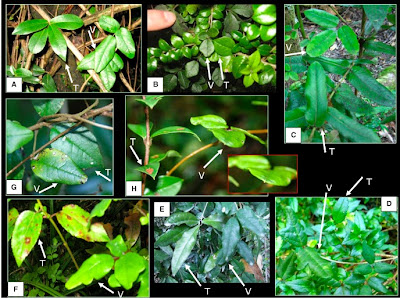
Earlier this month, I blogged about a first in the animal kingdom, discovered in Brazil. Now, South America has yielded a first in the plant kingdom. Native to Chile and Argentina is a woody vine called Boquila trifoliolata. While a few plants – including a type of mistletoe in Australia – can mimic another species, this vine is the first seen to transform its leaves to copy a number of different host trees. Mimetic polymorphism, as it is called, has previously only been observed in butterflies. B. trifoliolata's versatile leaves can change their size, shape, color, orientation, and even their vein patterns to match the surrounding foliage. If the vine crosses over to a second tree, it changes again, even if the new host leaves are 10 times bigger with a contrasting shape. The sophisticated camouflage defends against herbivores like weevils and leaf beetles, but the researchers point out that more study is needed since the vine doesn’t actually have to touch or climb the tree whose leaves it mimics; it only has to be near it.


Sunday, April 13, 2014
Self-contained
"It’s 6' from a window so gets a bit of sunlight. It grows towards the light so it gets turned round every so often so it grows evenly. Otherwise, it’s the definition of low-maintenance. I’ve never pruned it, it just seems to have grown to the limits of the bottle," says 80-year-old David Latimer of Cranleigh, Surrey, U.K.(IMAGE ABOVE), who has discovered the beauty of a terrarium. He has not had to water his thriving spiderwort in its sealed 10-gallon container since 1972 – 40 years ago!

Saturday, January 18, 2014
Horticultural heist
The smallest water lily in the world, the pygmy Rwandan water lily (Nymphaea thermarum), is described as just 1 cm wide with tiny satin white flowers and a butter yellow center. It was discovered growing in only a single location in Mashyuza, in southwest Rwanda, in 1987 by German botanist Professor Eberhard Fischer, but little more than 20 years later it disappeared with the destruction of its native habitat. Royal Botanic Gardens botanist Carlos Magdalena saved the plant from extinction by painstakingly cultivating a specimen from seeds kept in storage. The delicate flower could be seen at Kew Gardens just outside London – until January 9th, that is, when someone dug it up and carried it away. Director of Horticulture Richard Barley says, "You can’t put a price on it by virtue of its rarity. One can’t go down to the local garden centre and buy another one."

Monday, January 6, 2014
Angiosperm in amber
As usual, when I find a story about something fossilized in amber, I look no further… This time it's an angiosperm (flowering plant) discovered in the amber mines of Burma's Hukawng Valley. German and American scientists claim the newly-described flower (Micropetasos burmensis) is one of the most complete ever found in amber and the oldest evidence of sexual reproduction in a flowering plant. In the Cretaceous Period, 100 million years ago, flowers were still quite tiny, but were beginning to change the face of the earth, adding beauty, biodiversity, and food. The specimen (IMAGE ABOVE) includes a cluster of 18 tiny flowers, but - remarkably - captures the moment when 2 grains of pollen were penetrating the receptive part of the female reproductive system, which would lead to seed formation, had the act been completed. Professor emeritus George Poinar, Jr., of Oregon State University's Department of Integrative Biology explains, “In Cretaceous flowers we’ve never before seen a fossil that shows the pollen tube actually entering the stigma. This is the beauty of amber fossils. They are preserved so rapidly after entering the resin that structures such as pollen grains and tubes can be detected with a microscope.”

Monday, December 16, 2013
Anachronistic Osage orange
I don't remember what we called them when I was growing up in Illinois (hedge apples?), but I do remember some mischievous boys throwing the fruit of the Osage Orange at our car as we drove by. "In the fall, Osage-orange trees hang heavy with bright green, bumpy spheres the size of softballs, full of seeds and an unpalatable milky latex. They soon fall to the ground, where they rot, unused, unless a child decides to test their ballistic properties," reads an article with the tantalizing title "The Trees That Miss the Mammoths." The article goes on to explain that fleshiness and aromatic properties of the fruit entice large animals to eat them, pass through the seeds they contain, and deposit them – along with natural fertilizer – away from the parent tree. This evolutionary strategy worked beautifully in the age of the mammoths. Giant ground sloths and gomphotheres, one of the elephant's many interesting ancestors, gobbled up the fruit of the Osage apples and facilitated their propagation. But today, with the extinction of most megafauna, scientists were left with the "riddle of the rotting fruit," which remained on the ground beneath the tree or rolled downhill, sometimes carried away by water. Tropical ecologist Dan Janzen of the University of Pennsylvania and paleoecologist Paul Martin of the University of Arizona developed the concept of ecological anachronisms, organisms which persist despite their outdated adaptations. The pace of evolution is slow, but the disappearance of mammoths (at the hands of humans, according to many) was quick. The article concludes, "For a tree that lives, say, 250 years, 13,000 years represents only 52 generations. In an evolutionary sense, the trees don’t yet realize that the megafauna are gone."

Saturday, November 30, 2013
Mushrooms make wind
These are not the eggs of the great auk, but a bunch of shiitake mushrooms. Not only are they striking in color and pattern, but in their newly identified ability. As it turns out, shiitake and oyster mushrooms can make their own localized weather pattern! Whether or not there is a breeze to carry away their spores, the mushrooms are able to send them on their way. Researchers in fluid dynamics from Trinity College and UCLA confirmed the discovery using high-speed video cameras and mathematical models. "We show that fungi actively manipulate their local fluidic environment by altering the buoyancy of the air surrounding the mushroom using a combination of water vapor and active cooling," write the scientists in their abstract. In other words, before they disperse their spores, mushrooms release water vapor which cools the air around them and causes a convective dynamic that gets the air moving. This allows them to propagate even when the air is calm, they are growing close together, and their caps are only millimeters from the ground.

Tuesday, October 1, 2013
Apple family tree

British horticulturist Paul Barnett has spent the last 24 years cultivating a total of 250 varieties of apples in his back garden in Chidham, West Sussex. Inspired by the nursery where he worked, he decided to grow dozens of varieties of eating, cooking, and cider apples, including Granny Smith, Golden Delicious, Brownlees Russet, Wadhurst Pippin, Winter Gem, and historical varieties like Withington Fillbasket (1883) and Eady’s Magnum (1908). But because he didn't have the space to grow them in rows, he simply added branches to his existing tree (IMAGE ABOVE), which now stands 6 m (20') tall and requires support (and a label for each branch!). Barnett explains, "I wanted to grow my own trees but I didn’t have the area to plant that number so I started a 'family tree' where I can have all the different varieties in a smaller amount of space. I add to it each year by budding in the summer and grafting in the winter."
Friday, June 21, 2013
Plant with a palate for mutton

The Royal Horticultural Society at Wisley in Surrey, England, has been trying to coax a Chilean plant to bloom for 15 years and it's finally about to do so. The Puya chilensis is native to the Andes and has a special reputation. It is tall (the plant at the RHS stands 10' or 3 m), but that is not what is so noteworthy. And it is armed with spines (hooked spines which point inward and outward on its leaves and sharp spikes on its mace-like stalk), but that just helps get the job done. Like the Venus flytrap and other carnivorous plants the Puya has a taste for meat. It uses its razor-sharp weapons passively to snare and trap animals as large as sheep, which slowly starve to death at the base of the plant. As their bodies decay, the liquids sleep into the soil and provide nourishment. Says horticulturalist Cara Smith of the specimen in their greenhouse, "We keep it well fed with liquid fertiliser as feeding it on its natural diet might prove a bit problematic."
Thursday, May 30, 2013
Post-glacier regrowth

In 2007, researchers from the University of Alberta were collecting plant samples from the receding edges of the Teardrop Glacier in the Canadian Arctic. These included bryophytes (non-vascular land plants) that had been frozen for 400 to 600 years. Project leader Catherine La Farge describes, "As we walked up to the edge of the glacier, we could see patches of mosses that seemed to be coming out from underneath the ice. They were blackened, but there were also tints of green in there as well. As I looked more closely I thought, 'Oh my gosh, what's this? Either this has somehow managed to retain a vestige of its original color or it's just started to grow again after centuries under the ice.' The thought of that just blew my mind." The scientists were able to regrow 4 different taxa and thereby confirm that bryophytes are among the most resilient flora yet discovered. Since the bryophytes had frozen during the Little Ice Age - a period of cooling lasting a few centuries and ending in the 19th c., the researchers theorize that they played a strong role in recolonizing areas of the Canadian and Alaskan Arctic as they were revealed by glacier melt. The plants are still flourishing in a lab in Edmonton, and their wild cousins are sprouting along the foot of the Teardrop Glacier.
Subscribe to:
Posts (Atom)


