The axolotl, also known as the Mexican salamander (Ambystoma mexicanum) or Mexican walking fish is more colloquially known as Mexico's "water monster"– although it's hard to think of it as scary from images like the one above! The amphibian averages 9" (23 cm) in length, which easily fits in a zoo or research aquarium, but it is critically endangered in its only native habitat of the Xochimilco network of lakes and canals, which are suffering from pollution and urban sprawl. Scientists have created shelters of rocks and reeds to protect them from invasive species and pump in cleaner water, but they are disappearing at a rapid rate. Surveys by the Mexican Academy of Sciences found an average of 6,000 axolotls per square kilometer in 1998, 1,000 in 2003, and only 100 in 2008. Alarmed by the plummeting numbers, researchers plan to repeat the surveys during the axolotl's breeding season before they declare the animal extinct, but it may be only a matter of time. An attempt in 2013 by Mexico's National Autonomous University to net the creatures in the shallow, muddy waters of Xochimilco was described by biologist Armando Tovar Garza as "four months of sampling zero axolotls."
Friday, January 31, 2014

 Posted with Blogsy
Covert coral

A Canadian research vessel off Cape Desolation south of Ivittuut, Greenland, sent instruments down to a depth of 3,000' (900m) to collect water samples. When they pulled them back up, the instruments were destroyed, but on them were a few broken coral branches. Thus was discovered for the first time a coral reef in Greenland. Scientists had long known of ancient reefs in Norway and Iceland, and knew the currents were swift enough and the cold temperatures of the water were "warm" enough for coral to thrive in Iceland. But it took this happy accident – although the researchers were not happy about the smashed equipment at the time – to make the find. Another Canadian research vessel returned to the site last fall, but apparently the reef does not want to be studied. The image above is one of the few photographs they managed to take when they lowered a camera down onto the reef to explore it more closely. Doctoral student Helle Jørgensbye of Denmark's DTU Aqua describes, "We got some photos eventually, although we almost lost them at the bottom of the ocean as the camera got stuck fast somewhere down in the depths. Luckily we managed to get it loose again and back up to the surface."


Wednesday, January 29, 2014
Bones and scones

Not long after bones exhumed from a parking lot in Leicester, England, were confirmed to be those of King Richard II, the lost remains of England's first monarch, Alfred the Great (PICTURED ABOVE IN A BYZANTINE ICON), may have been found. The Anglo-Saxon king (849-899 A.D.) had initially been buried in Winchester Cathedral, but was later moved with his son Edward and his wife Alswitha to Hyde Abbey nearby. The location of his remains was lost to history when a prison was built over the Abbey in the 18th c. In an attempt to find them, archaeologists exhumed an unmarked grave at Saint Bartholomew's Church in Winchester, but the results were disappointing. They then "excavated" storage boxes from the archives of the Winchester City Museum that contained items excavated from Hyde Abbey in the 1990s. There the scientists from the University of Winchester may have found what they were looking for: a fragment of a pelvis bone (PHOTOS HERE). The radiocarbon date is right (895-1017 A.D.), the gender is right (male), and the age at death matches (between 26 and 45+ years). Another suggestive detail is that the bone was found near the monastery's High Altar, where only Alfred and Edward had been buried. The discovery of the 1,000-year-old pelvis is interesting enough, but a phrase in the headlines piqued my interest. Alfred is "best known in British history for his inability to make cakes." Click on the link for the story, unfamiliar to me but well-known to English schoolchildren and Anglophiles like my friend Sue.*
*Happy Birthday and thanks to you and David for the tip!
Tuesday, January 28, 2014
Vintage venom

Among snake handlers, his name is held in high regard. Amateur Australian herpetologist Kevin Budden (ABOVE RIGHT) specialized in collecting venomous snakes from the wild and, at the age of 20, finally found a live taipan (Oxyuranus scutellatus) in north Queensland and subdued it with his foot. Unable to bag the enraged and deadly snake, he held its grip on it until he reached a local snake-catcher. But by then his hand was cramped and sweaty and even with help bagging the snake, his grip faltered and it bit him on the hand. He was rushed to the hospital, but died the next day. This was 1950 and there was no antivenom for the taipan, which was why Budden wanted so badly to catch one. Even on his deathbed, he insisted that the snake should not be harmed, so it was taken to Melbourne and milked for its venom. Fast-forward 58 years when University of Queensland scientist Bryan Fry was at the University of Melbourne helping to inventory the uncataloged part of the collection of Straun Sutherland, founder of the Australian Venom Research Unit who died in 2002. Opening some of the dusty boxes, he discovered vial upon vial of vintage venom – Including that of the taipan which had killed Budden. “It was like opening a time capsule. It gave me goosebumps. These were very personal samples to us. To be working with the milkings from that exact snake…these weren’t just letters on the side of the tube. They had historical and emotional value.” And, Budden would be pleased to know, they still have scientific value. Even though it had been stored at room temperature for decades, the venom is stable and retains its toxicity, so it will continue to be studied.
Monday, January 27, 2014
Rockhoppers rock!

On the heels of a Gentoo penguin discovering a GoPro camera set up in the Antarctic, a bird of unknown breed has inadvertently captured video of a rock hopper penguin colony! Thinking it was stealing an egg, the thief instead flew off with a spy egg-cam planted by wildlife filmmakers John Downer Productions. Watch the aerial footage HERE.
Sunday, January 26, 2014
Presto agitato
The image above is the title page of the original edition of the 1802 score for the "Moonlight Sonata" by Ludwig van Beethoven. His Piano Sonata No. 14 in C-sharp minor "Quasi una fantasia," Op. 27, No. 2, as it is formally known, is one of his most popular compositions for piano. The third and final movement of the piece is meant to be played "very quickly and with excitement," but the tempo is often slowed in concert so that orchestras can keep up. The challenge of playing it at the originally intended speed was taken up by Ukrainian-born classical pianist Valentina Lisitsa. She is known for independently launching her career via social media, without initially signing to a tour promoter or record company. So far, the video of her amazing performance in Germany in 2008 has garnered 6,367,098 hits on YouTube. Add yours HERE.
Thanks Chase!

Thanks Chase!
Saturday, January 25, 2014
Monet moment
During a 3-week winter trip to the Normandy coast in the 19th c., French impressionist Claude Monet painted Étretat: Sunset (IMAGE ABOVE), a landscape showing a low-setting sun, a seaside cliff, and a needle-shaped rock formation. Through fieldwork and the techniques of forensic astronomy, researchers from Texas State University have revealed specific details about the painting. Not only did they determine exactly where Monet stood at his easel, they figured out exactly when. Astrophysicist Donald Olson and his team used planetary software to calculate, based on Monet's vantage point and the position of the crescent moon and sun in the painting, the narrow 4-day window during which the master work must have been completed. After studying Monet's correspondence and historical weather and tidal data, they narrowed the precise date to February 5th, 1883, at 4:53 PM local time. Olson has analyzed paintings by Edvard Munch, Vincent Van Gogh, and others over the years and defends himself from mixed reaction by art historians: "You can't ruin a painting's mystique through technical analysis."

Friday, January 24, 2014
Brazilian quills

Brazilian woman Sandra Nabucco, 52, had a strange and painful experience this week while walking her dog in Gávea, a neighborhood south of Rio de Janeiro. She describes, "It was a huge shock. I felt a thud on my head and then felt spines with my hands. The pain was enormous. I am a strong woman; an old person or child would have died....I saved its life. He broke his fall on my head." She is referring to the porcupine that apparently lost its footing crossing a telephone wire directly above her and embedded 200 of its quills in her scalp (IMAGE ABOVE), which had to be removed by surgeons with tweezers. The only consolation is that it could have been worse.
Thursday, January 23, 2014
Museum worthy
After suffering through winter temperatures of -22°F (-30°C), a Canadian man finally decided to fix his old furnace. Beneath it he found an incredible object – not from the ancient Indian burial site over which his 100-year-old house had been built, but a ceremonial axe from Central America (IMAGE ABOVE). It was identified as a “tumi" when he took it to a local university, but the researchers were unable to explain how this bronze knife, used in animal sacrifices and skull trepanation, ended up at his house. He learned that the item can sell for about $5,000 (€3,700) at auction, but decided instead to share it. After allowing the local museum to perform some tests, he suggested they put it on display, and says proudly, “I cannot believe it. Something that I found is important enough to be presented in a museum."

Wednesday, January 22, 2014
Holy Harley
A classic motorcycle is being auctioned in Paris on February 7th. The 1,585cc Harley-Davidson Dyna Super Glide (IMAGE ABOVE) was gifted in honor of the brand's 100th anniversary. The recipient? Pope Francis, who has added his signature "Francesco." The bike is expected to fetch as much as $20,000 (€15,000) and the proceeds will be donated to Catholic charity Caritas Roma for renovations of a hostel and soup kitchen in Rome. It's unclear if the pontiff ever took the bike for a spin, but he is known for his low-key modes of transportation, often refusing to ride in the popemobile so he can interact with the faithful. Ben Walker, head of motorcycles at Bonhams auction house, comments, "I suspect that it will [have] a very limited mileage."

Tuesday, January 21, 2014
Stone spider
Archaeologists did not begin to find Jurassic spider fossils until 1984, but at the turn of the 21st c. a treasure trove turned up in Daohugou, China. A short time ago the fossil beds turned up a large primitive female orb weaver (ABOVE RIGHT). Now researchers from the University of Kansas have identified the male version (ABOVE LEFT) and he is colossal by prehistoric standards. Though his body length is only .65" (1.65 cm), his legs stretch 2.3" (5.82 cm). Invertebrate paleontologist Paul Selden remarks, “First, it is an amazing spider. It’s the largest fossil spider—and great to have both male and female. Second, research into the anatomy reveals details of how it lived and interacted with its insect prey." But it would have been no match for a Carboniferous dragonfly…

Monday, January 20, 2014
Surveying the sea
In 1902, the first and only known specimen of what was later identified as the smoothtooth blacktip shark (Carcharhinus leiodon) was caught in Yemen. In 2008, more than a century later, the second specimen was discovered 1,850 miles (3,000 km) away in Kuwait. Where was this elusive fish found? At the fish market (IMAGE ABOVE), surveys of which biologists have found to be an effective research tool that offers advantages over traditional scientific field sampling. As scientist Julia Spaet of King Abdullah University of Science and Technology in Saudi Arabia explains, “The resources dedicated by a fleet of fishermen will always outmatch any scientific efforts to assess abundances. In other words, the fishing industry is more efficient at finding sharks where there are not [many] left.” But now a new sampling technique is on the horizon. A team of researchers were able to identify species in California's Monterey Bay Aquarium (including sardine, tuna, dolphinfish, mackerel, and even the ground menhaden that they were fed) and calculate their relative abundance by analyzing the DNA in 2 pint-size glasses of the water in their tank. Says environmental scientist Ryan Kelly of the University of Washington who led the study, "It might be unpleasant to think about when going for a swim in the ocean, but the water is a soup of cells shed by what lives there....Clearly this is an effective tool in the wild when you know what you're looking for."

Sunday, January 19, 2014
Timbuktu tomes
Unlike the Dead Sea Scrolls institutionally conserved in Israel, the ancient texts from Africa's center of scholarship – Timbuktu – have been kept safe throughout the centuries by virtue of remaining in private hands. Generations of private owners have kept the books from being ruined or stolen by French colonists since the late 19th c. and, more recently, by an Al Qaeda-affiliated group who invaded the storied city last year, destroying tombs and burning any ancient manuscripts they found. Abdel Kader Haidara founded the Safeguard and Valorization of Manuscripts for the Defense of Islamic Culture in 1996 to gather and protect the books and make them available to scholars for the first time. The texts, bound in camel skin, goat skin, and calf leather, have been packed in nondescript trunks (IMAGE ABOVE), loaded onto donkey carts, and taken to an unidentified location in Bamako, Mali's capital. Hundreds of thousands of ancient manuscript dating from the 13th c. to the 17th c. have been collected, with subjects that include religion, philosophy, law, and astronomy. In addition, the ancient scholars wrote about medicine, and Haidara hopes that his efforts – funded by private donations, crowd-sourcing, and a grant from the Ford foundation – will stave off age, moisture, insects, and fungi long enough for modern scholars to uncover traditional medicine for maladies that continue to devastate populations, such as malaria. Doctor and epidemiologist Badara Cisse of the University of Dakar in Senegal warns against counting on cures that are not based on evidential science: "In Africa, we are well behind because we love living with our past.” But it is living with the past that has preserved these books, and it is unknown yet what secrets they hold.
Thanks, Chase!

Thanks, Chase!
Saturday, January 18, 2014
Horticultural heist
The smallest water lily in the world, the pygmy Rwandan water lily (Nymphaea thermarum), is described as just 1 cm wide with tiny satin white flowers and a butter yellow center. It was discovered growing in only a single location in Mashyuza, in southwest Rwanda, in 1987 by German botanist Professor Eberhard Fischer, but little more than 20 years later it disappeared with the destruction of its native habitat. Royal Botanic Gardens botanist Carlos Magdalena saved the plant from extinction by painstakingly cultivating a specimen from seeds kept in storage. The delicate flower could be seen at Kew Gardens just outside London – until January 9th, that is, when someone dug it up and carried it away. Director of Horticulture Richard Barley says, "You can’t put a price on it by virtue of its rarity. One can’t go down to the local garden centre and buy another one."

Friday, January 17, 2014
Blue spew

French photographer Olivier Grunewald has been photographing volcanoes since 1997 and, with his friend Régis Etienne, captured scenes of the otherworldly Kawah Ijen volcano in East Java in images (EXAMPLE ABOVE) and a 52-minute documentary film (CLIP HERE). It is sulphur that makes the views so eerie and spectacular, appearing red during the day but glowing shades of blue during the night as it flows from an active vent. Flames from the adjacent hydrochloric acid lake flare up to 5 m high. It is also sulphur that threatens the health of the men who have been mining it for over 40 years. They brave the toxic fumes and heat to break up, gather, and load the crystallized hunks of the mineral. The loads they carry weigh between 80 and 100 kg and sell for 680 roupees per kilo (about €0.04). Some workers managed to haul out 2 loads every 24 hours, but at quite a sacrifice. Grunewald writes, "The sulphur, among the purest in Indonesia, is destined for the food and chemical industry. Whitening sugar, at the price of their health and youth, such is the destiny of these serfs to sulphur."
Thursday, January 16, 2014
Amazing apparatus
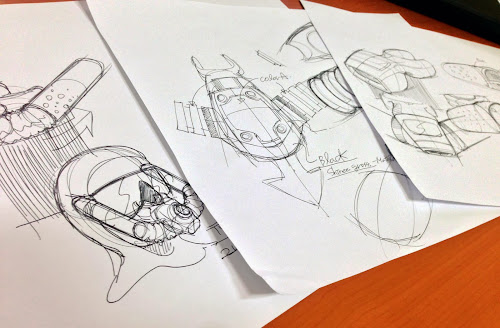
Korean student Jeabyun Yeon, who is studying product design at Samsung Art And Design Institute, has come up with a novel concept rivaling the SCUBA gear developed by Jacques Cousteau in the 1960s. The Triton Oxygen Respirator, as he calls it, uses technology developed by a Korean scientist that allows divers to breathe freely underwater. The oxygen is extracted directly from the water through a filter of fine threads with holes smaller than water molecules. A micro compressor, powered by a micro battery, compresses and stores the extracted oxygen in a tank. The mask consists of a plastic mouthpiece and 2 arms (SKETCHES ABOVE, PHOTOS HERE) and the device will revolutionize diving if it makes it out of the studio and into the water. Of the artificial gill, blogger Bill Ottman writes, "Essentially it turns humans into fish."
Wednesday, January 15, 2014
Ultimate rhino irony
In the 1960s, there were 70,000 black rhinos worldwide. Now, due to poaching and habitat loss, there are fewer than 5,000 in Africa and fewer than 2,000 of those in the Southern African nation of Namibia. One subspecies, the western black rhino, has already been declared extinct. But despite the animal's critically endangered status, and outrage from conservation groups and animal activists from around the world, hunters from Texas bid for the right to shoot and kill a black rhino in Mangetti National Park. The winner of the auction held by the Dallas Safari Club at their annual meeting over the weekend paid $350,000 for the "privilege" granted by Namibian wildlife officials, who will accompany him on his "hunt" of the designated rhinoceros. The meat from the animal will feed a nearby community and the proceeds from the auction will – ironically – go to a fund for conservation of the black rhino in the form of anti-poaching patrols, habitat protection, and research. Though the hunter has yet to be granted a permit from the U.S. Department of Fish and Wildlife to bring his trophy home, protesters point out that preserving this individual rhino for repeated eco-tourism and safaris would benefit Namibians more than auctioning a one-time hunting permit to kill it. Former game show host Bob Barker, now 90, writes in an open letter to the hunting club, "The rhino that your organization reportedly has in its cross hairs is an older 'non-breeding' male who has apparently been deemed expendable. As an older male myself, I must say that this seems like a rather harsh way of dealing with senior citizens.”

Tuesday, January 14, 2014
Flighty and flirty
The red-necked phalarope (Phalaropus lobatus) is only 7" (18 cm) in length, so the tracking device with which it was outfitted (IMAGE ABOVE) weighs a mere .6 of a gram. But the wafer-thin device has allowed researchers to discover that the waders, native to Scotland and points north, undertake one of the world's greatest bird migrations. The birds that were tagged in Shetland flew across the Atlantic, south down the eastern seaboard of the United States, across the Caribbean, and Mexico, and ended up off the coast of Peru - a distance of 16,000 miles (25,750 km)! Ornithologist were already familiar with the reversed sexual roles of the phalarope. The female is larger with fancier feathers, and after she hooks up with a male and lays 4 eggs, she leaves him to incubate and care for the chicks while she goes off in search of another mate. Malcie Smith of the Royal Society for the Protection of Birds applauds, "But it does mean that Mrs. Phalarope can go off and get two broods of chicks off in one short breeding season."

Monday, January 13, 2014
Impervious pillar

The Iron Pillar in Delhi, India (DETAIL ABOVE), is at least 1,500 years old and bears inscriptions dating back to about 400 A.D. The 24' (7 m) pillar was dedicated and rededicated to rulers and victors in battle. In addition to its historical significance, the Pillar of Delhi has a scientific claim to fame: its mpenetrability to corrosion is something modern technology cannot match. Professor A.P. Gupta, Head of the Department of Applied Sciences and Humanities at India's Institute of Technology and Management, has been studying the metallurgy industry in ancient India that was able to produce something that was 99.72% iron and – unlike that of today – contains absolutely no manganese or sulfur. The monument is also coated with a protective oxide film that researchers have been unable to recreate. The result is that even though the pillar has withstood 1,000 monsoons, it has never rusted.
Sunday, January 12, 2014
Snowbirds
Snowbirds have been flocking south. And this year, that is not just a metaphor for people who spend the winter months in the warmer weather. Snowy owls, which live in the Arctic Circle and Canada, have been venturing into the southern United States since early December for reasons yet unknown to scientists. The birds have even been sighted in Florida, for the third time ever. The snowy owl (bubo scandiacus) has large talons and a wingspan of up to 5'. They normally feed on seabirds and lemmings. Either the owls have been spreading out after having a very successful breeding season or – and it is unknown whether this could be attributed to climate change – their normal food sources have been disrupted. The unusual migration is being recorded (MAP OF SIGHTINGS ABOVE) and studied by Kevin McGowan of Cornell University's Lab of Ornithology, who at this point can only offer, "This is just not the normal way of things."

Saturday, January 11, 2014
Beach balls
What we have here are large ice boulders, some weighing as much as 75 lbs (34 kg), that form periodically on Lake Michigan. U.S. Park Ranger Amie Lipscomb explains that when large sheets of ice break into smaller chunks, the waves tumble them, rounding and smoothing their edges. At the same time, new layers of ice are added, resulting in the striking beach ball-sized ice formations in the image above, lapping up on the Sleeping Bear Dunes National Lakeshore. Suttons Bay photographer Ken Scott braved wind gusts and temperatures in the negative digits last week to capture the phenomenon on video (WATCH IT HERE). The strange scenery tends to go hand-in-hand with some of the biggest winter storms. Scott remarks, "That's when some of the best shows are."

Friday, January 10, 2014
Panda predecessor
In the United States, the National Zoo’s 4-month-old giant panda cub Bao Bao just made her first appearance before the media. It was less than 150 years ago that the first Westerner laid eyes on the animal. French priest Armand David was sent to do missionary work in China and stationed in the wild mountains northwest of Chengdu in Sichuan Province. David was also a naturalist, who hired hunters to bring him the body of the striking black-and-white bear. Journalist Henry Nicholls retraced David's steps and visited his room in the Dengchi Valley Cathedral (PHOTOS HERE). There he stood next to the table on which the priest may have dissected the panda before rolling up the skin and shipping it to his contact at the Muséum National d’Histoire Naturelle in Paris. In the note he sent separately, David described the bear's markings and suggested a Latin name. He added, "I have not seen this species in the museums of Europe and it is easily the most pretty I have come across; perhaps it will turn out to be new to science!" It was.

Thursday, January 9, 2014
Gray-Gray whale
An amazing discovery – declared by marine biologist Benito Bermudez of CONANP to be “exceptionally rare, without any precedent” was made off the Mexican coast on Sunday: conjoined twin gray whales (IMAGE ABOVE, MORE PHOTOS AND VIDEO HERE)! The anomalous animals, found floating n the Ojo de Liebre lagoon, had probably been miscarried or stillborn. There is speculation that the difficult birth may have killed their mother, who would have migrated with hundreds of other gray whales the 6,000 miles from the Bering Sea to Mexico's west coast to calve during the last week of December and the first two weeks of January. Even in their undeveloped state, the whales weighed nearly half a ton and measured about 13' (4 m) long. The heavy carcasses have been removed by a government agency for further study. Conjoined twins have occurred in other whale species such as fin, sei, and minke, but these gray whales are apparently a first. I don't know if whales have waists, but that is where they are said to be joined, which would classify them in human terms as pygopagus.

Wednesday, January 8, 2014
Stonehenge man

One of the highlights of the new visitor center built on the site of Stonehenge in Wiltshire, England, is the face reproduced from a skeleton found nearby. The Neolithic skeleton, discovered in an elaborate tomb in the 1860s, actually predates the stone monument by 500 years. The facial reproduction (TIME-LAPSE VIDEO HERE) was prepared by Swedish sculptor Oscar Nilsson based on information deduced from the bones by human skeletal biologist Simon Mays from the University of Southampton, U.K. The man was between the ages of 25 and 40, muscular, and had a well-defined chin and jaw. Archaeologist Alistair Pike, also at the University of Southampton, was a bit disappointed that more could not be learned from Stonehenge man's teeth. Isotopes extracted from the teeth and their enamel indicated that he had moved to the area from Wales when he was about 3 years old and that he ate more meat than his contemporaries. There was a little wear, indicating a soft diet, but there were no revelations to be made by analysis of plaque, because his choppers were unusually clean. Pike laments, "If we had been able to analyse his tartar, we could have identified species he was eating by sequencing proteins in trapped fragments, while bacteria could have revealed the health of his gut."
Subscribe to:
Comments (Atom)


