Thursday, October 31, 2013

Happy Halloween!


At this point in my life, my Halloween costume is less about being able to carry out the idea as the idea itself. And while I was less concerned about scaring children in my earlier costumes such as the bat (SEE SLIDESHOW BELOW), now I have the additional parameter of not wanting to frighten the elderly residents in the nursing home. My costume this year (IMAGE ABOVE) functions on 2 levels. To my fellow residents, and to the staff – many of whom are in costume themselves – I am a goofy ogre. But to continue my 25-year tradition as a Queen of Halloween, this year I am a homunculus, the monstrous representation of the body's correspondence to the brain, in which the features are exaggerated according to the space they occupy (IMAGE HERE)!

Wednesday, October 30, 2013

Scratch

Trace fossils can reveal much to paleontologists who see them for what they are. About a mark in the fluvial sandstone of Australia dating to the Early Cretaceous, Anthony Martin of Emory University remarks, "I immediately knew what it was – a flight landing track – because I've seen many similar tracks made by egrets and herons on the sandy beaches of Georgia." The rare fossil (IMAGE ABOVE) has a skidmark from the back toe of avian dinosaur dragging in the sand as it flapped its wings to come in for a soft landing. The discovery will add to the understanding of the evolution of flight In the Southern Hemisphere 105 million years ago when Gondwanaland was breaking up.

Tuesday, October 29, 2013

Sforzescu surprise

It may not seem like much yet, but when the 17 layers of paint are carefully removed from this wall with scalpels, lasers, ultrasound scaling, and special chemicals,, it will reveal the rest of a mural painted by Leonardo da Vinci. The painting has been discovered in Sforzesco Castle, the residence of the 15th c. duke of Milan, Ludovico il Moro, the same noblemen who commissioned "The Last Supper" for his family mausoleum. The fresco continues a painting on the ceiling of a wood-paneled room that was used to receive ambassadors (IMAGES HERE). When they looked up, they would have seen a garden pergola of 16 mulberry trees tied together with a golden, knotted rope. The trunk of each tree continues down the wall, and da Vinci's hand has been recognized in a depiction of sturdy roots bursting through rocks. Works by the master continue to turn up, including a painting of Madonna and Child in 2012 and a portrait of Italian noblewoman Isabella d’Este earlier this month.


Monday, October 28, 2013

Voice for the vultures

"The passion just grew, it never subsided,” says 36-year-old Kerri Wolter, who left her administrative job with a chemical manufacturer 11 years ago to advocate for Cape vultures in Pretoria, South Africa. She founded and manages VulPro, where she and her staff rehabilitate, breed, monitor, and educate the public about the misunderstood and threatened birds. Now extinct in Swaziland, Zimbabwe and Namibia, Cape vultures have been reduced to just 2,900 breeding pairs in the wild. An entire colony was recently wiped out after feeding on the bodies of 100 elephants which had been poisoned by poachers. In addition to her work on the ground, she ascends with fellow conservationist Walter Neser – expert paraglider - to fly with the vultures (VIDEO HERE) and explains, “They lack a voice, they’re the underdog of the animal world and critically misunderstood. Somebody has to speak up for them – they chose me.”

Sunday, October 27, 2013

Purring primate

The Caquetá titi monkey (Callicebus caquetensis) Is one of at least 441 new species of animals and plants – including a flame-patterned lizard, a thumbnail-sized frog, a beautiful pink orchid, a brightly colored snake, and a vegetarian piranha (!) – discovered in the Amazon rainforest within the past few years. But it is also on another list, having been added last week with more than 1,900 other animals and plants to the Red List of Threatened Species by the International Union for Conservation of Nature. I chose to illustrate this post with the monkey rather than the less charismatic piranha because it has a singular ability. Not only is it the size of a house cat, but it purrs like one, which reminded me of this 2010 story of an abandoned squirrel which learned to purr after its adoption by a family of kitties.

Saturday, October 26, 2013

Neon nerves

An international team of scientists has just visualized the central nervous system of the earliest animal yet, a 520-million-year-old Alalcomenaeus found in China. Using a CT scanner and 3D software, they were able to illuminate enough detail in the fossil (IMAGE ABOVE) to determine that the claw-like appendage that grew from its head, used for grasping and holding, evolved into the mouthparts of the spider. Spiders and scorpions both branched off from this group of megacheirans in the Cambrian period. "People like myself who are mad keen on creepy crawlies want to understand how very strange early arthropods relate to living ones," explains Greg Edgecombe of the Natural History Museum in London.

Friday, October 25, 2013

Necropants

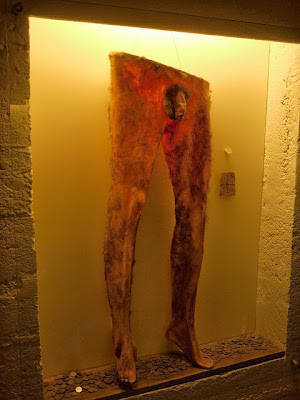
While the Salem Witchcraft Trials were going on in Massachusetts, U.S.A., in the 17th c., something similar was occurring in Iceland. The superstitious era is documented at the Museum of Icelandic Sorcery & Witchcraft in Hólmavik. Among the items on display is the world's only pair of nábrók (IMAGE ABOVE), which has been translated as necropants. To make a pair, one did not have to strike a deal with the devil, just with an acquaintance. After he died, he would be exhumed, the bottom half of his body flayed, and his skin worn to reap good fortune. If the correct procedures were followed, the riches would accumulate in the scrotum! I have my brother-in-law Nicholas to thank for this link, rather than what I thought was my extensive research on anthropodermic items.

Thursday, October 24, 2013

Highgate hopalong

The most famous posthumous resident of London's Highgate Cemetery East is Karl Marx. The most famous living resident is an Australian wallaby, spotted last Sunday hopping between the ivy-strewn graves (VIDEO HERE). Consulting zoologist Maurice Melzak tentatively identifies the creature as a Bennett’s wallaby, a species known to live in small wild colonies across the U.K. It has joined many non-native insects, arachnids, and animals – including grey squirrels, ring-necked parakeets, and muntjak deer – in the cemetery. The staff is unsure how the animal breached the gates, but are glad that if he stays inside he will not be in traffic. They do, however, have one concern. Volunteer coordinator Melanie Wynyard says of the marsupial, “It’s going to totally upstage the tours of course. No one is going to listen to what we are saying!

Wednesday, October 23, 2013

Busted

While it is uncertain that Shakespeare's Romeo and Juliet ever existed, romantics flock to Verona, Italy, to the Casa di Giulietta (Juliet’s house). Once probably owned by the Cappello family, who may have inspired the bard, this tentative connection has made it a major tourist attraction. It does, after all, have the balcony made famous in the play (IMAGE ABOVE). But the popularity of the site has resulted in some problems. A year ago, authorities banned the posting of notes addressed to Juliet by the lovelorn on the walls of the building, because of the damage the chewing gum and other adhesives have caused. Now it has been revealed that the right breast of the bronze sculpture of Juliet which stands in the courtyard has been disfigured at the hands of those same tourists. Their sentimental touches – meant to bring luck in love – have in fact rubbed holes in her bosom. The statue is believed to be at risk and it has been suggested that a portion of visitor entrance fees be devoted to its maintenance.

Tuesday, October 22, 2013

Paleo diet reconsidered

In 2012, an international team of researchers published a study after examining the plaque on the teeth of Neanderthal skulls. They reasoned that the early humans – known for their big game hunting skills – did have a nuanced understanding of vegetables and plants, and prepared and ate them for both medicinal and nutritional reasons. A pair of British scientists has now reexamined the data and offer a slightly different theory. They suggest that the Neanderthals ate the animals they hunted and killed stomachs and all. The plant compounds that turned up on their teeth could have originated as partially-digested stomach contents. The researchers point out that the practice – which is still carried out by cultures including Australian Aborigines, who eat the stomach contents of kangaroo, and Greenland Inuit who consume the stomachs of reindeer as a delicacy - may go back to our origins. While nutrition may be a simpler explanation, this does not rule out ritual behavior by the Neanderthals. Lead author Dr. Laura Buck of the Natural History Museum in London states, “It shows a level of dietary complexity not always appreciated before.”


Monday, October 21, 2013

Spotting stripes

Authorities in Africa are trying to stop the low-tech but effective methods poachers are using to kill elephants for their tusks (CLICK 1ST LINK IN THIS POST). Meanwhile, authorities in India are now battling high-tech poachers who are killing endangered Bengal tigers for their teeth, bones, skin, and sex organs, all of which are highly valued in traditional eastern Asian medicine. In the Panna Tiger Reserve, conservationists attached a GPS tracking collar to one of the tigers in the park last February. The location data is e-mailed to 3 people in charge of watching the tagged tiger. There is evidence that in July, poachers attempted to hack into the e-mail, which would have provided them with the exact location of the tiger – one of only 2,500 left in the wild.


Sunday, October 20, 2013

Mapping the Matterhorn

When English mountaineer George Mallory (1886-1924) was asked why he wanted to climb Mount Everest the Himalayas, he responded, "Because it's there." Well, project manager of SenseFly Adam Klaptocz had a similar reason for wanting to map the Matterhorn in the Swiss Alps: "Such a combination of high altitudes, steep rocky terrain and sheer size of dataset has simply not been done before with drones, we wanted to show that it was possible." The unmanned aerial vehicle (UAV) company and aerial photography company Pix4D used 3 drones to capture points just 8" (20 cm) apart. In the time it usually takes to climb the last 4,000' (1200 m) to the Matterhorn's summit – 6 hours – the drones had surveyed the entire mountain.

Saturday, October 19, 2013

Hoodoo hoodlums

The landscape of Utah's Goblin Valley State Park is characterized by formations known as hoodoos, or more colloquially as "goblins" (EXAMPLE ABOVE). In an act of vandalism that is not unprecedented, 3 idiots - scout leaders, no less - took it upon themselves to modify one of those geologic features. Identified by the authorities because they tagged themselves in the video they posted (VIDEO HERE), they are as uncaring of our national treasures as the fools who damage petroglyphs or obliterate them with graffiti. Jeff Rasmussen, deputy director of Utah State Parks and Recreation, declared that the men face potential felony charges for their senseless and destructive act: “It’s a valley full of these rocks that are perched up on these earth platforms, and obviously we’re very concerned and upset that someone would come and destroy this natural wonder that took millions of years to be formed.


Friday, October 18, 2013

Bat bullhorn

Biologists are finding more and more animal species, besides apes and crows, that use tools. Most recently, Gloriana Chaverri of the University of Costa Rica has discovered that a particular South American bat – Spix’s Disc-winged bat (Thyroptera tricolor), so-named because of the circular suckers on the bases of the thumbs and soles of the feet that allow them to hang (IMAGE HERE) – use leaves to amplify sound. The bats roost in groups of 5 or 6 inside unfurling Heliconia and Calathea leaves. Because the leaves remain curled up for only about 24 hours, the bats have to find new homes almost every day. Dr. Chaverri's tests in the laboratory confirmed that incoming calls were boosted by as much as 10 decibels and that the responses, although boosted by only 1–2 decibels, were made highly directional by the megaphone-shaped leaf.

Thursday, October 17, 2013

Cadboll cooperation

The Hilton of Cadboll Stone has had a storied history. The 7.5' (2.3 m) slab of local sandstone was erected by the Picts near the eastern coast of the Scottish Highlands around the year 800 A.D. On it they had carved intricate designs, apparently to celebrate their conversion to Christianity. Over the years, the monument has been damaged by weather, has been toppled and broken (possibly deliberately), and has been partly reinscribed with unrelated information. It has lain upside down in a local chapel, stood as an ornament in the garden of a Scottish castle, and was finally donated to the British Museum in 1921. The public demanded its return to Scotland that same year, but it has now stepped into the digital age. Between its creation and its current installation, thousands of bits of stone have been chipped away. The National Museum of Scotland has now x-rayed and digitized 3,000 of these fragments and created a virtual 3-D jigsaw puzzle that they are asking the public to complete. The citizen science project – PictishPuzzle.co.uk – will make its debut on October 25th. Archaeologist Mhairi Maxwell says, "We have created a software program that allows people with very average computers to go online and interact with a selection of 3-D objects in real time, push them together and try to place them to solve the puzzle....If we can come together to re-fit the pieces, it will be a huge step forward in our understanding."


Thanks, Sue!


Wednesday, October 16, 2013

Paleo pest

While just a fraction of the size of the giant dragonflies that flew in the Carboniferous period 300 million years ago, the tiny Eocene mosquito above is in some ways more important and in its preservation much more improbable. Smithsonian researcher Dale Greenwalt realized the rarity of the specimen, which had been discovered in oil shale in western Montana, after it was given as a gift to the National Museum of Natural History in Washington, D.C. The contents of the mosquito's stomach are full of the blood of animals that lived 45 million years ago, as proven by the high levels of iron ions and molecules of heme, which carry hemoglobin. Which species it preyed upon will remain unknown, since DNA molecules are too complex and fragile to fossilize (which is what also rules out cloning). The unlikely events that resulted in the first fossil of a mosquito found still engorged with ancient blood would have played out as follows: “The insect had to take a blood meal, be blown to the water’s surface, and sink to the bottom of a pond or similar lacustrine [lake-like] structure to be quickly embedded in fine anaerobic sediment, all without disruption of its fragile distended blood-filled abdomen.”

Tuesday, October 15, 2013

Dimorphic digits


Archaeologist Dean Snow of Pennsylvania State University had an epiphany a decade ago while reading the work of British biologist John Manning. Manning had discerned that the hands of men and women were dimorphic, that they differed not just in size but in the relative lengths of their fingers compared to one another. The ring fingers of men tend to be longer than their index fingers, while those two fingers are about the same length on a woman's hand. Snow had the brilliant idea of applying that knowledge to ancient cave paintings that included hand stencils. He has now analyzed those at 8 cave sites in France and Spain and determined that 75% of the handprints were female. One of these was the El Castillo cave in Cantabria, Spain, in which the hand stencils of men (IMAGE ABOVE, LEFT) were far outnumbered by the hand stencils of women (IMAGE ABOVE, RIGHT). And with that, he has overturned long-held assumptions that the paintings – of game animals including bison, reindeer, horses, and woolly mammoths – were made by males to magically improve the success of their hunts. "In most hunter-gatherer societies, it's men that do the killing. But it's often the women who haul the meat back to camp, and women are as concerned with the productivity of the hunt as the men are. It wasn't just a bunch of guys out there chasing bison around."

Monday, October 14, 2013

Ungreen burial

As many readers of Quigley's Cabinet are probably aware, it is not unusual in many places in Europe to reuse graves after a set number of years, during which the body has decomposed and traditionally the bones can be gathered together and placed in an ossuary. In Norway, the dead are given free cemetery plots for a period of 20 years, after which the family can pay for an extension. The bones and remains of the wooden coffins are left in place and new inhabitants are buried above them. But in the 30 years following World War II, the funeral directors of Norway made an environmental error. Thinking the practice to be more sanitary, they wrapped corpses in plastic only to find later that this kept them from decomposing. This led to a severe shortage of burial space, but the problem has been solved. "You may say wrapping people in plastic was the result of some pretty poor planning," says former graveyard worker Kjell Larsen Ostbye, but it has become big business for him. He has established a firm called Nomias, which injects a lime-based solution into the buried body to accelerate decomposition (DIAGRAM HERE). After obtaining permission from the family, the city of Oslo pays for the process, which takes only about 10 minutes per grave and leaves no trace. He has treated 17,000 Norwegian graves with hundreds of thousands left to go.

Sunday, October 13, 2013

Roly-poly olenellid

You may have some experience with pillbugs. Officially known as pill woodlice, we used to call them roly-poly bugs as kids because of their reaction when you touched them. They would squeeze themselves into a perfect sphere, a defense mechanism I have just learned is called conglobation. Extinct marine creatures known as trilobites also had this ability that protected them from an increasing number of predators and allowed them to thrive for over 270 million years. Paleontologists have confirmed that later species of trilobites rolled themselves up and even developed extra defenses such as locking mechanisms which prevented other animals from pulling them back open. But now paleobiologist Nicholas J. Butterfield and his doctoral student Javier Ortega-Hernandez of the University of Cambridge have proven that even the very earliest forms of trilobites were roly-polies! Doing their field research in Jasper National park in Alberta, Canada, they have shown that the Cambrian olenellids (EXAMPLE ABOVE) were more limber than they looked. Ortega-Hernandez called the specimens they collected, "...an exciting find, as it is clear evidence that, despite their limitations, olenellids were capable of rolling themselves up effectively."

Saturday, October 12, 2013

Pointing proboscis

The new ways poachers find to kill elephants just for their tusks are heartbreaking and horrifying, especially considering the intelligence of these large creatures. Consider the testing recently conducted by evolutionary biologists Richard Byrne and Anna Smet of the University of St. Andrews on 11 African elephants. The "object-choice task," as it is called, has been performed on many species, which are rewarded with food for learning to follow the line of a human’s pointing. Wild animals don't do so well – chimpanzees struggle to understand – but even domesticated animals like dogs and horses show only mixed results. Elephants, however, didn't even need training to understand – they followed the pointing arm spontaneously! They seemed to do it naturally, whether they were captive-born or wild-born. The researchers speculate that because elephants are such social animals, they use their own appendages (DETAIL OF AFRICAN ELEPHANT TRUNK ABOVE) to communicate. “The most likely possibility is that they regularly interpret trunk gestures as pointing to places in space.


Friday, October 11, 2013

Space scarab

I may have seen this amulet belonging to King Tutankhamun when I visited the traveling exhibition of his treasures in the 1970s. Little did I know that the yellow scarab at the center predates the ancient Egyptian king's 14th c. B.C. reign by 28 million years. That's when a comet hit the Sahara desert and heated the sand to such a degree that it formed silica glass and spread it over a wide area. The scarab, microscopic diamonds, and a mysterious black pebble dubbed “Hypatia” have been found by an international collaboration of geoscientists, physicists, and astronomers to be the first physical evidence left on the planet by a comet strike. Team member David Block of Wits University explains, “Comets always visit our skies – they’re these dirty snowballs of ice mixed with dust – but never before in history has material from a comet ever been found on Earth.”


Thursday, October 10, 2013

Dental donation

In The Image, a Christian charity in Grand Rapids, Michigan, received an unusual donation over the summer: a set of lacquered fossils that may be 15,000 years old. The tooth, broken into 2 pieces, and a short hollow tusk (SLIDESHOW HERE) are believed to belong to a North American mastodon. Puzzled and curious director Jay Starkey turned the donation over to the Grand Rapids Public Museum, which has added them to its educational collection for loan to schools. The museum's collection manager Tim Priest admits, "This is kind of an oddball way for something to come in."


Wednesday, October 9, 2013

By a nose

Irish photographer David Baz Jenkins caught the action of a seal almost being eaten by a shark off the coast of Cape Town, South Africa. As the predator surfaced, the prey rode upwards on its nose and then leapt off!

Tuesday, October 8, 2013

Long-nosed lizard

Alejandro Arteaga of Ecuadorian ecotourism company Tropical Herping needed just one more lizard to complete his book The Amphibians and Reptiles of Mindo. After searching for 3 years, his team of researchers and photographers found the Pinocchio anole (Anolis proboscis) clinging to a branch above a stream in a section of pristine cloud forest north of Quito. The elusive lizard, discovered in 1953, went missing completely between the 1960s and 2005 and this is only the 3rd one seen since that time. The specimen is a male, as indicated by its headgear – a sexually selected trait that indicates to females that it has good genes. The team kept the lizard only overnight, so that it could be photographed in daylight when its colors had brightened, then released it back into the forest. Says Arteaga, "After looking for so long ... It was very thrilling to find this strange lizard."

Monday, October 7, 2013

Burnishing Bobby

It has long been considered good luck to rub part of a statue: the belly of Buddha, the boot of a hero, even the crotch of a certain Frenchman. Growing up in Springfield, Illinois, I became quite used to seeing shiny noses on sculptures of American president Abraham Lincoln, the city's most famous resident. Recently, a grassroots campaign brought to the attention of Edinburgh authorities that a statue of one of their most famous residents needed refurbishing because of this custom. Greyfriars Bobby has stood since 1873 in the Scottish churchyard where his owner, a police night watchman, had been buried. A symbol of faithfulness, the terrier had refused to leave the grave for 14 years until his own death. Plans were soon put in place to "unburnish" Bobby's nose. The treatment by bronze sculpture specialists involved cleaning with a mild detergent, brushing with a special chemical solution, heating with a blowtorch to restore the patina, and applying several coats of a microcrystalline wax. Councillor Richard Lewis remarks proudly, “Although Bobby has never been in any immediate danger, it was highlighted to us that the practice of rubbing his nose was starting to make him look a little scruffy. As one of the most famous - and most popular - statues in the Capital, it’s only right that he looks his best at all times. Once we became aware of the local concern it was clear that we had to act and I’m delighted we’ve been able to get specialists in to restore Greyfriars Bobby to his former glory.”

Labels