Showing posts sorted by relevance for query buckland. Sort by date Show all posts

Friday, December 26, 2008

Frank Buckland


Frank Buckland (1826-1880) is one of my favorite eccentric Englishmen of the 19th c. He made his living as Inspector of Salmon Fisheries, but it is his incredible curiosity about the natural world that, let us say, sets him apart. The man had many skills, including preparing animal skulls and skins and treating sick porpoises at the zoo, and numerous interests, including touring English ossuaries and examining ancient Egyptian mummies. He conducted many of his own experiments, including evaluating the defleshing work of dermestid beetles, and sealing toads in limestone for one year to assess credibility of stories of live toads being released from newly quarried blocks. I once began an outline for a biography and here are the things Frank did that tickled and/or appalled me most:

  • Stole Ben Jonson’s heelbone from his tomb
  • Determined the relics of St. Rosalia at Palermo to be goat bones
  • Located the remains of John Hunter in a crowded church crypt so they could be reinterred in Westminster Abbey
  • Kept a skull found during the digging of a foundation after finding it to be an asylum patient
  • Kept a skull thought to be a murder victim after determining it to be a Crimean war trophy
  • Led the London Acclimatisation Society in introducing exotic species into England for their meat
  • Tasted buffalo, earwig, field mice, giraffe, kangaroo, leopard, mole, ostrich, porpoise, sea slug, snake, whale, zebra
  • Owned a pet rat that he allowed on the dining room table
  • Raised a bear, buzzard, fish, jaguar, magpie, mice, monkeys, owl, parrots, raccoon, snakes, woodchucks
  • Discredited the Fee Jee mermaids exhibited by P.T. Barnum and other showmen
  • Observed the mummified body of performer Julia Pastrana (photo below), whom he had seen on stage
  • Questioned the safety of corsets
  • Put eels in public fountain as a prank

To his discredit, Buckland chain-smoked cigars. To his great credit, he wrote the multi-volume Curiosities of Natural History. Among his acquaintainces he counted Chang and Eng Bunker (1811-1874), the “Original Siamese Twins”; Swiss naturalist Louis Agassiz (1807-1873); Austrian anatomist Joseph Hyrtl (1810-1894); and married giants Martin van Buren Bates (1837-1919) and Anna Swan (1846-1888).

Friday, August 27, 2010

Audubon ate 'em


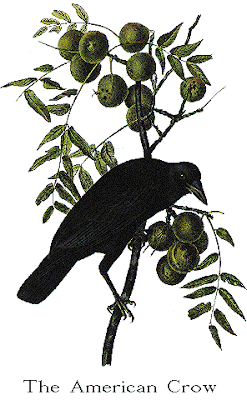
My Dad dropped an intriguing nugget of knowledge in conversation yesterday, which I confirmed last night so I could bring it to you today. French-American naturalist John James Audubon (1785-1851) tasted almost all of the birds he so beautifully drew. It shouldn't be so surprising, given that they were a viable food source, he was going to kill them anyway, and he was on the trail for months at a time. As one website explains, "Audubon's life was tinged with irony. Naming himself 'the American Woodsman,' he anticipated the practice of placing rings on birds' legs to track their movement, marking nestlings with 'a light silver thread' and checking on them a year later. He often lamented the quick destruction of the wild — so much that he has become an example for modern conservationists. Yet to paint realistic pictures, he had to shoot hundreds of birds. Because he worked in the wilderness for long stretches with no other food source, he had to eat those birds, too." Biographer Richard Rhodes adds, "There weren’t any cameras in the early 19th century, nor any binoculars. To draw a bird you had to shoot it. He shot, collected, mounted and drew. After he drew he dissected, investigating the birds’ anatomy and what they ate. Sometimes he shot multiple specimens to determine the type and preserved the skins for museums. And then, since he was out in the wilderness for weeks at a time collecting and drawing, he almost always cooked and ate his catch–which gives an idea of how quickly he could do a drawing. People today don’t realize that wild birds, including songbirds, were considered a valuable food resource in Audubon’s day and were shot in great numbers for sale in local markets, much as wild fish are harvested today."

Audubon (pictured in 1826 with his gun) left his critiques of the taste of various birds (images above), which I have collected from biographies and his journal entries. Of the great blue heron, he writes, "Young birds from the nest afford tolerable eating; but the flesh of the old birds is by no means to my taste, nor so good as some epicures would have us to believe, and I would at any time prefer that of a Crow or young Eagle." "Their flesh is dark, generally tough, and has a rank fishy taste," is his comment on the flavor of the Florida cormorant. The wood thrush was "delicate and juicy," and, for some, the loon was best "served almost raw." A diary entry in October 1820 read, "Grebes were cooked and eat but extremely Fishy rancid and fat-," and the following month he wrote, "I eat the purple grakle it tasted well-." He says nothing of the young turkey, killed within 20 miles of Washington, that he shared at the table of President Andrew Jackson.

Since I once made a visit to the zoo specifically to look at the animals Frank Buckland sampled, I would say that knowing this information will cause me to look at Audubon's engravings with even more interest.

Monday, March 12, 2012

Tomb of the known soldier


Last summer, I mentioned the collection of daguerreotypes donated to the Library of Congress by the Liljenquist Family (on-line catalog here). Many of the names of the nearly 700 Civil War soldiers depicted are unknown. Well, thanks to the wife of a descendant, one young man has his identity back. A week ago, Karen Thatcher of Martinsburg, West Virginia, recognized his photo (2nd image) as matching a crayon enlargement (see it in slideshow here) - a 19th c. technique of making a larger colored portrait from a photo - that had been handed down in the family of her husband Larry. Now that it has been pieced together, here is the soldier's story:
David M. Thatcher was just 17 when he enlisted in the Confederate Army on April 19, 1861. The War Between the States had broken out only the week before. Thatcher left his family's farm in Martinsburg to join Company B, Berkeley Troop, of the First Virginia Cavalry. Before he went to war, the teenager sat for an ambrotype. He posed proudly in his uniform, armed with a revolver and a saber. Across his chest was braided frogging and at his waist was a belt buckle bearing the Virginia state seal. Thatcher was under the command of General J.E.B. Stuart in the Battle of Buckland Mills when he was wounded Oct. 19, 1863. The Confederacy prevailed, but Thatcher died the next day. His parents collected his body from the battlefield near Warrenton, Virgina, and brought him home in a horse and wagon. They buried him in the cemetery of their local Tuscarora Presbyterian Church, where his gravemarker (1st image) still stands. "When thou goest out to battle against thine enemies, be not afraid of them, for the Lord thy God is with thee," it reads.
According to Library of Congress curator Carol Johnson, Thatcher may have given the photo to his girlfriend before he left for the war and his family may have had it reproduced to hang on the wall after he was killed. The story of the young soldier - a brother of her husband’s great-grandfather - is tragic, but reuniting him with his biography is remarkable. “I’m just awestruck," exclaims the collector. "This anonymous young boy has gotten his life back.” The Thatchers add, “We’re just tickled to death...that we’re able to put a name to that face.”

Sunday, March 3, 2013

Fine furniture


A week ago last Thursday, my Mom signed me out of the facility for a couple of hours and brought me back to my "museum." We filled my favorite cabinet with my favorite things (pictured above), and set it up in my room. It's like a Quigley's Cabinet microcosm: fossils of a fern, a crinoid, and bird footprints; a postmortem tintype and an antique photo of a dissection; the skull of a rabbit on a stand that has a museum label on the bottom and a crocodile skull that was given to me by Georgetown University Press when I transferred positions; 2 sculptures by my friend George Higham; an emu egg, an impala horn, and a turtle shell complete with bottom carapace found by my friend Sue in her yard; an Egyptian statue that belonged to my octogenarian friend, embalming historian Edward Johnson; a Day of the Dead sculpture of a skeletal surgeon working on a patient (that one was given to me by my brother-in-law when my lung collapsed in 1990); a set of books by 19th c. British naturalist Frank Buckland; and bugs fossilized in amber received as gifts over the years from my sister. But perhaps my most prized possessions are a mammoth tooth and woolly mammoth hair. Since that is my favorite extinct species, my eyes were drawn to a recent weird news story in which mammoth remains were found in Siberia. Such a quantity of bones and tusks were located that it is believed the area may represent a mammoth graveyard. The discovery was not a surprise to the locals. Says researcher Viktor Kotlyarov, “Some villagers used vertebrae as stools at home.”

Thursday, May 28, 2009

Follow-ups

Whales, articulated and dismantled My first follower Angie linked me to her ex-husband Grant's website because he wrote the score for a documentary about humpback whales. And Megan forwarded this link from Monday about the disposal of a dead whale on a Delaware beach (they harvested the skull and buried the body).
.
The house that May (re)built Follower Kent writes, "I loved the post about May Savidge. I have an ongoing interest in the amazing things that people can accomplish when they are devoted to a cause over a long period of time." He also suggests I consider allowing comments on the site - I may at some point, but until I do, readers are welcome to e-mail me!
.
The art of David Teniers the Younger After seeing my post on Teniers' monkey paintings, my Mom pointed out that it was fashionable to upholster Chippendale couches in monkey print fabric, and I found an example here.
.
Giraffe evolution Shortly after this post, an anecdote about the remarkable memory of giraffes appeared in the news.

.

Face transplant A second face transplant has already been performed in the U.S., on a 59-year-old man who was disfigured in an accident in a Boston subway station.

Autotomy If the video of the wriggling detached lizard tail gave you the creeps, this newly posted video of a Chinese speed-cooking contest will really make your skin crawl!
.
Robo-animals Here's another story about an animal outfitted with a customized prosthetic - this time a turtle now named "Tonka" for obvious reasons!
.
Seahorses and sea dragons Scientists have pieced together how seahorses evolved to swim standing up. In another story, a seahorse has been saved after being dropped 3 miles inland by a seagull.
.
Poisonous plants Friends Megan and Erin pointed out this article about a garden of poisonous plants cultivated by the author of a new book.

Disturbingly young parents DNA tests have proven that 12-year-old Alfie Patten did not impregnate his girlfriend Chantelle Stedman. Instead, her baby Maisie was fathered by a boy who was 14 at the time.
.
.
Killer chimpanzees Two new developments in the mauling of Charla Nash: 1) Stamford, Conn., police have confirmed the presence of Xanax in the animal's system before the attack, and 2) A judge has frozen $10 million in assets belonging to the chimp's owner, since the Nash family is suing her for $50 million.
.
Frank Buckland Researchers have decoded the genetic mutations responsible for the rare condition of "bearded lady" Julia Pastrana, who is mentioned and pictured in this post.

Monday, January 12, 2009

Corsets and wasp-waists


.
.
.
.
.
.
.
.
.
.
.
.
.
.
.
.
.
.
.
.
Despite the dangers of corseting, which have been pointed out for a century,* some people cinch themselves up anyway. Ironically, the classic wasp-waist is now associated with a man. Calling himself Mr. Pearl, Mark Pullin set up as a corset-maker to the stars in London in 1994. Since 2002, he has been in Paris designing for couture houses, painstakingly cutting, stitching and embroidering by hand every corset he creates. Mr. Pearl himself has worn an 18" corset day and night for over a decade. "Corset-wearing requires a moderate intake. I do not eat junk food. Beans are a disaster - and beer, definitely not," says Mr. Pearl, who takes off his corset only to have a bath.

*I mentioned in my post about Frank Buckland that he questioned the safety of corsets. There is also a skeleton at the Mütter Museum that displays the remodelling of a woman's ribcage after years of wearing a corset.

Labels