Wednesday, June 30, 2010

Oil and turtles


1st image) A Hawksbill turtle coated with oil is removed from a transport crate at the Audubon Center for Research of Endangered Species in Algiers, Louisiana; 2nd image) One of dozens of Kemp's Ridley sea turtles rescued in late May/early June; 3rd image) A sea turtle covered in oil swims off Grand Terre Island, Louisiana, on June 8; 4th image) A dead sea turtle on the beach in Waveland, Mississippi, on May 5th; 5th image) A nest of loggerhead turtle eggs in Sarasota, Florida.

On day 71 of the unabated BP oil spill that has so far spewed as much as 137 million gallons of oil into the Gulf of Mexico, my thoughts are with the turtles. Since the blow-out of the Deepwater Horizon rig, 156 Kemp’s ridley sea turtles have been found dead, and although not all of the deaths may be attributed to the oil, not all of the dead turtles may have surfaced. Says Barbara Schroeder of NOAA, “It is very complex. Most of the impacts occurring to turtles are out of sight. Most turtles never wash ashore.” These turtles were hovering near extinction when their nests on the beaches of Rancho Nuevo, Mexico, were threatened by the 1979 blow-out of the Ixtoc 1 rig, which dumped 5 million gallons of oil into the Gulf. The eggs were airlifted to South Padre Island, Texas, where the turtles' nesting area is again threatened. To save sea turtles from the BP disaster, federal and state agencies will be digging up 700 nests - containing some 50,000 eggs of loggerhead, Kemp's ridley, and leatherback, and green sea turtles - and moving them from beaches in Alabama and on the Florida panhandle to Florida's Atlantic coast. "[T]he continuing environmental disaster occurring in the Gulf of Mexico requires that we take extraordinary measures to prevent the loss of the entire 2010 cohort of hatchlings produced on Northern Gulf beaches," reads the plan.

Sea turtles are among the animals biologists are most concerned about in the Gulf because they are among the most likely to see long-term population loss and because the oil spill threatens their population at every stage of life. Oil threatens the turtle hatchlings, which can be poisoned by ingesting the oil, can have their mouths sealed shut by it, or can choke on tiny tar balls. Among mature females, oil can cause deformities in their offspring and affect hatching success rates. Even if turtles survive their initial exposure to oil, studies have found that long-term and chronic exposure can result in damage to the respiratory tract, gastrointestinal tract, and brain. Externally, chemical burns can cause the skin of turtles to slough off. About the images of the oil-covered turtles, marine scientist Elizabeth Griffin Wilson explains, " That's just the tip of the iceberg."Still, we are compelled to scoop up and scrub off as many turtles as we can, which makes it all the more heartbreaking that BP is frustrating rescue efforts and incinerating alive any that are corralled in the oil burn-offs.

Here is a petition by MoveOn.org Political Action that states, "'BP: Stop blocking the rescue of endangered sea turtles before you burn them alive in your 'controlled burns,'" if you care to sign.

Tuesday, June 29, 2010

White elephants


A "white elephant" has come to mean many things, but the definitions all refer back to the sacred white elephants kept by kings in Thailand, Burma, Laos, and Cambodia. The discovery of such pale elephants (they are not actually albinos - see comparison in 2nd image) was taken as a sign that the kingdom was being ruled justly and was blessed with peace and prosperity. It is therefore ironic that a white elephant was captured over the weekend in Burma (3rd image), although others see the animal's find as a sign of hope for the country's opposition parties. It was not the 1st white elephant to be found during Burma's oppressive military rule. Three white elephants were discovered between 2000 and 2002 and presented to Prime Minister General Khin Nyunt, who built a garden in Rangoon in which to keep them. Since the general was purged and placed under house arrest in 2005, the regime's leaders have never visited the site.

The idiom of a white elephant as a possession that is a dubious honor to maintain because of its expense derives from the fact that receiving a gift of one of these special animals from the king was both a blessing and a curse. The sacred nature of the beast indicated the recipient's favor, but also precluded that the elephant work for a living to offset the cost of feeding and maintaining it. Happily, this did not present a problem for Pope Leo X (1475-1521), who received 4-year-old Hanno from King Manuel I of Portugal. After arriving by ship in 1514, the white elephant became the pope's favorite pet, living next to St. Peter's Basilica and walking in processions. But Hanno didn't have to be maintained for long - he died in 2 years after being administered a gold-enriched laxative to cure his constipation. There's a moral in there somewhere...

Monday, June 28, 2010

Weightless Hawking


If you saw the interview on ABC earlier this month, you learned that British theoretical physicist Stephen Hawking - who has had ALS* for an unprecedented 46 years - now has movement in only a single muscle in his cheek, which he uses to operate his electronic speech synthesizer. This makes it all the more gratifying that Hawking was able to fulfill one of his lifelong dreams by experiencing weightlessness on April 26, 2007. "It will be bliss to be weightless," he said before the flight on a so-called "vomit comet," a specially-modified Boeing 727 that flies parabolic arcs to train astronauts. The experience, offered by Zero G Corporation, is also available to the public at $4,950 per person. After his 90-minute flight featuring 8 25-second bouts of weightlessness, Hawking said,"It was amazing. The zero-g part was wonderful. I could have gone on and on....I recommend the experience to everyone." If you would like to follow his advice, but can't afford the steep price tag, you might consider a freefall experience in a vertical wind tunnel.

*Amyotrophic Lateral Sclerosis, better known in the U.S. as "Lou Gehrig's disease."

Sunday, June 27, 2010

Gibbets and guillotines


It can all be a bit confusing. The gibbet was a structure like a gallows on which a body was exposed after execution. But not in Halifax, West Yorkshire, England, where it was an early form of the guillotine - except that Dr. Joseph-Ignace Guillotin (1738-1814) had not yet proposed the use of a mechanical device to carry out the death penalty in France, so his name was not used for it.

The posthumous punishment of gibbeting, also known as "hanging in chains," was usually reserved for traitors, murderers, highwaymen, and pirates. Gibbets could be seen spotting the landscape of Warwickshire, Somerset, Surrey, and Devon until the practice was outlawed in England in 1834. Here is an eyewitness account: "There is no other form of execution but hanging; it is thought that the taking of life is sufficient punishment for any crime without worse torture. After hanging murderers are, however, punished in a particular fashion. They are first hung on the common gibbet, their bodies are then covered with tallow and fat substances, over this is placed a tarred shirt fastened down with iron bands, and the bodies are hung with chains to the gibbet, which is erected on the spot, or as near as possible to the place, where the crime was committed, and there it hangs till it falls to dust." Gibbeting was also used as a deterrent to criminals in Amsterdam, where an aging Rembrandt (1606-1669) rowed to the site where the corpse of 18-year-old Elsje Christiaens (1st image) was strung up with the ax she had used to kill her landlady in 1664.

The Halifax gibbet was used between 1286 and 1650 to behead some 80 male and female prisoners. More than 100 years later, a replica was erected at the spot where the original had stood. The original is depicted (2nd image) as it appeared in the 17th c. and described in 1822: "The platform, four feet high, and thirteen feet square, faced on every side with stone, was ascended by a flight of steps; in the middle of this platform were placed two upright pieces of timber, five yards high, joined by a cross beam of timber at the top; within these was a square block of wood, four feet and a half long, which moved in grooves, and had an iron axe fastened in its lower edge, the weight of which was seven pounds eleven ounces; it was ten inches and a half long, seven inches over at the top, and nine at the bottom, and towards the top had two holes to fasten it to the block. The axe is still to be seen at the gaol, in Halifax: the platform remains, but has been hid, for many years past, under a mountain of rubbish."

The guillotine was used to behead as many as 40,000 in France during the 1793-1794 Reign of Terror and remained the official method of execution until 1981, when capital punishment was outlawed. The last public use of the guillotine was the beheading of Eugen Weidmann in 1939, after which execution was carried out behind closed doors. It has finally come out of hiding and is on display at an exhibit about crime and punishment at the Musée d'Orsay in Paris. The horse-drawn cart that carried Marie Antoinette (1755-1793) and others to the guillotine is called a "tumbrel" - except when that word is used to refer to the medieval punishment of the ducking (or cucking) stool, but that only further confuses the issue...

Saturday, June 26, 2010

Authentic Christo


When you saw the new AT&T commercial with the fabric-draped buildings, did you immediately think of the art of Christo and his wife Jean-Claude? So did a lot of people - including Christo. That's why the American artist's lawyer demanded the disclaimer that you now see at the end of the ad: "The artists Christo and Jeanne-Claude have no direct or indirect affiliation or involvement with AT&T." The ad began airing just a week after a memorial service for Jean-Claude (1935-2009), who died in November of a brain aneurysm. Christo and Jean-Claude (2nd image) always flew on separate planes so that the survivor could carry on their work in the event of a fatal crash. Not only has Christo, 75, vowed to carry on their environmental artworks, he has now had to defend them against what some have called a blatant rip-off by the ad agency BBDO Worldwide. It is easy to see why when you look back over their decades of work - "The Gates," Central Park, New York City, 1979-2005 (1st image), "The Pont Neuf Wrapped," Paris, 1975-1985 (3rd image), "Wrapped Walk Ways," Jacob Loose Park, Kansas City, Missouri, 1977-1978 (4th image), and "Valley Curtain," Rifle, Colorado, 1970-1972 (5th image) - and at their work in progress. Not only did they swathe structures in fabric, but that fabric was often saffron in color.

Friday, June 25, 2010

Cricket contagion


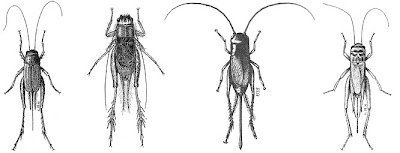
Remember when North American honeybees began to die off in 2006? Although a number of factors contribute to what has been called Colony Collapse Disorder, its exact mechanism remains a mystery. Well, something similar is happening to crickets. Although the cause - a cricket paralysis virus (3rd image) - is known, it is hard to eradicate and highly contagious within the house cricket species (Acheta domesticus, far right in the 1st image). Because this is the only species grown commercially in the U.S., the spread is causing a cricket shortage and necessitating caution among cricket farms that have not been hit. Among those that have, the effect is devastating. Consider the Lucky Lure Cricket Farm in Leesburg, Florida, less than 15 miles from where I live. The 9 million crickets they had on hand to sell to reptile owners, bait shops, zoos, and theme parks suddenly went silent in February. Owner Beth Payne (2nd image, with foreman John Legan) explains, "At first, we thought it was just a bad hatch." She consulted with a professor of entomology at the University of Florida to find that it was the aggressive virus, and tried to decontaminate and restart her operation 4 times before giving up in May and declaring bankruptcy, putting her 8 employees out of work. Lucky Lure had been in business since the 1950s, and the sound of the hordes of crickets was compared to a heavy rain or a stampede of horses. When I was in graduate school, we were trained to ask questions after presentations so that the speaker did not "hear crickets" in the audience. But that is exactly what these cricket farmers would like...

Thursday, June 24, 2010

Aerial archaeology


There are many subdisciplines in the field of archaeology - including biblical archaeology, ethnoarchaeology, experimental archaeology, historical archaeology, and maritime archaeology, to name a few - but one of the most interesting is aerial archaeology, the study of archaeological remains by examining them from altitude. Imagine this:
"What's that? The field of ripe barley at two o'clock, two miles, near the L-shaped wood? Those patterns can't be natural ... too regular. Let's have a closer look ... There! A series of rectangles one with a circle inside. We'll have that. ... Opening window! Wing down a bit! ... more... more... that's great!" Grab the 35mm camera - photograph the target - reach behind you for the 70mm camera - wait - it's clearer from this angle, photograph it again. Log your position on the GPS, mark up the report form on the knee pad and go back to scanning, as you search for a new target.
That is a description of the photographic reconnaissance, which can be done in person from a plane or remotely from a kite. Fields of cereals, sugar beets, and peas are ideal for spotting cropmarks, patterns of differential growth in vegetation caused by variations in the subsoil - which may be due, for instance, to the presence of stone wall foundations. But such indicators of archaeological deposits may also be spotted in soil, frost, rainwater, and shadow patterns. Adding other technologies, like imaging radar, further enhance what can be seen by the naked eye, like the outlines of an ancient city in Tel al-Daaba, Egypt. Many scientists are making use of the satellite images from Google Earth to identify geoglyphs, such as those revealed when the Amazon rainforest is clearcut (click on images for more information). Some also use Google Earth to document the looting of ancient sites and lobby for their protection. But Google Earth is also credited with facilitating armchair archaeology, which makes for some surprising headlines in the weird news, as when L.A. musician Nathan Smith found indicators of a Spanish ship that ran aground in Texas in 1822 - carrying gold and silver worth a possible $3 billion.

Wednesday, June 23, 2010

World population


Quigley here to dispel another widely-held belief. The idea that as many people are alive today as have ever lived is untrue. Population growth in human history reached the following milestones:
  • 1 billion in 1804
  • 2 billion in 1927
  • 3 billion in 1960
  • 4 billion in 1974
  • 5 billion in 1987
  • 6 billion in 1999
The current world population as of this month is estimated by the U.S. Census Bureau to be 6,829,000,000 and we are projected to reach 7 billion next year, according to the United Nations. The total number of people who have ever lived is calculated to be between 100 and 115 billion. "So, our estimate here is that about 5.8 percent of all people ever born are alive today. That's actually a fairly large percentage when you think about it," concludes Carl Haub of the Population Reference Bureau.

The math involves changes in birth rates and life expectancy, and was pioneered by Harvard demographer and statistician Nathan Keyfitz (1913-2010). It was British scholar Rev. Thomas Robert Malthus (1766-1834) who 1st pointed out that food supply increases arithmetically, while population increases exponentially, meaning that at some future point the world's population will become unsustainable. Malthus wrote in An Essay on the Principle of Population (1798):
"The power of population is so superior to the power of the earth to produce subsistence for man, that premature death must in some shape or other visit the human race. The vices of mankind are active and able ministers of depopulation. They are the precursors in the great army of destruction, and often finish the dreadful work themselves. But should they fail in this war of extermination, sickly seasons, epidemics, pestilence, and plague advance in terrific array, and sweep off their thousands and tens of thousands. Should success be still incomplete, gigantic inevitable famine stalks in the rear, and with one mighty blow levels the population with the food of the world."
There is some debate these days about whether the Industrial Revolution permanently altered this trajectory or merely staved off a Malthusian catastrophe.

Tuesday, June 22, 2010

Scullery maids


The lowliest member of the household staff was the scullery maid, an assistant to the kitchen maid. Yet she was still worthy of portrayal on canvas, as evidenced by the paintings above: "A Scullery Maid Preparing A Chicken" (1776) by German artist Willem Joseph Laquy (1st image), "The Scullery Maid (L'Ecureuse)" (1738) by French artist Jean-Simèon Chardin (2nd image), and "The Scullery Maid" (1705) by Italian artist Giuseppe Maria Crespi (3rd image). The grueling duties of a scullery maid were as follows and could last up to 17 hours a day:
  • Scrubbing the floor, stairs, and sinks
  • Scrubbing work tables
  • Scouring the pots, dishes, and utensils after each meal and morning and afternoon tea
  • Polishing brass and silver
  • Lighting the fires on the kitchen stoves and keeping them clean
  • Cleaning vegetables, plucking fowl, and scaling fish
  • Clearing away meat and vegetable garbage
  • Supplying hot water for tea and washing
Her duties may have included lighting the morning fires in the bedrooms and hauling warm water upstairs for bathing. The scullery maid may also have been required to wait on her fellow staff members and to empty their chamber pots.

In Victorian England, these tasks would certainly been performed by a woman, but in the Middle Ages female domestic servants were rare, so they would have been carried out by a man - a scullion.

Monday, June 21, 2010

Private islands


Since my post on Plum Island being put up for sale on the Atlantic coast, 2 other less industrial island properties have gone on the market:

Will-O-Isle (1st image), Putnam Lake, New York
$1.5 Million
After purchasing the island for a mere $72,500 35 years ago, a New York City ad executive and his family have used Will-O-Isle as a weekend getaway, rowing to it because there are no gas-powered boats allowed on Putnam Lake. The 5-minute ride is the equivalent of 3 city blocks, but takes you a world away. There is a 3-story, 4-bedroom stone home on the property, which was built in 1932.

Turkey Island (2nd image), Rock River, Iowa
$179,000
This 43.5-acre island in the Rock River close to its juncture with the Mississippi was acquired 13 years ago by a lumber company that built a sawmill on it to harvest and replant the maple trees. Once farmed by Sauk Indians and early settlers, Turkey Island now supports deer hunting and is a great place to dock a boat, swim, and get away. “When you are there, you feel like you are in a remote place. But you are not,” says the company president.

Curious about the ownership of private islands, I soon learned that the majority of those offered for sale worldwide - from Argentina to Zambia - are marketed through the Canadian firm Private Islands Online. They list dozens and dozens of islands for sale in the U.S. alone, from Ram Island, Washington, to Ram Island, Maine. You can search by state or country, by keyword (for instance, undeveloped islands or those boasting a helicopter pad), by type (islands with a residence or a beach), or by price (currently ranging from $30,000 to240,000,000).

Here is an article about the incentives and drawbacks to owning an island, with a slideshow of some of the priciest properties. Here is a list of celebrities who own islands. Lastly, there are both a magazine and a blog about privately-owned islands. I now know which island I will imagine owning...

Sunday, June 20, 2010

Rat netsuke


Traditional Japanese garments, including kimonos, had no pockets, so women tucked things in their sleeves, but men hung small pouches, baskets, or boxes from their sashes with beaded cords to hold their belongings. Beginning in the 17th c., these beaded cords were secured with small sculptures called netsuke, which have become collector's items. The L.A. County Museum of Art has an extensive collection, so I chose the rat-related netsuke to use as examples. These include a rat pair from the 18th c. (4th image); a seven rat group, a rat on a coiled rope, and a rat on a tobacco pouch from the mid-19th c. (2nd, 3rd, and 5th images); and a frustrated ratcatcher from the late 19th c. (1st image). The rat is one of the 12 signs in the Japanese zodiac (which parallels the Chinese zodiac, but differs from the Western zodiac in being divided into years rather than months). Those born in the year of the rat (1936, 1948, 1960, 1972, 1984, 1996, 2008) your ambition and tolerance for hardship make you a good worker. You are honest, except when you hide feelings of anger. This ability to control your emotions can make you manipulative, but you are fair and expect the same of others. You are highly organized, eloquent, and shrewd. And although have a tendency toward obstinacy and intolerance, you are considered sensitive, sociable, and quite charismatic! For more information on netsuke, try the International Netsuke Society. I think I want one for my birthday!

Saturday, June 19, 2010

How old?


Two women in 2 different centuries have claimed to live past the age of 150. The 1st was proven to be a hoax, and the 2nd cannot been authenticated.

Joice Heth (pictured above) was billed by American showman P.T. Barnum as "The greatest national and natural curiosity in the world." She was said to have been born in 1674, had nursed future president George Washington (1732-1799) while a slave, and was on tour in 1835 at the age of 161. Even though she was blind, toothless, nearly paralyzed, and toured with Barnum for only 7 months, Heth springboarded his career after he purchased her for $1,000 from her former promoter R.W. Lindsay. Her act - which consisted of telling stories about "little George," singing hymns, and entertaining questions from the audience - raked in a handsome profit for the showman. She performed for as long as 12 hours a day, 6 days a week, in everything from museums and concert halls to taverns and railway houses across the northeastern United States. Because of doubts raised repeatedly in the press about the authenticity of her age and even her person - some of it stirred up by Barnum himself to reignite interest, Barnum promised a postmortem examination. After Heth died of natural causes on February 19, 1836, Barnum engaged the services of surgeon David L. Rogers to perform an autopsy in New York's City Saloon before an audience of 1,500 - each of whom purchased a ticket for the privilege. When Rogers declared the age claim a fraud (she was probably no older than 80), Barnum insisted there was a case of mistaken identity and that Heth was still alive. Later he admitted the hoax.

Turinah has been discovered recently by census workers in Indonesia, who believe her claims to have been born in 1853, making her 157 years old. She still works around the house, has smoked clove cigarettes all her life, and has an adopted daughter aged 108. "Despite her age she still has an incredible memory, clear sight and has no hearing problems," says statistics bureau official Jhonny Sardjono. Turinah speaks fluent Dutch, a language used during the colonial period which ended in 1945. Although the Indonesian government accepts her age, the Guiness Book of World Records will not consider her claim - which would make her the oldest person who ever lived - because she burned her identification documents to avoid being linked to the attempted Communist takeover of the country in 1965.

Friday, June 18, 2010

Australian angel


The Gap is a picturesque rocky outcrop in Sydney Harbor that also happens to be the most frequently chosen location for Australians to commit suicide, with an average of 30 jumpers a year - and 15 times that number who decide not to make that 90M leap. Meet a man the media is calling an angel: Don Ritchie (pictured) has gently dissuaded some 160 potential suicides over the past 50 years. Ritchie, 82, is a former life insurance salesman who lives right across the street from the landmark and scans the ocean view while reading his newspaper. When he sees a likely jumper, Ritchie quietly engages them in conversation. Some accept his invitation to follow him home for something to eat or drink. Others slip out of his grasp, sometimes literally. He describes an experience with a young man who, as it turns out, grew up next door to Ritchie and played with his grandchildren: ‘‘I went over and I tried to talk to him, asking him questions about where he was from. He wouldn’t talk much, just kept looking straight ahead. I was talking to him for about half an hour…thinking I was making headway. I said ‘why don’t you come over for a cup of tea, or a beer, if you’d like one?’ He said ‘no’ and stepped straight off the side…his hat blew up and I caught it in my hand.’" The ones he saves return with thank you gifts or remember him with Christmas cards.

Although he was awarded a Medal of the Order of Australia in 2006 for his interventions, and he and his wife have been named 2010's Citizens of the Year by the town council, he shuns the limelight for fear it will attract more would-be suicides to Gap Park. He is glad for cell phones, which other visitors use to alert authorities, since his fence-climbing days are over. Ritchie doesn't try to counsel the people he meets, he just lends a friendly ear. He has heard from many survivors that a smile goes a long way. When he was interviewed, he was reading the Dalai Lama's The Art of Happiness. Every now and then, he would glance up to scan the horizon for anyone who might need him. He'll keep doing so, he says, for as long as he's here. Asked about when he's not, he chuckles softly and says, "I imagine somebody else will come along and do what I've been doing." Still, the council has succeeded in having security cameras installed and has lobbied the government for additional security measures.

Thursday, June 17, 2010

Seven Sutherland sisters


When you tally it up, the world-famous Sutherland sisters (1st image, with their brother Charles) had more than 36' of hair:
This gave them a place on P.T. Barnum's stage and in advertisements for the hair products their father developed - including shampoo, hair grower, dandruff remedy, and scalp cleaner (3rd image) - based on a foul-smelling concoction their mother had used on them as children in rural New York. On stage for Barnum, they sang and danced before dramatically letting down their "Niagara of curls" to thunderous applause. During their years of stage performances and their decades of entrepreneurship, they had their misfortunes (early deaths, mental illness, failed marriages, bad investments) and after their retirement from show business they had their eccentricities (elaborate pet funerals, gold-shod carriage horses, and bodies allowed to lie in state in their home for weeks on end). Their continued endorsement of one of the bestselling beauty products of the turn of the century made them millionaires, but the money didn't last. The Sutherland sisters were precursors of the women's movement, but the popularity of shorter hairstyles for women ended the success of their hair tonics. The surviving sisters spent their later years in their hometown in a mansion that burned to the ground after their deaths.

Wednesday, June 16, 2010

The most interesting person in the world


The television ads for Dos Equis beer crack me up! They build up a mythology about a man with the following qualities:
  • His legend precedes him, the way lightning precedes thunder.
  • His personality is so magnetic, he is unable to carry credit cards.
  • He never says something tastes like chicken - not even chicken.
  • His beard alone has experienced more than a lesser man's entire body.
  • He's been known to cure narcolepsy just by walking into a room.
  • He once had an awkward moment, just to see how it feels.
  • He lives vicariously - through himself.
  • His charm is so contagious, vaccines have been created for it.
  • His blood smells like cologne.
  • In museums he is allowed to touch the art.
  • Even his enemies list him as their emergency contact number.
  • People hang on his every word, even the prepositions.
  • He can speak French - in Russian.
  • He wouldn't be afraid to show his feminine side - if he had one.
If you have not seen the commercials, they are all collected here. And here is the associated website The Most Interesting Academy, which was "founded in an unknown year by a group of fascinating people whose names have been lost to history (probably intentionally)." The most interesting man in the world, played by Jonathan Goldsmith, is the Academy's distinguished emeritus, grand benefactor, and patron sage. "I don't always drink beer, but when I do, I prefer Dos Equis," he says. As one cultural critic puts it, "The most interesting man in the world, by definition, would not be found enthusiastically endorsing a mass-market consumer product." In other words, he will drink the beer he's selling when he damn well pleases, but bloggers suggest that he prefers scotch. In any event, stay thirsty my friends.

Tuesday, June 15, 2010

Bouler's birds


If you watched the CBS Evening News last night, you were introduced to a passionate and empathetic 11-year-old. Olivia Bouler is turning her talent for drawing to funding relief efforts for the birds of the Gulf, where she vacations every year. "It wasn't fair for them. They didn't do anything wrong," she says. The future ornithologist was devastated by the news of the oil spill and motivated to raise awareness and money. Olivia is sending one of her drawings to each of the donors to the National Audubon Society. The first 500 will be original drawings, after which she will send limited edition prints. Examples above are from her Facebook page, which now has more than 18,000 fans, and donations total more than $100,000. The funds will be used for animal rescue and to establish a new bird habitat in the Gulf. I made a donation last night. If you would like to contribute, too, donate here and then forward the receipt to Olivia at oliviasbirds@aol.com.

Monday, June 14, 2010

Faux fur


I have mentioned the extinct Tasmanian tiger - or thylacine - before and linked to film footage of it. But the news today is that Hobart artists David Hurst and Rebecca Kisling (2nd image) created an imitation thylacine hide - complete with head and tail - from a merino sheepskin. Hurst relishes the irony of bringing the Tasmanian tiger back (in a sense) through the use of one of its favorite meals - one of the stock animals it was hunted to extinction for killing. The replica pelts have been crafted in a limited edition and will sell for $6,000.* One of Hurst's 1st clients is Tasmania's Mole Creek Hotel. The artist likes the idea of the faux hides becoming tactile displays.

Hurst did his research before he embarked on the project, and has touched and smelled authentic thylacine skins like the tanned specimen of one of the last wild tigers shot in 1930 and curated at the National Museum of Australia (1st image). Hurst's creations are a fraction of the cost of what the real thing can fetch at auction. In 2002, a rug made from genuine pelts of eight tasmanian tiger pups sold for nearly $270,000.

*At current exchange rates, the Australian Dollar is currently worth .861 of the U.S. Dollar.

Sunday, June 13, 2010

Starlight camera


While it is possible to photograph nature under low-light conditions using a traditional camera, and the starlight camera is promoted as a means of surveillance, wildlife filmmakers are embracing the technology. With it, they can capture the behavior of animals like hyenas (1st image), badgers (2nd image), and other species (watch film clips) non-invasively. Filming on location in Kenya, a team shooting the BBC/Discovery series "Human Planet" took advantage of an image intensifier camera in combination with a full moon to capture scenes of the elephants, which are most active at night. The team's researcher Renee Godfrey describes the experience:
"So we sit and wait downwind in our hide, in the black of the night, listening for breaking branches as elephants walk through the bush or the padding of big feet on sand. The riverbed below is an opera stage and we sit above in the Gods, waiting for the performance to begin. The moon aches with light as it casts shadows that play tricks on your eyes. Suddenly and silently, from nowhere, a herd of 18 elephants arrive on stage; babies, mothers, brothers all dance under the moonlight. White faces and whiter teeth smile, and we try to breathe and blink as quietly as we can. Mark Deeble, the cameraman, changes lenses on the camera as if carrying out a Tai Chi routine – every move thought through and with slow, silent grace so as to keep the elephants unaware of our existence.

The elephants move underneath us, babies playing with each other and running around gangly legged and trunked, trying to copy the behaviour of their elegant peers. We are captivated, camera rolling. Trunks touch trunks and tusks gleam brilliantly, irridescent under Nature’s spotlight, until the sound of a distant trumpeting call from deep within the bush breaks the silence and lifts every hair on my body. Another herd are on their way – tonight’s performance is far from coming to an end.

Unexpectedly the evening breeze drops and a light wind blows from our hide down into the riverbed. Within seconds, the herd of elephants below us run off in total silence, back into the acacias. The wind picks up and we realise our human scent will now be drifting up the riverbed and the wise elephants will be heading far away from us. Exhausted but invigorated by what we have just witnessed, it’s time for bed on our mattresses under the blanket of stars. If the wind changes they could come back – this time the elephants would be the ones aware of our existence… while we dream and snore the rest of the night away."

I think I would prefer elephant-gazing to star-gazing...

Labels