Wednesday, March 31, 2010

Ghanaian caskets


The West African nation of Ghana has become known over the last 50 years for the creative caskets custom-made to reflect a person's trade or interest. The tradition apparently began when a village chief had a sedan chair made in the shape of an eagle by a crafstman named Ata Owoo. A neighboring chief then had one commissioned in the shape of a cocoa pod, but died before it could be delivered, so it became his casket. When an apprentice's grandmother, who had never flown, died in 1951, her family had a casket in the shape of an airplane built to bury her. According to another story, the demand for "fantasy caskets" began when a fisherman was buried in a fish-shaped casket: "Ever since then photographers have been buried in camera-shaped coffins, people who like to drink in caskets shaped like beer bottles, and avid smokers - you guessed it - in cigarette-like wooden coffins." In the ensuing years, caskets have been commissioned in many forms:
angel, antelope, Bible, bull, canoe, car, crab, elephant, hammer, leopard, lion, lobster, mobile phone, pineapple, red pepper, rooster, sewing machine, shallot, shoe, snail
Caskets can take a month to build and can cost the equivalent of a year's wages. The only regret that the artists and carpenters of the Ga tribe have is that what they have spent weeks creating ends up underground, where it can't be seen. There are some that won't be buried - 12 by Kane Quaye, who has crafted them for 30 years in his workshop in Accra, Ghana - on display at the National Museum of Funeral History in Houston, Texas. The Amsterdam arts organization Mediamatic also ordered some caskets, including a customized teddy bear, for exhibit.

Another artisan Joseph "Paa Joe" Tetteh Ashong, who opened his shop Six Foot Enterprise in 1962, explains that most Ghanaians are still buried in traditional caskets, which he also makes. The custom coffins are popular with the wealthy, foreigners who buy them as art, and the just plain eccentric.

Monday, March 29, 2010

Bibles stopping bullets


"In addition to all this, take up the shield of faith, with which you can extinguish all the flaming arrows of the evil one."--Ephesians 6:16

Whether or not you take this Bible passage literally, the book itself has saved lives by shielding believers from bullets fired in war, during crimes, or by accident.

May 2009 Rodeo del Medio, Argentina Protestant minister Mauricio Zanes Condori, 38, was trying to talk 2 thieves out of robbing his church when one of them shot at his chest with a handgun from a distance of 2M. The psalm book he held to his chest slowed down and deflected the bullet, which left him with only a scratch.

April 2008 Hambden, Ohio, U.S.A. A deer slug fired by a 17-year-old hunter penetrated the outside and several interior walls of a house before lodging in a Bible on a closet shelf, sparing the members of the family who were all home at the time.

August 2007 Rustamiyah, Iraq U.S. soldier Pfc. Brendon Schweigart, 22, was helping retrieve a tank in Iraq when he was hit by a sniper's bullet. The bullet ended up lodged in the Bible (2nd image) he received in boot camp and was carrying in his shirt pocket.

November 2006 Orange Park, Florida, U.S.A. A 54-year-old man was ambushed with a rifle while taking out his trash. One bullet clipped his cap, and a second was stopped by 2 New Testament Bibles he was carrying in his shirt pocket to give to friends. He was left with only a red mark and some pain in his chest.

November 2001 North Fort Myers, Florida A woman intent on shooting and killing her sons to spite her mother-in-law was thwarted in the case of her 16-year-old, Kenneth Wallace, whose leather-covered Bible stopped almost all of the shotgun's blast.

January 1920 New York, New York, U.S.A. During a quarrel, Frances Cierco was stabbed in her apartment. During his escape, the assailant shot the building's janitor at point-blank range, but the bullet struck a prayer book in his coat pocket and dropped, spent, into the pocket of his vest.

1918 Germany
American soldier W.R. Wilson's Bible spared his life from a German sharpshooter's bullet, leaving him with only a flesh wound to his chest. Upon release from the hospital, he intended to donate the Bible to the National Archives.

1916 France The Bible used by New Zealand Corporal William Henry Pimm saved his life during World War I (though he died of combat wounds 2 days later). "The story goes that he was praying with his bible before battle. From what we can understand, he was closing it as the stray bullet went in," says his great-great-grandnephew. The family heirloom (1st image) is being auctioned on-line for more than $100,000.

June 1863 Port Hudson, Louisiana, U.S.A. Arkansas soldier Julius Glover Elmore was one of 6,700 Confederate troops defending Port Hudson during the Civil War. When he was felled by a Federal bullet, he was believed killed, but he regained consciousness and the miniball was found lodged in the Bible he carried.

April 1862 Shiloh, Tennessee, U.S.A.
Confederate soldier Sam Houston, Jr., carried a Bible into the Battle of Shiloh during the American Civil War. A bullet entered the book, which was in the breast pocket of his coat and is now in the Sam Houston Memorial Museum in Texas, and stopped at the 70th Psalm.

With more people carrying a gadget than the "Good Book" these days, there are stories of bullets being stopped by a laptop and a Blackberry, though the report of an iPod saving a life has been discredited. And while the Mythbusters disproved the likelihood of a 400-page book stopping a bullet, the dozens of reports to the contrary suggest that this is more than an urban legend.

Auto-appendectomy


If you have a weak stomach, consider skipping this post. It is not about the heroic biopsy that the scientist in the Antarctic performed on herself. It is not about the horrific instances in which pinned hikers amputate their own limbs. It is not about trepanation, which some have carried out on themselves. And it is not about the psychologically dubious act of self-castration. It is about 2 specific instances - 40 years apart - of doctors who performed their own appendectomies.

American surgeon Evan O'Neill Kane (1861-1932) believed that the general anesthetic ether was being used too liberally and wanted to test whether patients could tolerate surgery under a local anesthetic. Using mirrors, he removed his own appendix in 1941 - this at a time when the surgery required a much larger incision than it does today. The appendectomy was a success and he was back at work 36 hours later. This was just 1 of 3 self-surgeries by Dr. Kane: in 1919 he had amputated his own finger after it became infected, and in 1932 he repaired his own inguinal hernia (1st image). Of the hernia surgery, Time magazine reported, "To the operating room in Kane Summit Hospital he summoned a, reporter and a news photographer. While they recorded details he propped himself on an operating table, cleaned the left groin where he was to cut, gave himself a local anesthetic, proceeded to operate. He chatted and joked with the nurses as he cut, sponged and sutured for 1 hr. 45 min." Again, he was back at work less than 2 days later.

Russian physician Leonid Ivanovich Rogozov (1934-2000) spent September 1960 to October 1962 caring for 13 researchers at the remote Novolazarevskaya Station in Antarctica. While there he suffered weakness, nausea, fever, and abdominal pain that indicated peritonitis. With no option for evacuation, the only life-saving alternative was to take out his own appendix. He performed the 2-hour surgery in a semi-reclining position, half-turned to his left side (2nd image). Three men stood by: one to hand him instruments, a second to hold a mirror and adjust the lighting, and a 3rd to stand by in case either of the others couldn't continue. "I didn’t permit myself to think about anything other than the task at hand. It was necessary to steel myself, steel myself firmly and grit my teeth....My poor assistants! At the last minute I looked over at them: they stood there in their surgical whites, whiter than white themselves. I was scared too. But when I picked up the needle with the novocaine and gave myself the first injection, somehow I automatically switched into operating mode, and from that point on I didn’t notice anything else," remembered Dr. Rogozov. He anesthetized the area with novocaine, removed his perforated appendix, and administered antibiotics directly into his peritoneal cavity. A 1/-hour into the operation, he began experiencing weakness and nausea, so he paused frequently, but he recovered fully in 1 week and 2 weeks later resumed his normal duties.

While Dr. Kane's operation is accepted as the 1st example of a self-appendectomy, Dr. Rogozov was unaware of it when he performed his operation under dire consequences and with no possibility of outside help.

Sunday, March 28, 2010

The devastation of St. Pierre


At 7:50am on May 8, 1902, Mt. Pelée on the French-Caribbean island of Martinique roared to life. In a single minute, the deafening blast sent a superheated cloud of gas, ash, and rock (2nd image) down the south slope of the volcano, killing the 28,000 residents of St. Pierre, the "Paris of the West Indies." The crews and passengers of 18 ships were also killed. There were, at most, 2 survivors.

One of these was Léon Compere-Léandre, a young shoemaker, who described the disaster that struck as he was sitting on his doorstep on the outskirts of the city:

"I felt a terrible wind blowing, the earth began to tremble, and the sky suddenly became dark. I turned to go into the house, with great difficultuy climbed the three or four steps that separated me from my room, and felt my arms and legs burning, also my body. I dropped upon a table. At this moment four others sought refuge in my room, crying and writhing with pain, although their garmets showed no sign of having been touched by flame. At the end of 10 minutes one of these, the young Delavaud girl, aged about 10 years, fell dead; the others left. I got up and went to another room, where I found the father Delavaud, still clothed and lying on the bed, dead. He was purple and inflated, but the clothing was intact. Crazed and almost overcome, I threw myself on a bed, inert and awaiting death. My senses returned to me in perhaps an hour, when I beheld the roof burning. With sufficient strength left, my legs bleeding and covered with burns, I ran to Fonds-Sait-Denis, six kilometers from St. Pierre."


The other man to survive had a prison cell to thank for his protection - a cell which still exists (3rd image). Louis-Auguste Cyparis a.k.a. Ludger Sylbarus (c. 1875-c. 1929) was a 25-year-old imprisoned for wounding a friend with a cutlass. Four days after the eruption, he was found, and received a pardon after he recovered from his burns. Cyparis joined the Barnum & Bailey Circus and was billed as "The Lone Survivor of St. Pierre" (1st image). He showed his burns and toured with a replica of his cell.

A 3rd apocryphal witness to the events narrowly escaped being killed by them. A young girl named Havivra Da Ifrile was on an errand halfway up the flank of Mt. Pelée on her way to church services in St. Pierre when she saw smoke emerge from the crater and engulf residents of the city. She ran to her brother's boat on the show and rowed to refuge in a cave. "But before I got there I looked back -- and the whole side of the mountain which was near the town seemed to open and boil down on the screaming people. I was burned a good deal by the stones and ashes that came flying about the boat, but I got to the cave," she remembered. She lost consciousness and was found drifting 2 miles out to sea.

After the eruption, a lava dome rose 1,000' out of the crater of the volcano, finally collapsing 11 months later. Coincidentally (because it was not the catalyst for this post), Mt. Pelée's dome partially collapsed in February of this year and heavy rains triggered a series of small to moderate pyroclastic flows.

Friday, March 26, 2010

Tarim mummies travel


Three mummies have been transported to the U.S. to be displayed in the exhibit "Secrets of the Silk Road" (March 27, 2010 - July 27, 2010) at Bowers Museum in Santa Ana, California:
  • The "Beauty of Xiaohe" (1st image) is almost perfectly preserved - right down to her eyelashes - despite being 3,800 years old. The editor of the exhibit catalog calls her "the Marlene Dietrich of the desert."
  • A mummified baby has stones covering his eyes and a nose stuffed with red wool. He had been buried with a "baby bottle" made of a sheep's udder.
  • "Yingpan Man" (3rd image) comes equipped with grave goods and dressed in silk finery. He had been given a gold foil death mask in the Greek tradition and has a blond beard underneath.
The mummies date to the Bronze Age, but the story of their excavation begins in 1934 when their tomb complex was discovered by Swedish archaeologist Folke Bergman (1902-1946). They lay inside a huge sand dune covered with 2,500 wooden stakes (2nd image) in the Lop Nur desert of western China. The Xiaohe tombs were rediscovered in 2003, just as Bergman had described them nearly 70 years earlier, by Idelisi Abuduresule, director of the Xinjiang Archaeological Institute. Careful excavation of just the upper 2 layers of the western section of the dune revealed 33 tombs and yielded 15 intact mummies. About half of the estimated 330 tombs have now been uncovered. "When we unraveled the cowhide used to wrap the coffins, the wood looked as fresh as the day it was buried, and the tombs' occupants lay cleanly in their coffins, free from the invasion of a single grain of sand," described Idelisi. The dead had been buried in boat-shaped coffins with woollen clothing and more than 1,000 cultural artifacts, including gold jewelry, straw baskets, stoneware, and jade and wooden carvings. The mystery of the Tarim mummies (also known as the Ürümchi mummies) is their inexplicable Caucasoid features, which suggest that they or their ancestors came to China from central Europe. It is unknown whether they were nomads, adventurers, or raiders along the Silk Road.

The exhibit will travel in 2011 to the Houston Museum of Natural History and the University of Pennsylvania Museum of Archaeology and Anthropology.

Dwarfs on display

"In photographing dwarfs, you don't get majesty and beauty. You get dwarfs."--American author and art critic Susan Sontag (1933-2004)


China got a lot of press recently for opening a theme park populated by dwarfs. Announcement of the opening of the so-called Dwarf Village raised questions about the ethics of the attraction and compared it to the human zoos of the past. Here are the 1st few sentences of a review of the book Spectacle of Deformity that I just wrote for Fortean Times:
"During my first conversation many years ago with sideshow historian James Taylor, he disabused me of the notion that the acts – dwarfs, giants, conjoined twins, human skeletons, albinos, leopard boys, and bearded ladies – were exploited. Author Nadja Durbach does the same in the introduction to this volume. 'Posterity,' she writes, 'is condescending.' Mentally competent freaks saw the exhibit of their bodies as a means of self-support and, in some cases, an alternative to institutionalization."
In America and Europe, dwarfs and midget families have a long history of performing at circus sideshows. The dwarf children of the Ovitz family formed the Lilliput Troupe and took the stage throughout eastern Europe. The Doll Family worked for Ringling Brothers and Barnum & Bailey and appeared in several films. Admiral Dot, Commodore Nutt, and General Tom Thumb and Lavinia Warren (whose marriage was heavily promoted) all worked for legendary showman P.T. Barnum (1810-1891).

But I also ask you to consider that contemporary Chinese hiring practices discriminate on the basis of height, prompting some average-sized citizens to undergo costly, lengthy, and excruciating limb-lengthening surgery to gain an advantage. The dwarfs at the park are gainfully employed and self-sufficient. They are not shunned or bullied, which in the past has led some to attempt suicide, and instead have found camaraderie and respect. By seeing the dwarfs perform at the park, says its owner, the public will leave impressed by their skills and courage. By living and working together, the dwarfs enjoy being part of a community of people who all face the same challenges.

That said, here are some occupations that dwarfs undertake today, knowing that their physical anomaly will be a big draw that some will find offensive: bullfighting, boxing, dwarf tossing. Rolling Stones guitarist Ronnie Wood raised eyebrows when he expressed his desire to hire dwarfs to play tricks on the guests at his daughter's wedding.

In comparison, working at Yunnan Province's Kingdom of the Little People seems like a pretty good gig. The 80 or so dwarfs receive relocation fees, a good weekly salary, and free room and board. They live in dormitories, but during the day act in skits in the performance hall and pretend to live in the 33 fairy-tale cottages. They have access to dance training and English lessons. All between 2' and 4' 3", they are served by an on-site police force and fire brigade.

It is not for us to judge. They have voices of their own.

Thursday, March 25, 2010

Blood donor heroes


We all know that blood donation saves lives, but statistics show that only 3 of every 100 Americans give blood. In the news, 3 heroes for this very reason:

Americans Maurice Wood, 83, and Al Fischer (pictured), 75, have a friendly rivalry going. They are the only 2 people in the U.S. who have donated 320 pints of blood - that's 40 gallons! Wood crossed the proverbial finish line first, with Fischer reaching the goal in September 2009. "Some people give money," he said. "I give blood. It's my cause and has been for a long time. I haven't stopped. I'm going to keep doing it until I drop." He receives cheers when he turns up at a blood drive and he has received a "Heroglobin Award," but Fischer does it not for the accolades, but to help people in need. "What if your mother needed blood? Would you give blood?" he asked. "What about your brother? How about your next-door neighbor? How about all mankind?"

Australian James Harrison, 74, is called "the man with the golden arm." He has been donating his blood, which contains a rare antibody, for 56 years. His plasma stops babies - including his own grandchild - from getting brain damage or dying from Rhesus disease, a form of anemia. It has also been used to develop a vaccine for pregnant women and newborns. Harrison has donated blood 984 times since requiring a 13-liter transfusion during major chest surgery as a teenager. "I've never thought about stopping. Never," he says. "I was in hospital for three months. The blood I received saved my life so I made a pledge to give blood when I was 18." Harrison's donated blood has saved the lives of more than 2 million babies.

American Jim Becker, 79, began selling his blood four times a year in 1956 to cover the cost of season tickets to the Green Bay Packers football games without breaking the budget of his growing family. After 23 years, Becker found out that he had the same disease that killed his father at age 43, a rare disorder that causes excess iron in his blood - and would have killed him, too, except for having blood drawn regularly. Becker had no idea he had been keeping the disease at bay all these years. "There's no cure for it," he said. "They said the only way to lessen it was to give blood, because the blood draws the iron out of the system." He has therefore helped himself in addition to countless others.

Tuesday, March 23, 2010

Last to see Lincoln


This man, who died the year I was born, was the last person alive to have viewed the face of American president Abraham Lincoln (1809-1865). Fleetwood Lindley (pictured in 1963 and as a young boy) remembered the day clearly and recounted it many times.

When Lincoln's sarcophagus was to be permanently interred in a newly-built tomb in Springfield, Illinois, in 1901, Lindley's father – a friend of the president and one of a team of men who had taken it upon themselves to safeguard his remains after they had almost been stolen – pulled the 13-year-old boy out of school with instructions to ride his bicycle quickly and secretly to Oak Ridge Cemetery. Lindley hurried to the tomb and was ushered into a chamber that contained 22 people, including several members of the so-called Guard of Honor. The room contained a fan, a lamp, and the exhumed casket on a pair of sawhorses. The windows had been covered over so that no one could see inside. The same two plumbers who had sealed the casket in 1884 used chisels to reopen it, releasing a pungent, choking smell. Lincoln's face was revealed, and Linwood realized at the time that it was a lifetime experience. White chalk had been applied by an embalmer to the president's dark brown face, the headrest had fallen so that his neck was thrown back, and his eyebrows were missing, but the mole on his cheek and the coarse black hair were easily recognizable. Though his clothing had mildewed, Lincoln was dressed elegantly in a black broadcloth suit, a small black bow tie, and a pair of kid gloves. The casket lid was resoldered and Linwood was allowed to hold one of the leather straps as it was lowered beneath the tomb floor and sealed with concrete.


Lindley died at the age of 75 and was buried in the same cemetery as Lincoln's tomb. He had told his story in person to California professor Ronald Rietveld - who had been a boy of about the same age when he discovered the only existing photograph of Lincoln in his casket.

Monday, March 22, 2010

Faked photo


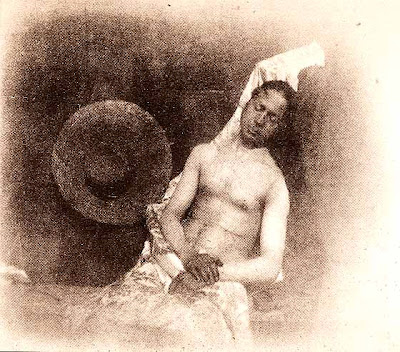
On the back of the 1840 photograph (1st image), a note penned in French:
"The corpse of the gentleman which you see on the other side is that of M. Bayard, the inventor of the process whose marvelous results you have just seen or which you are going to see. As far as I know, this ingenious and indefatigable researcher has been busy perfecting his invention for about three years. The Academy, the king, and all those who have seen his drawings, which he himself considered imperfect, have admired them as you are admiring them at this moment. This has honored him greatly and has earned him not a penny. The government, which had given far too much to M. Daguerre, said it could not do anything for M. Bayard, and the poor man drowned himself. O, the fleeting nature of human things! Artists, scientists, and newspapers have been concerned with him for a long time, and now that he has been exposed at the morgue for several days, nobody has yet recognized him or asked for him. Ladies and gentlemen, let us pass on to other things, for fear your sense of smell may be affected, for the head and the hands of the gentleman are beginning to rot, as you can see."*
The drowned man was French photographer Hippolyte Bayard (1807-1887) and he was very much alive. The discoloration on his face and hands was not decomposition, but a summer tan - as much a process of the sun as the direct positive method of photography that he had invented a year earlier, and for which he had received no recognition. Instead, Louis-Jacques-Mandé Daguerre (1787-1851), the inventor of the eponymous daguerreotype, was basking in the limelight.

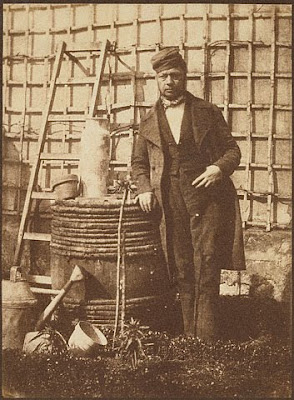
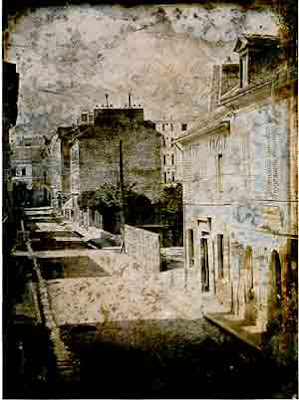
Bayard missed out on being considered the inventor of photography, but was photographing the streets of Paris (3rd image) in 1845 and posing for a self-portrait as a gentleman gardener (2nd image) in 1847. In fact, his career lasted another 4 decades. "Self-Portrait as a Drowned Man," a work that registers Bayard's bitterness and resignation, survives him as the 1st fictional photograph - 150 years ahead of the release of Adobe Photoshop, which makes hoaxing photos all too easy.

*Translated text quoted from A New History of Photography edited by Michel Frizot (Konemann, 1998).

Authentic photo


This famous photograph (1st image) - "Loyalist Militiaman at the Moment of Death, Cerro Muriano, September 5, 1936" - was taken during the Spanish Civil War by Hungarian photojournalist Robert Capa (1913-1954). It was originally published in a French magazine with a 2nd similar image of one of the man's fellow resistance fighters and the caption, “With lively step, breasting the wind, clenching their rifles, they ran down the slope covered with thick stubble. Suddenly their soaring was interrupted, a bullet whistled — a fratricidal bullet — and their blood was drunk by their native soil.”

Allegations that the "Falling Soldier" photograph was staged were first made in 1975. In 1996, a British journalist identified the soldier falling to his death as Mario Brotóns Jordá, who was documented to have been killed in that location on that day, but the authenticity of the photo itself was still disputed in 1998 by a British historian.

To refute the suggestion that Jordá had posed for the photograph prior to his death, Capa biographer Richard Whelan had the photo analyzed forensically by Captain Robert L. Franks, chief homicide detective of the Memphis Police Department and a talented photographer in his own right. Whelan writes, "The most decisive element in his reading is the soldier’s left hand, seen below his horizontal left thigh. Capt. Franks told me in conversation that the fact that the fingers are somewhat curled toward the palm clearly indicates that the man’s muscles have gone limp and that he is already dead. Hardly anyone faking death would ever know that such a hand position was necessary in order to make the photograph realistic. It is nearly impossible for any conscious person to resist the reflex impulse to brace his fall by flexing his hand strongly backward at the wrist and extending his fingers out straight." With this evidence, Whelan suggested that it was time to let both Capa and Borrell rest in peace, and to acclaim the "Falling Soldier" once again as an unquestioned masterpiece of photojournalism and as perhaps the greatest war photograph ever made.

Robert Capa (2nd image) died with his camera in his hand when he stepped on a land mine while documenting the First Indochina War - years after swearing off combat photography. While fleeing Europe in 1939, he had lost thousands of his negatives, leaving them behind in a Paris darkroom. These made their way, via the darkroom manager and an anonymous filmmaker, to Mexico. Surfacing in the 1990s and transferred to the International Center of Photography in 2007, these photos became the centerpiece of an exhibit of Capa's life and work that also included contact sheets (3rd image), caption sheets, handwritten observations, personal letters and original magazine layouts.

Sunday, March 21, 2010

Vitruvian people


No doubt you are familiar with the 1st image, even if you don't know its formal name. This version of Vitruvian Man was drawn by Renaissance artist Leonardo da Vinci c. 1487. The name refers to ancient Roman architect Marcus Vitruvius Pollio (1st c. B.C.), who described the human figure as the main source of proportion in classical architecture. Some of the proportions set forth in his text are as follows:
  • the length of a man's outspread arms is equal to his height
  • the distance from the top of the head to the bottom of the chin is 1/8th of a man's height
  • the maximum width of the shoulders is 1/4th of a man's height
  • the length of the hand is 1/10th of a man's height
  • the distance from the bottom of the chin to the nose is 1/3rd of the length of the head
  • the length of the ear is 1/3rd of the length of the face
  • the length of a man's foot is 1/6th of his height
Leonardo's diagram, based on Vitruvian proportions, expresses his belief that the workings of the human body were an analogy for the workings of the universe. Many other artists (see slideshow) have interpreted Vitruvius's words over the centuries, including German artist Albrecht Dürer in 1528 and English poet and printmaker William Blake in 1795.

But were you aware that there are a number of Vitruvian women? As a modern response to the idea that man is the measure of all things, a woman has been drawn in his place. Pictured (2nd image) is "Sex Change for Vitruvian Man" (2005) by contemporary Australian artist Susan Dorothea White. Also of note is "Vitruvian Woman" (1989) by contemporary American artist Nat Krate. There have also been a performance piece (1980) and a video installation (2009) intent on feminizing the iconic image of the Vitruvian Man - without giving him a "wife," as was done with the Visible Man.

Saturday, March 20, 2010

Capture myopathy


I was unaware that capture myopathy is a big danger when handling wild animals until I saw the condition referenced in this article about the National Zoo losing almost their colony of big-eared bats (drawing, 1st image). Capture myopathy - also known as exertional, transport, stress, or degenerative myopathy; exertional rhabdomyolysis; or white muscle disease - is a non-infectious disease characterized by damage to muscle tissues brought about by extreme exertion, struggle, or stress. It is incurable and caused by a change in metabolism that causes a buildup of lactic acid in the bloodstream that causes muscle to die. It can occur in mammals (particularly ungulates) and birds anywhere that wildlife is trapped or captured, and may be exacerbated by warm weather. Marked by increased breathing and heart rate, uncoordinated movement (a stiff gait or tremors), and red or brown urine, onset of capture myopathy make take weeks or mere minutes. It often results in death, and a necropsy will show swollen kidneys and hemorrhage or edema in the muscles and lungs. Animals with a deficiency of selenium in their diet may be predisposed to capture myopathy. Other factors include species, age, previous experiences, general health, genetics, and learned/innate behavior. To prevent the disease, experts recommend minimizing pursuit and handling time, selecting appropriate weather conditions, and placing animals in a less stressful environment as quickly as possible.

In a court case in Maine about the trapping of lynx, an expert witness testified that capture myopathy is the equivalent of post-traumatic shock in humans. Biologists in Spain warn about susceptibility to the disease when capturing little bustards (3rd image) for radio-tagging, and write that it is seen frequently in long-legged birds, like flamingoes, ostriches, and cranes. Operation Migration, which reintroduces endangered whooping cranes into the wild, recommends hooding the birds when they are handled for banding or physical examination. A survey by a member of the Deer, Elk & Reindeer Farmers' Information Network found that of a total of 5,200 animals, capture myopathy occurred in 6% of fawns, 12.5% of yearlings, and 20.6% of adults. The Irish Hare Initiative warns that capture myopathy has ethical and practical implications for researchers, veterinary professionals, carers, conservationists, and field sports enthusiasts. Western Animal Rescue of Australia urges those who report an injured or displaced wallaby or kangaroo (joey pictured, 2nd image) to simply observe the animal until help arrives, since they don't handle capture very well. And the American Mustang Foundation points out that round-ups of wild horses result in instances of capture myopathy, requiring euthanasia after injuries sustained during capture, dying during transport, or suffering severe stress triggered by the sound of helicopters like those used to capture them. It certainly makes the Chincoteague Pony Swim seem a little less romantic...

Friday, March 19, 2010

The Cabinet of Dr. Caligari


My friend Sharon Packer, M.D., a clinical psychiatrist, asked me a while back if the name of my blog was in reference to the German Expressionist film "The Cabinet of Dr. Caligari". No, I answered, it refers to a cabinet of curiosity. Well, her curiosity was attuned to psychiatry and the movies, and she now has 3 books under her belt, one of which was chosen as a Choice Outstanding Academic Title:
  • Dreams in Myth, Medicine, and Movies (Praeger, 2002) The author describes how surrealist artists purposely applied Freudian dream theories to their art to make the public aware of modern ideas about dreams.
  • Movies and the Modern Psyche (Praeger, 2007) She discusses how trends in psychological treatment, such as talk therapy and medicines like Thorazine and antidepressants, are represented in film and how these representations influenced psychological practice.
  • Superheroes and Superegos: Analyzing the Minds Behind the Masks (Praeger, 2009) In the first book about superheroes written by a psychiatrist in over 50 years, Packer invokes biological psychiatry to discuss such concepts as "body dysmorphic disorder," as well as Jungian concepts of the shadow self that explain the appeal of the masked hero and the secret identity.
The Cabinet of Dr. Caligari is discussed in all 3 of the books, and can be watched here. Caligari is an asylum director turned carnival hypnotist, who compels his somnambulist - an inmate at the asylum - to murder. The staff realize that Caligari is himself insane and have him arrested. The story is told by one man to another and it is not revealed until the end of the film that the storyteller is the resident of a mental institution, which undermines the tale in which he plays a large part.

Siegfried Kracauer makes the point in his book From Caligari to Hitler that Caligari is the prototype of the authoritarian ruler - himself insane - who forced others to commit equally insane acts, eerily suggestive of the events that would take place 25 years later in Nazi Germany. "Caligari's continuing success suggests that people are still perturbed by the possibility of losing control during dream and sleep, and that people share a near universal fear of committing criminal acts while unconscious, and that people harbor a lingering fear of archvillain authority figures who impose themselves on others," writes Packer (2002). "Essentially, this 1919 classic is still capable of tapping into our deepest concerns about social control and personal responsibility." Some critics saw Caligari as Sigmund Freud (1856-1939), and biographers confirm that it was no accident that the film's screenwriters focused on an evil psychiatrist who turned out to be a sideshow charlatan and an asylum inmate: Alfred Janowitz hated the psychiatrist who alleged that he faked battle fatigue during the war and Carl Meyer was embittered because he lost a brother to battle and lost his father to suicide while still a youth.

The Cabinet of Dr. Caligari is so well-known that it is often assumed to be the first great film ever made, the foremost example of German Expressionism, the first horror movie, or the first depiction on film of an evil psychiatrist, although none of those superlatives is quite true. But as one of the most memorable films in its genre, Caligari has affected viewers and makers of movies. Film noir owes its origins to German Expressionist film and Batman's creator has credited it with inspiration. Packer (2009) writes, "...Batman's aesthetic was directly influenced by the harsh angles and dark shadows and mean streets of German Expressionism." Director Tim Burton evoked it in the angular sets of his Batman movies, and also in his film Beetle Juice. The character "Max Schreck" in Batman Returns was in homage given the same name as the actor who starred in Nosferatu, another example of the genre. Packer points out that a dotted line can be drawn between Caligari and Hannibal the Cannibal. And Caligari's crooked streets, jarring angles, and mismatched rooftops have endured in contemporary set design and in illustrated children's books, including those by Dr. Seuss.

Of the scenery, Packer writes (2007), "Everything in Caligari is set at an angle, and a deliberately disorienting angle at that. One need not understand a single word of the silent film script to sense the uncanniness of Caligari's madhouse or of the carnival. Even the opening garden scene, where two benign-looking men sit side by side talking about the story to follow, instills a sense of the uncanny. Once the film is over, and once we learn that these men are inmates in the asylum behind the garden, we realize that they themselves are mad, and that their recollections of the events may have taken place in their imaginations only. This ambiguity makes us walk away with an even greater sense of uncanniness, wondering if our own perceptions are as distorted as the intersecting angles on the famous Expressionist film set."

By the way, Hitler suppressed the genre and condemned all Expressionist art as decadent.

Thursday, March 18, 2010

Poularde de bresse en vessie


I caught part of an episode of "The Best Thing I Ever Ate" that my Mom was watching a while back. The answer for food connoisseur and TV host Ted Allen (b. 1965) was a dish called "Poularde de bresse en vessie." Created by French restaurateur Fernand Point (1897-1955), this comes out of the kitchen looking like a large golden globe (1st photo). But what appear to be rivers and tributaries are actually veins - the French translates to the less appetizing "chicken cooked in a pig's bladder"! "Yes, you read that last one correctly," writes a blogger. "Along with Ted describing his experience they had footage of the actual dish at the restaurant in Las Vegas at Caesars Palace. If a quivering dinosaur egg with veins sounds appetizing to you, perhaps you should consider stopping by. The dinosaur egg is in fact an inflated pig bladder, with a guinea hen inside. How he could find that appetizing, especially after the waiter popped the bladder with a knife, is beyond me." Another blogger jokes that he will cook the poularde en vessie - if you bring the bladder.

But the critics call what Point did "genius":
"
The bladder poached in water insulated its contents but stretched and swelled up like a balloon so that it was taken to the customer's table looking like a football, where it was punctured and the chicken carved. Setting aside the dramatic aspect of the dish, using a bladder is exactly the same principle as modern sous-vide cookery: the flavours are retained and amalgamated during cooking."
The 2nd photo shows the dish being prepared by French chef Guy Savoy (b. 1953). And at least one American was inspired to try it at home while in Lyon, France. I wouldn't object to eating it, if it were served to me, but prefer my chicken to have a better "scald" on it. As tender as it may be, the bladder-steamed chicken in the photos looks pale.

Wednesday, March 17, 2010

Reconsider the Desiderata

Desiderata

Go placidly amid the noise and haste,
and remember what peace there may be in silence.
As far as possible without surrender
be on good terms with all persons.
Speak your truth quietly and clearly;
and listen to others,
even the dull and the ignorant;
they too have their story.

Avoid loud and aggressive persons,
they are vexations to the spirit.
If you compare yourself with others,
you may become vain and bitter;
for always there will be greater and lesser persons than yourself.
Enjoy your achievements as well as your plans.

Keep interested in your own career, however humble;
it is a real possession in the changing fortunes of time.
Exercise caution in your business affairs;
for the world is full of trickery.
But let this not blind you to what virtue there is;
many persons strive for high ideals;
and everywhere life is full of heroism.

Be yourself.
Especially, do not feign affection.
Neither be cynical about love;
for in the face of all aridity and disenchantment
it is as perennial as the grass.

Take kindly the counsel of the years,
gracefully surrendering the things of youth.
Nurture strength of spirit to shield you in sudden misfortune.
But do not distress yourself with dark imaginings.
Many fears are born of fatigue and loneliness.
Beyond a wholesome discipline,
be gentle with yourself.

You are a child of the universe,
no less than the trees and the stars;
you have a right to be here.
And whether or not it is clear to you,
no doubt the universe is unfolding as it should.

Therefore be at peace with God,
whatever you conceive Him to be,
and whatever your labors and aspirations,
in the noisy confusion of life keep peace with your soul.

With all its sham, drudgery, and broken dreams,
it is still a beautiful world.
Be cheerful.
Strive to be happy.

You may have had the writing above hanging on your wall at one point in your life - and you may have been under the impression that it was centuries old. Not so! Specifically, you may have believed that the original had been found in Old St. Paul's Church in Baltimore in 1692. Also false! The prose was in fact penned in 1927 by the American poet and attorney pictured above, Max Ehrmann (1872-1945). Ehrmann worked in law and business (his family's overall factory) before he began writing full-time at age 40. He penned this comment, which seems to refer directly to the Desiderata:
"I would like, if I could, to leave to my country a bit of chaste prose that had caught up some noble moods. My life is spent in a time and among a people of commercial interest, with its attending selfishness, cruelty and ostentation. I would reclaim a little of the heart of man, infuse some gentleness into the stern ethics of trade, and make life the supreme art instead of acquisition. If, in an hour of noble elation, I could write a bit of glorified prose that would soften the stern ways of life, and bring to our fevered days some courage, dignity and poise - I should be well content."
"Desiderata," which translates to "desired things," achieved fame only after Ehrmann's death. He may have foreseen such a thing, having written in his journal, "Perhaps even when I am dead, some browser in libraries will come upon me, and, seeing that I was not altogether unworthy, will resurrect me from the dust of things forgotten." The verse has been quoted by American advice columnist Ann Landers (1918-2002), printed in hundreds of thousands of greeting cards, and reproduced by the millions on plaques and posters - often without attribution. The Desiderata's popularity also received a boost when it was found after his death on the bedside table of American politician Adlai Stevenson (1900-1965), who had intended to use it in a Christmas card.

Regarding the prevailing idea that the verse originated in the 17th c., scholars point out that some of the words it contains were not even in use at that time. The current and copyright-holder points out the perpetuation of errors, like the word "cheerful" for "careful." He and friends of Max Ehrmann have been chasing down rights-infringers for decades, seeking royalties - but more importantly, recognition of the true author.

Tuesday, March 16, 2010

He Pingping

The world's shortest man, He Pingping, has died at the age of 21. Pingping's world record stature of 29" was due to primordial dwarfism and was recognized by the Guiness Book of World Records in 2008. "For such a small man, he made a huge impact around the world. From the moment I laid eyes on him I knew he was someone special – he had such a cheeky smile and mischievous personality, you couldn't help but be charmed by him. He brightened up the lives of everyone he met and was an inspiration to anyone considered different or unusual," said Guiness's Craig Glenday. He became an international celebrity in a matter of weeks and marked the publication of the 2009 Guiness yearbook by posing between the knees of 6' 5" Russian Svetlana Pankratova, the world's leggiest woman. His name means "wine bottle," he chain-smoked cigarettes, and he was said to be quite a ladies' man.

Earlier this year Pingping travelled to Istanbul to launch of the Guinness World Records live roadshow, posing with the world’s tallest man, 8' 1" Sultan Kösen of Turkey. Pingping was in Rome taping a TV show when he began suffering chest pains and was admitted to the hospital 2 weeks ago. He died on Saturday of a heart condition. There are plans to return his body to China, where he is survived by his parents and 2 sisters, all average-sized. “We just did not expect this bad news. Pingping went to Italy… and he called us every day saying he wasn’t eating well and that he missed us," said his sister Lihua.

Pingping was born - no bigger than the palm of his father's hand - in Wulanchabu, Inner Mongolia, China, which is also where the world's tallest man (until September 2009), Bao Xishun, is from. Pingping was diagnosed with osteogenesis imperfecta.

Next in line for the title of world's shortest man may well be Khagendra Thapa Magar of Nepal, who is only 22" tall, but had to wait until his 18th birthday in October 2009 to apply.

Sunday, March 14, 2010

Follow-ups


Census 2010 3/13/10 Reader Chase wrote to say that 10 questions are more than enough, considering how "confidential" census data has been used against certain races in the past - and could perfectly legally be used again under the Patriot Act.

Elephant multiple and miracle births 3/12/10 A woman watching a webcam of a rhinocerous at a Scottish zoo alerted the staff that she was giving birth so that they could witness the rare event.

Mexican jumping beans 3/6/10 Friend Sheila reports, "My cousin actually owned a Mexican jumping bean company. One month they all died. He now sells shampoo."

Napoleon's hair 3/5/10 A New Zealand antiques dealer commented that he owns a lock of Napoleon's hair.

Treasure trove 3/1/10 Coins from the time of Alexander the Great have been found in Syria.

Salt: The good, the bad, and the tasty 2/21/10 "My favorite flavoring," writes my friend Sheila. "We are nothing without it." She recommends the book Salt: A World History by Mark Kurlansky. Still curious about salt, I found a video of salt harvesting, a slideshow of gourmet salts, and a glossary of fine sea salt and artisan salt. And here is an article assessing the debate about the consequences of salt in the diet.

Praying mantis 2/19/10 Reader Cynthia liked Sheila's anecdote and said, "Good story, felt like I was there."

Kumbh mela 2/17/10 Indian pilgrims who shave their heads as a sacrifice do not feel exploited that their hair then becomes hair extensions in the West.

Mother Cabrini 2/15/10 Melissa Johnson Williams, practicing embalmer and executive director of the American Society of Embalmers, has done some checking and found that the body of Mother Cabrini is not an incorrupt mummy, but a wax reproduction serving as an "urn" (which I take to mean containing her bones or other remains).

Ironic deaths 2/4/10 A bullet intended to be fired in celebration of a wedding in New Delhi, India, accidentally hit and killed the groom. Two Russian men were boiled to death after taking a sauna and diving into what was supposed to be a cold plunge pool.

Vivisection 1/22/10 Lawyer Antoine Goetschel specializes in defending animals.

Ancient Egyptian finds
1/20/10 The first DNA study on a royal mummy has found that King Tutankhamun had malaria. The burial chamber of one Ancient Egyptian queen has been unearthed in Cairo and another in Saqqara.

Kite-fighting 1/19/10 Pakistan's highest court has rejected a petition to lift the ban on the annual kite festival.

Views from space 1/11/10 A meteorite that fell to earth 40 years ago has been found to contain the "building blocks of life."

Good cove, bad cove 1/6/10 "The Cove" won an Oscar. While the Japanese slaughter dolphins and whales for food, thousands of Thais attend a funeral for a dead whale. Meanwhile, another funeral had to be held - for Dawn Brancheau, a trainer at SeaWorld in Florida with 16 years' experience who was drowned by a killer whale that had killed 2 people in the past.

Child heroes 12/23/09 A California teenager pulled a mother and her 2 young children out of her car stuck on the railroad tracks 90 seconds before they were hit by a train. A 5-year-old in Indiana saves her father's life by calling 911.

Nipple shields 12/20/09 Lactation consultant Freda Rosenfeld is known as the "breast whisperer."

Otis elevator, part 2 12/13/09 The BBC assesses the safety of elevators in the wake of a fatal accident in London.

Airborne fish 11/29/09 It rained fish in Australia.

More white tigers 11/24/09 A tiger farm in China where the occupants are allowed to die so their bones can be made into wine.

Cloaca 11/17/09 Wim Delvoye, the artist who created the Cloaca machine, is also responsible for a sculpture that has stirred up much controversy on the campus of the Herron School of Art in Indianapolis.

Taxidermy furniture 11/16/09 Here is more detail about the "gatorbike" featured earlier in a follow-up to this post.

Circus animals on the lam 11/13/09 A woman in Arkansas came home to find her house full of cows. A python was stolen from a petting zoo in Florida. A zoo in Japan carries out a bi-annual preparedness drill in which one employee is designated to be the escaped tiger. The disappearance of a taxidermied gorilla from a British museum 50 years ago has just been revealed as a college prank. A zebra broke loose from the Ringling Brothers and Barnum & Bailey Circus in Atlanta, but damaged his hooves and later had to be euthanized. An emu also died after it was captured running down a Texas highway. A gorilla wandered away at the Dallas Zoo.

Camino del Rey 11/11/09 Here's an equally scary motorbike path, although I've been unable to determine its location.

Glasswing butterflies 10/13/09 Butterflies that developed wing-color mimicry as a defense mechanism also developed UV colors and vision so that they could find each other and mate.
Theodore Roosevelt, naturalist 10/8/09 Someone has stolen a 15" walrus tusk from a fireplace mantel in Theodore Roosevelt's home on Long Island.

Dinosaur eggs 10/3/09 The dinosaurs on an island in Romania were "dwarfs." The "missing link" known as Ida proves not to be a human ancestor. The world's oldest writing has been found on 60,000-year-old ostrich eggshells. The oldest known dinosaur relative has been discovered in Africa. Scientists in India have excavated the almost complete skeleton of a prehistoric snake that preyed on baby dinosaurs. And a British grandfather has found a dinosaur bone in his garden.

Gossamer 9/27/09 A creepy video of a female wolf spider carrying her babies on her back. A new water-repellent material has been patterned on spider hairs.

Grave and golem 9/3/09 The psychiatric diagnosis of the golem.

Castaways, real and imagined 8/26/09 A farmer in China makes his home in a tree.

Messel pit 8/24/09 An ancient primate fossil has been discovered in the Messel pit. The ancient fossil of a crocodile with armadillo-like body armor (reconstruction above) has been discovered in Brazil. A fossil of a new species of dinosaur has been found in Utah. A giant horned crocodile excavated in Africa would have preyed on human ancestors.

Jaws in 1916 8/8/09 A woman in Australia was bitten fighting off an attacking shark. Researchers have discerned that the killer whale would be the victor in a fight with a great white shark.

Capitol cornerstone 7/26/09 If you have an hour, I recommend this radio broadcast that tells the melancholy true story of house abandoned by a family and entered decades later as a sort of time capsule by the narrator, who was 11 years old at the time.

Creative cremains 7/24/09 Tasha Tudor's $2 million estate is in probate, so her ashes were divided up between her children.

Metrology 7/18/09 Here is a photo of one of the most perfect spheres ever created by humans.

Elusive animals 6/4/09 The Sundaland clouded leopard, only recognized as a distinct species 3 years ago, has been caught on film.

Vultures 5/4/09 A pair of California condors have built the first condor nest in the Pinnacles in more than 100 years. Authorities in Tennessee are hanging dead vultures from trees to drive the living ones off.

Bears in the news 4/24/09 Grizzly bears are encroaching on polar bear territory. A woman's fingers were bitten off by a bear in a Wisconsin zoo.

Ocean garbage dump 4/22/09 An accumulation of trash in the North Atlantic is being compared to the Pacific garbage dump.

Frozen fog 3/27/09 The spectacular sight of a frozen waterfall in Estonia.

Centenarians - and then some 3/26/09 John Babcock, Canada's last known World War I veteran, has died at the age of 109. A 101-year-old Chinese woman has grown a horn. The oldest person in the U.S., 114-year-old Mary Josephine Ray of New Hampshire, has died. A British centenarian ascribes her longevity to drink and cigarettes.

Elephant and dragon 3/24/09 An elephant hired to be at a Hindu wedding ceremony went on a rampage and crushed 20 limousines. And an Indonesian park ranger has been saved from the jaws of a Komodo dragon.

Cave canem 3/9/09 "Pompeii-like" excavations are being carried out in India to reveal what life was like before and after a massive volcanic eruption 74,000 years ago.

Big bunny 2/24/09 Another very large rabbit.

Killer chimpanzees 2/17/09 Wild chimps in Senegal have been observed making and using spears to hunt other primates.

Abraham Lincoln's 200th birthday 2/12/09 The Gettysburg Address recited by a 2-year-old. The ransomed body of the former president of Cyprus has been found.

Neglectful freezing deaths 2/4/09 Juanita Goggins, the first African-American woman elected to the South Carolina Legislature, has frozen to death in her home.

Disturbing decapitations 1/23/09 In a freak accident, an Australian woman's head was severed by flying metal thrown up by a lawn mower. A pet dog in South Africa came home carrying a human head. The 600-year-old skull of a beheaded pirate was stolen from a German museum. And Hustler has been denied access to pictures of the nude, decapitated body of Georgie murder victim Meredith Emerson.

Animal accidents 1/16/09 Biologists in California are analyzing roadkill to determine animal migration patterns.

Caves 1/15/09 Formations in a cave on a Spanish island have recorded changing sea levels with precision.

Custom of the sea 1/10/09 A list of 6 incredible coincidences, including the story of cabin boy Richard Parker.

Volcano videos 1/5/09 Two Russian volcanoes erupt side by side.

Birds and dogs 12/15/08 A chihuahua in California was snatched by an owl. Piglets are being carried away by hungry eagles in Iowa.

Octopus with attitude 11/26/08 The Atlantic longarm octopus can mimic a flounder.

Labels