
Showing posts with label human marvels. Show all posts
Showing posts with label human marvels. Show all posts
Friday, January 2, 2015
Galyons' galleons
 Posted with Blogsy

Saturday, November 22, 2014
Brahma baby

"Hundreds are crying in the streets, hundreds of others are praying and setting up camp here. Some are even panicking and believe this is a sign of the end of the world. I have never seen anything like this in my whole career," says a police spokesperson in Baruipur, West Bengal State, India, about the throngs of pilgrims arriving to see a child born with 4 arms and 4 legs. Although the condition is due to an incompletely formed conjoined twin, it is viewed as divine. Because multiple limbs are common among Hindu deities, the parents have named him God Boy.
Thursday, August 21, 2014
Homunculus hands
"I do not go to school because the teacher says other kids are scared of my hands. Many of them used to bully me for my deformity," says 8-year-old Kaleem, whose hands weigh 17.6 pounds (8 kg) each and measure 13" (33 cm) from the base of his palm to the end of his middle finger. His local doctor in India is unable to diagnose the condition that began at birth without genetic testing. Pediatrician Krishan Chugh of the state-of-the-art Fortis Memorial Research Institute in Gurgaon, near Delhi, has reviewed both photographs and video.and thinks the boy may be suffering from either lymphangioma or hamartoma. Both conditions are treatable, if the family can raise the funds (SLIDESHOW AND VIDEO HERE).

Saturday, July 19, 2014
Devolution discredited
A 2006 BBC documentary entitled “The Family That Walks on All Fours” shows 5 siblings living in a remote area of Turkey who are unable to walk upright (CLIP HERE, IMAGES HERE). They have an inherited condition called Uner Tan Syndrome (UTS) and they are used to illustrate a theory developed by its discoverer, neuroscientist and evolutionary biologist Ûner Tan of Turkey's Cukurova University, that people with UTS are a human model for reverse evolution - “devolution” – and offer insights about how our predecessors transitioned from 4-legged to 2-legged walking. In a newly published study by American anthropologist Liza Shapiro of the University of Texas at Austin shows that the family and others with UTS have simply adapted to their inability to walk upright and do not represent an example of backward evolution. She does this by showing that the study subjects walk in a lateral sequence (placing a foot and hand down on one side and then the other), while apes and other nonhuman primates walk in a diagonal sequence (placing a foot down on one side, then a hand on the other side, and continuing in that pattern). Shapiro sums up, "As we have shown, quadrupedalism in healthy adults or those with a physical disability can be explained using biomechanical principles rather than evolutionary assumptions.”

Saturday, May 3, 2014
Pastrana pastiche

I have almost finished making my way through a poorly edited book about 19th c. sideshow attraction Julia Pastrana. Having blogged about her before, I was well aware of the abuses suffered by the Mexican "Ape Woman" during her life and the mummification of her and her newborn son after death. So I went in search of a photo of the mummies, which were mainly in private hands until they were repatriated to Mexico and buried in 2013. I came up with the image above, but I find it hard to believe that the child shown was only 3 days old...
Thursday, April 17, 2014
Indian twins
"We don't wish to get separated. We will stay like this even when we grow old. We want to live as we are," says Shivram Sahu, the twin on the right in the photo above. He and his conjoined brother were born 12 years ago in a tiny village near Raipur in central India, sharing 2 legs, 4 arms, and a single stomach, but having independent hearts and lungs. They are able to walk, ride a bicycle to school (where they are among the top students in their class), and play cricket on all 6 limbs with their friends (SLIDESHOW HERE). Surgical separation would leave them both debilitated – Shivram more so without legs and a lifetime of medical issues ahead of him. I learned when I researched my book that, unless the surgery can be done successfully when they are babies, it is best psychologically for conjoined twins to make the decision themselves when they are old enough. Advocates also caution against narrow definitions of what a "normal" body is.

Sunday, March 30, 2014
Ancient acromegaly
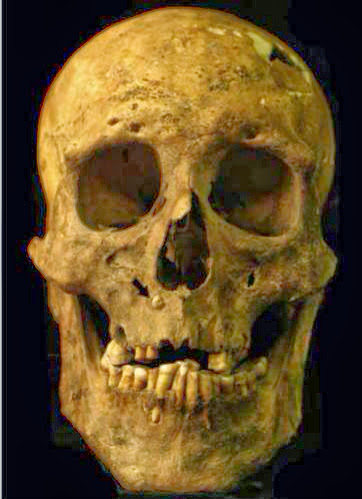
About 3,800 years ago, members of a hunter-gatherer culture known as the Windmiller buried one of their own near what is now Elk Grove, California, U.S. They daubed the 30-something-year-old man's body with red ochre, festooned him with beads, and added other shelf ornaments. But unlike others who were buried face-down with their heads oriented to the west, this man was interred face-up and headed north. His skull did have some unusual features: a protruding brow, a lantern jaw, a protruding chin, and very crowded teeth. Its width and height suggested hypergrowth in adulthood. Physical anthropologist Eric Bartelink of California State University, Chico, has now confirmed his condition to be acromegaly. Unlike gigantism, in which the pituitary gland releases excessive amounts of growth hormone during childhood, acromegaly – a rare endocrine system disorder – doesn't begin until early adulthood. By then the body’s long bones have finished growing, so the exaggerated growth only affects areas like the face, hands, and feet where bone development is still possible. The skeleton is the earliest and one of the most complete to be diagnosed with acromegaly, but Bartelink is unsure from the grave whether the individual had been singled out. “I would expect that the person would have been treated differently, but it’s hard to say, The physical expression of the disease takes about 10 years to become fully noticeable, so it would have taken a bit for other members of the society to take notice.”
Tuesday, December 10, 2013
Hans' hair

The current record-holder for the title of world's longest beard in a living male is Canadian Sarwan Singh, whose facial hair was measured at 7' 9" (2.37 m). This doesn't hold a candle to Norwegian-born American citizen Hans Langseth (1846-1927). As a Farmer in Minnesota and North Dakota, he would roll the bundle up and tuck it in his jacket (VIDEO LINK HERE). He later joined the circus so he could display it for a living, but that change of career was short-lived because he got tired of rubes yanking on it to prove to themselves it was real. Langseth's beard (IMAGE ABOVE AT AGE 66) measured an incredible 8 1/2' (5.64 m)! Or perhaps I should say measures, because the beard is still with us even though its bearer is long gone. It survives in the collection of the Smithsonian Museum of Natural History, where staff members have been known to try it on. After his death, Langseth's family cut his facial hair off and later donated it, so "King Whiskers" (MORE PHOTOS HERE) was buried with just a 12" beard.
Sunday, December 1, 2013
Veni, vidi, Vinicio
He came, he saw, he was embraced by the pope. Vinicio Riva traveled with his aunt Caterina Lotta from Vicenza, Italy, to Vatican City to be 2 among the 50,000 members of the general audience in St. Peter's Square on November 6th. Afterward, Pope Francis greeted the pilgrims and spent a minute with Riva, taking his face in his hands, kissing him, and giving him a blessing. Photographs of the gesture (EXAMPLE ABOVE) made international news as further evidence of the Pope's warmth and affection towards the marginalized, including imprisoned youth and homeless people. Riva's disfigurement (MORE PHOTOS HERE) is caused by the genetic (and noncontagious) disease neurofibromatosis. "He didn't have any fear of my illness. He embraced me without speaking....I felt a great warmth," recalls the 53-year-old. "I felt I was returning home ten years younger, as if a load had been lifted."

Thursday, April 11, 2013
Phocomelia phantom

Perhaps the most famous example of a person born with phocomelia is Mignon the Penguin Girl, who toured in circus sideshows in the early 20th c. Phocomelia is a condition – caused by thalidomide (before it was taken off the market) or by genetic inheritance – characterized by malformation of the limbs. One result is oligodactyly, the opposite of polydactyly, in which digits of the hands or feet are missing. There is no "poster girl" for another condition: phantom limb phenomenon. This is the condition experienced by a majority of amputees, who feel sensations of movement and especially pain in their missing limb. For instance, someone who has lost an arm might feel as if his or her hand were balled up and the nails were digging into the palm. All of this leads up to a strange case from a couple of years ago brought to my attention on Reddit. A woman born with phocomelia had only three fingers on her hand. That hand later had to be amputated after she was in an accident. After the amputation of the hand, she sprouted a phantom hand complete with 5 fingers, including a phantom thumb and index finger that had been absent since her birth. Authors P.D. McGeoch and V.S. Ramachandran of the Center for Brain and Cognition at the University of California, San Diego, write, "This suggests that a hardwired representation of a complete hand had always been present in her brain....The case powerfully demonstrates the interaction of nature and nurture in creating and sustaining body image."
Sunday, February 24, 2013
Wild boy's bones

The British government has taken measures to protect the grave of a famous feral child, "Peter the Wild Boy." He was brought from Germany, where he was found, to live in the court of King George I. When his novelty wore off, Peter was entrusted to the care of farmer James Fenn, and supported by a generous allowance from the Crown. His age was estimated at 72 when he died in 1785. He was buried in St. Mary's, Northchurch In Hertfordshire, and his grave was marked by a stone (photo here) paid for by the locals. More than 200 years later, flowers are regularly placed at the site.
Thursday, February 14, 2013
Julia Pastrana

I love mummies (and chances are that if you are reading this, you do too), so it is with mixed emotions that I relay the news that Julia Pastrana (1834-1860) has been buried in her native Mexico. Pastrana had hypertrichosis and was purchased, possibly from her mother, by a showman who took her on tour in the U.S. and Europe. He married and educated her, billing her as "the ugliest woman in the world." She was seen by Charles Darwin, who was less fascinated by her appearance than he was with the fact that she had a double set of teeth. When she died shortly after childbirth, her husband had her remains and those of her infant son (who didn't survive) preserved and exhibited the mummies. The showman eventually went insane, and the mummies for the most part disappeared from public view until the 1990s. The remains were damaged by mice, vandalized, stolen, and finally ended up in a storage room at Oslo University in Norway. “Her story has always had a bad ending,” said Jonathan Fielding, New York-based director of a play about Pastrana. “The big difference is that now it has an appropriate ending.”
Sunday, July 29, 2012
Elastic skin


__________
There's a special shelf in Quigley's Cabinet for human mavels:
Friday, April 20, 2012
Handwriting without hands
 |
| Kennebec Journal |
 |
| Pittsburgh Post-Gazette |
This year, the honor - designated for a student with a cognitive delay or intellectual, physical, or developmental disability - has been given to 7-year-old 1st grader Annie Clark (2nd image). She is one of 8 adopted Chinese siblings and is enrolled at the Wilson Christian Academy in West Mifflin, Pennsylvania. "I think about doing words and spelling [but have] learned to go slow," says Annie (video and sample here).
Neat penmanship is something I'm sure Trish Vickers of Charmouth, West Dorset, U.K., is glad she has. She lost her sight 7 years ago, but just finished writing 26 pages of her first novel by hand. It was not until she asked her son to read it back to her that she learned that the pages were blank - her pen had run out of ink. They called staff in the fingerprint bureau of the Dorset Police who volunteered their time to reveal the missing words by using a crime light to enhance the indentations. "Fortunately apart from one line we managed to retrieve the whole lot. It was nice to do something good for somebody and it was nice to read the book as well," said one of the officers (video here).
Thursday, April 5, 2012
Congress of Curious Peoples

Since you are reading Quigley's Cabinet, I assume you are a curious sort, and if you live in the vicinity of New York you have the opportunity to put that curiosity into action and attend the upcoming Congress of Curious Peoples, in whole or in part (tickets here). The 10-day event will be held on Coney Island April 13-22, 2012, at Sideshows by the Seashore - the last permanently housed traditional ten-in-one circus sideshow in the U.S. - and the Coney Island Museum. The celebration and concluding symposium, Congress for Curious People (schedule here), will explore Coney Island's subversive political and artistic power through spectacular performances, exhibitions, and films. Lecturers including Paul Koudounaris will investigate the relationship between education and spectacle in American amusements, the collection of curiosities from the Renaissance to the present, and the display of "freaks" and "primitive peoples" in fairground settings. The series will explore "popular and scholarly assumptions about the importance of Coney Island's legacy, its sordid past, and its titillating present." The opening night event of the Congress is sponsored by Ripley's Believe It or Not!, the keynote speakers at the symposium (schedule here) are the co-producers Aaron Beebe and Joanna Ebenstein - whose blog Morbid Anatomy inspired my own, and my friend James Taylor will help name the 2012 Inductees into the Sideshow Hall of Fame with "Mayor of Coney Island" Dick D. Zigun.
Monday, February 27, 2012
Newest oldest shortest man


 Chandra Bahadur Dangi from Nepal was officially recognized yesterday as the world's new Shortest Living Man. "I'm very happy that I'm being recognized by Guinness World Records and that my name will be written in book. It's a big thing for my family, my village and my country. I am very happy," said the weaver during the ceremony in Kathmandu (photos above, more here and here). Chandra has spent his entire life in Rhimkholi, 250 miles west of the capital (which he had never before visited). He grew up with 5 brothers and 2 sisters of average height, was often treated like a toy and gave up looking for a wife, and now lives with his nephew and family. The new record-holder was brought to the world's attention by a contractor cutting timber in the remote mountain village. Chandra hopes that the exposure he receives as a result of his new record will lead to medical advice and support, since he has never seen a doctor for his undiagnosed condition. But his intentions are also generous, with plans to start a charity that will benefit his village. "I will use this to make my country proud." At 21.5" (54.6cm), the septagenarian has unseated teenager Junrey Balawing of the Philippines at 23.5" (59.99cm), who took the title away from 18-year-old Khagendra Thapa Magar of Nepal at 26.4" (67.08cm), who was named after measuring shorter than 24-year-old Edward Nino Hernandez of Columbia at 27.46" (70.21cm), who succeeded He Pingping of China at 29" (74cm) upon his death in 2010 at the age of 21. Craig Glenday, editor-in-chief of Guinness World Records, is astonished: "I'm continually amazed that this record keeps getting broken. Just when you think it's impossible for the record to get any smaller, Mr Chandra comes along and astonishes us all by being the shortest person ever measured. What I find equally remarkable is his age - if he really is 72, he is by far the oldest person to be awarded the shortest-man record in Guinness World Record's 57-year history."
Wednesday, July 13, 2011
Human magnets


It may be the "oldest trick in the book," but it makes for some amusing photos. Just be sure to snap the pictures before you sprinkle the talcum powder on the subjects (click the images above to learn their names and read their stories).
Wednesday, April 20, 2011
Nuremberg Chronicle

Rare-book dealer Ken Sanders was volunteering at a fund-raising event, appraising books for visitors to Utah's Sandy Museum. A man stepped up and produced from a garbage bag a book so old its binding had disintegrated and its oversize pages were loose (1st image). How old? 1493! "It's considered to be one of the world's first illustrated books printed with movable type," says Sanders, who had never seen a copy of the Nuremberg Chronicle outside of a rare book room. The book was the 15th century's equivalent of a history and travel book. It was compiled by Nuremberg physician and humanist scholar Hartman Schedel, illustrated by the leading artists of the day, and printed in Latin and German in editions totaling 2,500. The Nuremberg Chronicle is lavishly illustrated, one of the earliest integrations of pictures and text. "It has some 1800 woodcut illustrations in it. Every page has an illustration, which is highly unusual for a book of that antiquity," explains Sanders. Speaking of unusual, so are some of the illustrations themselves. Quoted in an English translation of the text, the author describes several miraculous creatures:

"Some are without heads, their eyes being in their shoulders" (1st image).
 "Some have lower lips so large that they cover the entire face....Some have no tongues, and speak to one another in winks, in the manner of the cloister people....some people have ears so large that they cover the whole body" (2nd image).
"Others have very large feet and legs, but no paunches, and are
 marvelously fleet of foot. In the summertime, while lying on their backs, they protect themselves against the sun by the shade of their feet" (3rd image).
"Some are double-sexed, the right breast male, the left one female. They are indiscriminate in their associations with one another and bear children" (4th image).
 The owner, who inherited the book, requested anonymity and is laying low until it is authenticated. Incunabula are exceedingly rare and this example may be worth as much as $100,000 if all the pages are there.
Sunday, April 17, 2011
Two halves


Two men, generations apart, born with sacral agenesis:
Doug Forbis
(1st image, seated; 3rd image, playing frisbee; 5th image, picnicking with his girlfriend at the local park; video here) Furbis, 24, is a graduate student in Spartanburg, South Carolina, planning to become a physical education teacher for kids with special needs.
"It's so rare for kids with special needs to have a teacher with special needs -- that almost never happens. I think it would help a lot for these special need kids to say, 'Look, Mr. Forbis is a teacher, I can do that, too. He lives by himself, gets around town, goes shopping, I can do that, too.' A lot of kids don't know that's an option," explains Forbis.
"The only challenges I run into are other people's mindsets, nothing physical or anything related to me. People who think a person in a wheelchair shouldn't be at the mall or shouldn't be hanging out with their friends. It's crazy," says Forbis.
Johnny Eck (1911-1991) (2nd image, seated; 4th image, doing a handstand; 6th image, visiting with a young neighbor in Baltimore; video here and watch him walking here) A sideshow performer billed as the amazing "Half-Boy," "King of Freaks," and "The Most Remarkable Man in the World," Eck (his family name was Eckhardt) was also an artist, photographer, and illusionist. He may be best recognized for appearing in the cult classic film "Freaks" (1932).
"Why would I want those? Then I'd have pants to press," quipped Eck about legs.
"What can you do that I can't do, except tread water?" he challenged.
"If I want to see freaks, all I have to do is look out the window," said Eck, after he went into seclusion at age 76.
Subscribe to:
Posts (Atom)


