Sunday, October 31, 2010

Happy Halloween!


While we Americans have raised pumpkin carving to a fine art, the Jack o'lantern originated in Ireland. The carving of a lantern is associated with the ancient Gaelic harvest festival of Samhain, where it served to ward away evil spirits. The craft was not associated Halloween until the mid-19th c. and was more easily practiced in the U.S., where the native pumpkins were much easier to carve up than the rutabagas (Swedish turnips) the Irish had used. "It took me about 2 hours to hollow out and carve the little turnip and I got a nasty blister on my finger due to the force that was needed to gouge out the flesh," writes a blogger who replicated the experience.

Have a Halloween holiday full of scares, treats, and laughs! Click here for a look at our family portrait this year~

Saturday, October 30, 2010

"La Llorona" deconstructed


This close to Halloween, it's time for a ghost story. I was unaware of this one until my friend Sheila's husband Troy brought it to my attention. In my own peculiar way, I have tried to incorporate a few of the variations and some of the history, so you may want to follow one of the links for a more fluid reading...

La Llorona (1)

A baby christened "Maria" was born to a peasant family in a humble village. She grew into a woman of startling beauty who captured the attention of men rich and poor. They awaited her entrance in a flowing white gown at the local dances and paid her plenty of attention, and she reveled in it.

A. To attend the events, however, she had to leave her 2 young sons home alone. Then one day the boys were discovered drowned in the river. Maria was accused of having neglected her children, resulting in their accidental drowning, or worse, actively drowning them to remove the obstacle to her social life.

B. A wealthy man lavished her with gifts and attention, and she bore him 2 sons. But he soon returned to his former habits of drinking, gambling, and womanizing. He was gone for months at a time, returning only to visit the boys, which caused Maria to resent them. The man threatened to leave Maria for a wife of his own class and goaded her by riding past her in a carriage seated next to an elegant lady. This sent Maria into a rage. She grabbed the children and threw them both into the river.

C. Maria and the son of a Spanish aristocrat fell in love, but kept their relationship a secret because they were of such different social castes. After they had several children, the grandee arranged for his son to marry a Spanish woman of equal social standing. Obediently, the son broke the news to Maria, telling her that he could never see her again. Enraged and jealous, Maria stabbed the children one by one and dropped them in the rushing river.

As her children floated away, Maria realized what she had done and hurried to save them, but it was too late. She broke down into inconsolable grief, screaming and wailing as she ran down the road. They were lost and their weeping mother mourned them day and night, walking back and forth along the riverbank looking for them. She refused to eat, and the gown she wore became soiled and torn. Already looking like a specter, she finally died at the river's edge, but her ghost continued to haunt the banks at dusk. She was heard weeping and wailing, and was seen drifting between the trees along the shoreline or floating on the current with her long white gown spread out upon the waters. Maria became known as La Llorona, the weeping woman. To this day, children are warned (2) against going out in the dark for fear La Llorona might snatch them and throw them to their deaths in the river.
Don’t go down to the river, child,
Don’t go there alone;
For the sobbing woman, wet and wild,
Might claim you for her own.
(1) The legend of La Llorona (pronounced "LAH yoh ROH nah"), Spanish for the Weeping Woman, has been a part of Hispanic culture in the Southwest since the days of the conquistadores.
(2) "La Llorona" is a cautionary tale told in many variations from the Southwestern U.S. to Central America to keep children away from the river at night. It is thought to have originated in Mexico and is possibly pre-Colombian in origin, since there are similar tales in Aztec, Toltec, and Mayan lore.
The spooky tale has inspired oral legend, prose, verse, film, and music.

A word about the illustration: I usually avoid using images that are unattributed or can't be linked back to the original source, but I have made an exception today because the image is so compelling. If you are the artist of this work - or know who is - please contact me!

Friday, October 29, 2010

Specimen swallowed


Burmese hunters find them easier to locate in monsoon season because the raindrops enter their snub noses and make them sneeze, giving away their location. But the only scientifically observed specimen was killed for bush meat by the time primatologists were made aware of it (pictured). Eventually other members of the team did find live snub-nosed monkeys, but the creatures escaped before pictures could be taken. To show what the living creature looks like, they offer a drawing, a Photoshopped composite, and video footage of a similar species.

R. strykeri (better known as "Snubby" to the scientists or "mey nwoah" in the local dialect) has fleshy lips, an upturned nose, black fur, a wispy white beard and ear tufts, and a relatively long tail. It is the 1st of this Old World monkey species to be found in Burma, and has a range of about 100 sq. miles. There may only be 300 of the snub-nosed monkeys left, qualifying them as "critically endangered." Their territory is being encroached on by Chinese logging companies, adding to the threat of being killed for the table - although the locals prefer bear meat.

Thursday, October 28, 2010

Halloween hangings


This post is not about the perennial stories this time of year about decorations that are too reminiscent of African American lynching victims. Rather, it is about the rare stories in which a Halloween decoration turns out to be the real thing:42-year-old woman who had hanged herself that morning or the night before.

MARINA DEL REY, California 2009

I authenticated these stories on Snopes.com, which also documents the unfortunate accidental demise of 2 teenagers (in 1990 and 2001) who were staging gallows scenes at Halloween events. But the most extraordinary story* occurred decades ago at a California funhouse, where "every day is Halloween":

LONG BEACH, California 1976
When a crew member knocked off the arm of a prop at the Nu-Pike Amusement Park while filming an episode of "The Six Million Dollar Man", the break revealed a real bone inside. Famous Los Angeles coroner Thomas Noguchi determined that the "hanged man" at the funhouse was the authentic mummified body of train robber Elmer McCurdy, shot and killed by an Oklahoma posse in 1911!

*Told in detail in my book Modern Mummies.

Wednesday, October 27, 2010

Dim sum


I am past due for some dim sum. Here in the U.S., this meal is typically enjoyed as a Saturday or Sunday brunch. In Chinese, the literal translation is "little heart" and dim sum is associated with the ancient tradition of going to tea. At the more traditional restaurants - like Fortune, which I used to patronize in Falls Church, Virginia - the varied menu items are hurried around the dining room on carts. Your ticket is marked with a stamp for each dish and tallied up at the end of the meal. The 1st time my Mom joined me and my sister and family for dim sum, we forgot to provide her with a description of the items in advance, so she was a bit overwhelmed by the immediate requests from our table for shu mai (steamed pork dumplings), bao (steamed buns filled with barbecued pork), and har gow (steamed shrimp dumplings). We ordered plenty of potstickers, too, but never anything from what my sister likes to call the "parts cart"!

Tuesday, October 26, 2010

Augustus Saint-Gaudens


I lived in the Washington, D.C., area for 23 years and regret that I never made it to Rock Creek Cemetery to see this remarkable piece of funerary art by Irish-born American sculptor Augustus Saint-Gaudens. "Grief" (1st image), as it is commonly known*, was commissioned by American author and historian Henry Adams (1848-1919) for the grave of his wife and installed in 1891, 6 years after her death. His art was often designed for specific sites, and projects typically took upwards of 10 years to complete. Sculpture by Saint-Gaudens (shown in a photo in the 3rd image and in a painting by Kenyon Cox, 2nd image) stands in Boston Common and New York's Central Park, but he was known not just for his public and private monuments. Interested in numismatics, he redesigned coins for the U.S. Mint at the request of President Theodore Roosevelt - including one that is still considered the most beautiful American coin ever issued.

Famous for his works that commemorate others - Abraham Lincoln and several Civil War generals among them - Saint-Gaudens has been remembered on a postage stamp, at a National Historic Site, in a special exhibition at the Metropolitan Museum of Art. and with a centenary symposium at the Smithsonian American Art Museum.

*The title of the sculpture is actually "The Mystery of the Hereafter and The Peace of God that Passeth Understanding."

Monday, October 25, 2010

Airborne animals


True stories about animals getting loose in the cabins of airplanes - a mouse, a marmoset, a pig (!), and most recently a hamster - can be as amusing as the lambasted 2006 movie (which has its own factual counterparts). But an August flight from Kinshasa to Bandundu in the Democratic Republic of Congo took a frightening and tragic turn as a result of an animal stowaway. A Filair Airlines Let L410 turbolet (example pictured, 1st image) with 18 passengers and 3 crewmembers crashed into a house about 2km from its destination. The accident (2nd image) was originally attributed to the plane running out of fuel, but the real cause was revealed to investigators by the lone survivor.

An unnamed passenger hid a crocodile in a large duffel bag with the intent of selling it. Shortly before the plane reached the airport, the animal escaped. Following the frightened flight attendant, the panicked passengers stampeded toward the cockpit, throwing the small plane off balance. Despite the desperate efforts of the pilots - British first officer Chris Wilson, 39, and Belgian owner of Filair Danny Philemotte, 62 - to stabilize the aircraft, it flipped over in mid-air, killing 19 of the 21 on board on impact and the 20th later in the hospital. The crocodile itself survived the crash, but was cut up with a machete by rescuers.

Sunday, October 24, 2010

Colonel committed


"He looks in pretty bad shape, doesn't he?" asked Billy McIntosh of Savannah about his great-great-great grandfather's remains (3rd image). Revolutionary War hero Lt. Col. John McIntosh had been toasted Saturday night by Billy and others, including congresswoman Debbie Gignilliat Buckner (D-Georgia), after being picked from the funeral home and driven to the waterfront (2nd image). The Colonel was then carried to his 3rd funeral by horse-drawn hearse (1st image) yesterday morning. The 1st was held after his death in 1826, but historians have deduced that McIntosh was washed out of his original grave during hurricane floods in the 1850s, because the Fisk coffin in which he was reburied had not been invented until 1848. "I personally think he's so McIntosh stubborn he didn't want to stay in the ground,'' said Missy Brandt, who chairs the McIntosh County Historic Preservation Commission and coordinated the reburial ceremony. When he was in command of Georgia's Fort Morris, Col. McIntosh famously responded to British demands to surrender by responding, "Come and take it,'' which they eventually did.

This latest (and presumably last) send-off was celebrated by more than 100 mourners, including some in colonial uniform. After a blessing by Rev. Danny Grace, pastor of First Presbyterian Church of Darien that John McIntosh and his family helped found, 8 men lowered John McIntosh's casket into the grave the old-fashioned way (with ropes) not too far from a historical marker memorializing him and the plantation where he had lived. As a final gesture, Scottish Clan Donald members "Dub" Peder and Reece Acklen, and a few other admirers, bid the Colonel a final farewell with 12-year-old Scotch, a little of which they poured into the open grave.

But in answer to Billy's question above, reader Wright - whom we have to thank for alerting us to this story, providing us with his firsthand observations, and supplying the above photographs - writes, "Despite the celebration and flowing libations during the wake, and the musket volleys and bagpipes throughout the day, it was nonetheless sad to see Colonel John's iron casket all rusted out and ripping at the seams. Everybody that honored him had their hearts broken just a little bit when they saw it. I know mine was."

Saturday, October 23, 2010

Fisk funeral


There is a funeral being conducted today - and everyone at the local Historical Society is very excited about it. "You don't get to throw those words together every day," writes Wright, the reader who told me about the event and will be present. "It is even more rare these days to boast of attending a burial for a genuine Revolutionary War hero." Lt. Col. John McIntosh (1748-1826), who commanded Georgia's Fort Morris, reemerged from his grave 4 years ago. The metal burial container (1st image) that surfaced near the Sapelo River was at first mistaken for a fuel tank, but was soon identified as a Fisk coffin (2nd image, examples). Named for its inventor, Almond D. Fisk of New York City, the Fisk coffin (3rd image, patent) is known for its mummiform shape, its viewing window, and its tight seal - which sometimes preserves 19th c. remains intact to this day. An anthropologist at Colonial Williamsburg writes, "The intent was to preserve the remains of people who died far from home more or less intact until such time as they could be brought back home for the family funeral. And it worked, as I was to discover one afternoon....Called by Colonial Williamsburg security to a trench being dug behind the site of the Public Hospital, I was shown one of Fisk's patent cases hanging half out of the side of the excavation. A backhoe had snapped off its feet. The operator had sent his assistant into the ditch to see what had fallen out. He was last seen heading for Newport News." Preservation is not a certainty, however. When a Fisk casket was found already occupying a newly dug grave in Lexington, Kentucky, in 2007, the remains of the occupant consisted of "mostly bones, with some teeth, hair, fingernails and pieces of clothes." But a Fisk coffin found at a construction site in Washington, D.C., in 2005 revealed the shrouded body of a 13-year-old boy in hand-sewn clothes with enough soft tissue to determine from adhesions on the lung and calcifications of the lymph nodes that he had an infection and likely died of pneumonia.


The Fisk coffin containing the body of Col. McIntosh had rolled out of the riverbank onto the edge of the marsh in 2006 due to the natural erosion of the soil. It was turned over to the McIntosh Co. Coroner's Office and stored at Darien Funeral Home, where the soldier's body has been examined and analyzed. "The body inside was somewhat preserved having been buried with charcoal, a burial practice to absorb bodily fluids and perhaps control odor," explained Matthew Williamson of Georgia Southern University, who excavated several members of the McIntosh family - generations of whom have resided near where the Colonel made his reappearance - to prevent them from suffering the same fate. As I finish this post, the committal has just gotten underway at Mallow Plantation to rebury Col. McIntosh and 3 of his grandchildren: 30-year-old Maria, 25-year-old Maizie, and Catherine, who died in infancy. They will be laid to rest (again) after a ceremony including bagpipes, a color guard, and traditional Scottish last rites.

Friday, October 22, 2010

Ramesses' repatriation


No one in the group I was with last night was aware that an ancient Egyptian mummy who ended up in a museum in Niagara Falls (1st image) had not too long ago been identified as the pharaoh Ramesses I (d. 1290 B.C.) and repatriated to Egypt. Here is the timeline of this amazing story:

Thursday, October 21, 2010

How to culture a pearl


It is a lot easier to artificially stimulate a mollusk (1st image, a mussel) into creating a pearl than it is to find a natural one. These round and flawless alternatives as we know them today have been around for 100 years and now make up 99% of all pearls sold worldwide. The steps involved in culturing a pearl are as follows:
  1. Find an ideal location to raise freshwater or saltwater pearl oysters after you have consulted a manual.

  2. Obtain your pearl oysters, either by collecting them in the wild or obtaining them from a breeder.

  3. Set up the farm using either the Tahitian long line method, floating rafts (2nd image), or underwater trestles.

  4. Allow the oysters to mature.

  5. Employ a grafting technician to perform the nucleation, the surgical procedure of implanting the foreign object (usually a shell bead) around which the pearls will form.

  6. Wait 2 or more years.

  7. Harvest the pearls when the nacre layer is about 3mm thick.

To quote the Shawshank Redemption, "Easy, peasy, Japanesey."

Wednesday, October 20, 2010

Psychotic squirrels


For every heartwarming story about a squirrel - like this cuddly kitten wanna-be, this endearing little guy who bumped his head, or this comedian that popped up in a vacation photo - there are plenty of fear-inspiring stories about squirrel hoodlums guilty of the following crimes:
I'm inclined to side with the citizens of East Texas, who celebrate Squirrel Awareness Month by opening squirrel hunting season...

Tuesday, October 19, 2010

Insect identified


Like many other bloggers, I found this image of a silver beetle well worthy of passing along - but not before I figured out what it is. The only clue in the article is that it is a rare beetle that lives in Costa Rica and other Central American countries. A few clicks later, I had nailed it: Plusiotis chrysargyrea. These tropical precious metal scarabs are nocturnal and like to live in cloud forests. Some can be found in the southern U.S. There are about 200 species of these "living jewels," some gold, some copper, some metallic green. The iridescent colors on their thick cuticle are comprised of multiple laminated layers of thin-film chitin with a crystal lattice microstructure that refracts and polarizes light-waves, allowing them to attract mates, discourage rivals, and blind hungry birds with their glare. Little is known about these beetles, but they have been observed eating tree roots and foliage. They can't be too hard to find or they'd retail for more than $75.

Monday, October 18, 2010

Goat killing


The ambiguity of the title of this post covers the 2 oddly dissimilar stories about this animal in yesterday's weird news.

On Saturday afternoon, 63-year-old Robert H. Boardman, his wife Susan Chadd, and friend Pat Willits went hiking in Washington State's Olympic National Park. They encountered an aggressive mountain goat on the trail 4mi north of the visitor center, so Boardman told his companions to head back down the trail and attempted to shoo it away. Nobody saw what happened next, but apparently the goat was undeterred and they heard Boardman yell. They found him motionless with the animal standing over him. Willits frantically used his cell phone to summon help. "The mountain goat was terribly aggressive. It wouldn't move. It stared us down." says Jessica Baccus, whose family came upon the frightening scene. Her husband Bill happened to be a park scientist, so he called for help on his park radio and tried to lure the goat away. Others joined him in shouting and pelting rocks, but it was the reflection from a waved space blanket that finally ran the animal off. Jessica, a former park ranger, was finally able to approach Boardman's bleeding body and attempt CPR. A doctor who happened to be hiking took over the resuscitation attempts and a Coast Guard helicopter arrived 20 minutes later to airlift the victim out of the park. He was pronounced dead upon arrival at Olympic Medical Center. Boardman is believed to be the 1st person to have died in an incident involving an animal in Olympic National Park. The mountain goat, one of 300 that live in - but are not native to - the park, was found and killed.


1st image) Photo by David Moskowitz of mountain goats in mist in the Goat Rocks Wilderness of the Washington Cascades, 2nd image) A goat is weighed at a sheep market in advance of the Eid al-Adha festival in Srinagar, India.

Sunday, October 17, 2010

Waking up in the morgue


I have difficulty distinguishing between a trope and a meme, but I guess the idea of waking up in the morgue qualifies as the latter - except that it really does happen! Here are a few examples from around the world:

Maryland, U.S.A., 2010 When police were called to check on Ruth Shillinglaw Johnson, 89, they encountered a motionless body and "a decomposition smell," so they did not check for a pulse. They notified Johnson's adult son of the death of his mother, whom he knew wished to donate her body to science. A State Anatomy Board employee arrived 3 hours later to remove the body. It was at that time that Johnson took a deep breath and moved her arm. She was rushed to a hospital, and has since been moved to a hospice.

Jablonowo, Poland, 2009 The husband of an 84-year-old woman who had fallen unconscious called an ambulance and a responding EMS doctor pronounced her dead. "A funeral company took the body to the morgue. Several hours later, a worker there noticed the bag containing the body was moving. He called a doctor who noted the woman's vital functions had returned," said a spokesman for the police, who were investigating the incident.

Anandpur Sahib, India, 2008 Mange Ram passed out when he was crushed by a stampede of people that killed 146. "When I woke up, I was in the middle of a row of bodies waiting for postmortem," the 19-year-old said, shivering. His request for water startled the staff of the civil hospital. Eyewitnesses said there was such confusion after the trample at the Naina Devi shrine that procedures for pronouncing death and identifying victims were not followed. Those who had suffocated and those who were merely unconscious were bundled into available vehicles and driven the 18 km to the nearest medical facility, some of them dying en route.

La Victoria, Venezuela, 2007 Carlos Camejo (pictured with document authorizing his autopsy), was declared dead after a highway accident. He was taken to the morgue, but bled when the medical examiner made an incision to begin a post-mortem examination. "I woke up because the pain was unbearable," said the 33-year-old.

North Carolina, U.S.A. 2005 Larry Green was hit by a car while walking across a highway. He was put into a body bag and sent to the morgue, and the medical examiner did not notice he was still alive until 2½ hours after the accident. "The medical examiner is called after death. Someone else pronounced his death, and the medical examiner is called to investigate the cause and manner of that death. He does not pronounce people dead," said M.E. J.B. Perdue in defense of his alleged disregard of Green's vital signs. After it was discovered that he was still alive, Green spent 2 months in the hospital recovering from his injuries, which include brain damage.

Yikes.

Saturday, October 16, 2010

Badger bodysnatcher


I've tasked myself with providing a particularly link-rich post about this story, after finding that I could illustrate it with a picture of the churchyard in question, rather than merely a stock photo of a badger.

The congregation of St. Remigius Church in Long Clawson, Leicestershire, U.K., are between a rock and a hard place, because they have identified a bodysnatcher in their midst but can do nothing about it. The culprit is a protected species and theirs is a protected property. In addition to prohibiting the taking, injuring, or killing of badgers, the Protection of Badgers Act 1992 made it a criminal offense to interfere at all with the sett (see def. 2, sense 2) of the beast. Combine that with concerns that there might have been a medieval house on the adjacent field and you have what a spokesman for English Heritage called "a complex issue where finding a solution to satisfy everyone is hard."

The church, dedicated to St. Remigius, dates back to the 12th c. and the churchyard contains 800 years' worth of buried remains, including those of the Bozon family, Lords of the manor from 1304 to 1539. The problem surfaced (pardon the pun) earlier this year when someone reported seeing a skull and a bone on top of the ground. Since then, 4 leg bones have been found - including one by a boy who took it home to his parents. The parish council sought the advice of a local badger group who suggested badger-proof fencing, so that the burrowing animals could be relocated to a nearby field. While Natural England was willing to grant a license, English Heritage advised that moving the badgers could cause more damage to the protected site.

Rev. Simon Shouler complains, “...there is nothing we can do other than to let them remain in the churchyard, digging up the remains of people who have been buried for several hundred years." They cannot even rebury the disturbed remains in their own graves for fear of breaking the law. Instead, he carries out regular patrols and gathers stray bones, storing them for reinterment in a new grave.

Friday, October 15, 2010

Le sang d'un roi


"The blood of a king." That's why this otherwise artful gourd takes on a more sinister character. It was a pivotal moment in French history, a few years after the revolution had begun. The monarchy had been abolished and the king was stripped of his title by the Republican government. He had been arrested and imprisoned for high treason, and a reprieve had been voted down. So on the morning of January 21, 1793, Louis XVI (1754-1793) was executed before a large crowd. His spiritual advisor, English priest Henry Essex Edgeworth, accompanied him and described what he heard and saw:
"He was proceeding, when a man on horseback, in the national uniform, and with a ferocious cry, ordered the drums to beat. Many voices were at the same time heard encouraging the executioners. They seemed reanimated themselves, in seizing with violence the most virtuous of Kings, they dragged him under the axe of the guillotine, which with one stroke severed his head from his body. All this passed in a moment. The youngest of the guards, who seemed about eighteen, immediately seized the head, and showed it to the people as he walked round the scaffold; he accompanied this monstrous ceremony with the most atrocious and indecent gestures. At first an awful silence prevailed; at length some cries of 'Vive la Republique!' were heard. By degrees the voices multiplied and in less than ten minutes this cry, a thousand times repeated became the universal shout of the multitude, and every hat was in the air."
Immediately afterward, the excited crowd members rushed the scaffold to dip handkerchiefs into the spilled blood as souvenirs. Among them was Maximilien Bourdaloue, whose name is inscribed on the gourd along with images of key figures of the French Revolution. The gunpowder gourd became a reliquary for this morbid keepsake and was supposedly given to Emperor Napoleon Bonaparte before passing into the hands of an Italian family at the turn of the 20th c. The family contacted geneticists at the University of Bologna to test the residual blood in the gourd, although the handkerchief had long since vanished. Member of the team Davide Pettener said, "It’s a very strange story. We thought it was a joke at first because we work on population genetics. But we realized it’s very important from a historic point of view.”

The scientists scraped out 5 small samples of the dried blood to analyze the DNA, and published their results in Forensic Science International: Genetics. A gene from the Y chromosome (inherited from the father), indicated a male with blue eyes, which the king was known to have. They hope to match mitochondrial DNA (inherited from the mother) to a descendant of either the king or his mother. If they can't find a living relative, they will petition the French authorities for permission to take a sample from the dried heart of Louis XVI’s son, Dauphin Louis-Charles, who died at age 10. This relic resides in the Cathedral Basilica of St. Denis outside Paris. “A match on the Y chromosome of the Dauphin will immediately authenticate the blood as belonging to the king Louis XVI,” says team leader Carles Lalueza-Fox of the Universitat Pompeu Fabra in Barcelona. At that point the gourd, presently valued at $700,000, would presumably be reappraised.

Thursday, October 14, 2010

Supercentenarians


While I wasn't paying attention, a new category arose in the field of gerontology. "Supercentenarians" describes people who have lived to the great age of 110. These individuals have been the subjects of research and of portrait photography. In his 2003 series "Living in Three Centuries: The Face of Age," Mark Story features the photo of a 110-year-old man (1st image) whose father stood on the platform during the Gettysburg Address. Story describes, "All of a sudden I realized that I was photographing a person whose father stood next to Abraham Lincoln in 1863. I started to cry and got goose bumps because it struck me just how old 111 was, and how far it reaches back in our country's history." Here is a sampling of supercentenarians:

Sarah DeRemer Knauss (2nd image)
119 years (1880-1999), United States
Sarah lived her entire life in Pennsylvania. Nothing ever fazed her, according to her daughter, who survived Sarah by 5 years, dying at age 101.

Hendrikje Schipper (3rd image)
115 years (1890-2005), Netherlands
Henny was a premature baby, a sickly child, and a breast cancer survivor. She lived with her parents until she was 47, when she married. At age 82 she decided to will her body to science, and was found to have died of undiagnosed gastric cancer.

Christian Mortensen (5th image)
115, (1882-1998), Denmark
Christian emigrated to the U.S. at age 21 and was employed as a tailor, a milkman, a restaurateur, and a factory worker. In 1978, he arrived at a retirement home on his bicycle, declaring that he was there to stay. He died there 20 years later in his sleep, leaving no living relatives.

María Esther Heredia de Capovilla (6th image)
116, (1889-2006), Ecuador
María was born into a well-to-do military family and had 5 children of her own. She was given Last Rites at the age of 100, when she nearly died of a stomach ailment, but survived another 16 years before succumbing to pneumonia.

There is no consensus on such longevity, except that once one reaches 100, heredity is the defining factor. I would suggest that sense of humor also plays a role. When Jeanne Calment (1875-1997) of France (4th image) became a supercentenarian, she quipped, "I've only ever had one wrinkle, and I'm sitting on it."

Wednesday, October 13, 2010

Tarra


I have been following the Elephant Sanctuary in Hohenwald, Tennessee, from shortly after its founding in 1995 as a 2-person endeavor with a single Asian elephant to a 2,700-acre refuge housing more than 2 dozen Asian and African elephants. I was surprised to learn yesterday that one of the co-founders, Carol Buckley, has been forced out. The sensationalized news headline reads, "Woman sues for elephant visitation rights." The story is better understood from the elephant's perspective:

Hi, my name is Tarra. I was captured in Burma 6 months after my birth in 1974 and imported to the U.S. shortly before it became illegal. I lived with a California businessman who called me 'Fluffie.' I spent my nights in his driveway and my days in the parking lot of his tire dealership. A local student of exotic animal management volunteered to care for me, reduced my working hours, and soon adopted me. Carol (2nd image) renamed me and took me around the world to entertain in circuses and amusement parks. We were on TV and in the movies, and I even learned to roller skate! Although I enjoyed it, Carol decided that this talent sent the wrong message, so we instead appeared at zoos with a more educational program. Carol and I performed for 21 years, living in a private compound in Los Padres National Forest when we weren't on the road. In 1991 I had a baby, but it was stillborn, which is typical for 1/3 of the calves of first-time mothers in the wild and in captivity. I retired from show business 4 years later and became the 1st resident of the Elephant Sanctuary. Within a few years, several other elephants had moved in and we became fast friends. I also bonded with my buddy Bella (1st image), a friendship celebrated on the air and in a book. I gave up painting, which I had taken up years ago. As Carol explained it, "Tarra is recovered and doesn't need to paint anymore....She doesn't need that artificial stimuli — because she's got the real thing." The Elephant Sanctuary even stopped selling prints of my abstract works in 2008 because of the exploitation of elephant artists in Thailand. No exploitation here - and no crowds of visitors (who can instead watch us remotely on the Elecam). Just food, fellowship, roaming room, and a swimming hole to wallow in. But where's Carol?

Tuesday, October 12, 2010

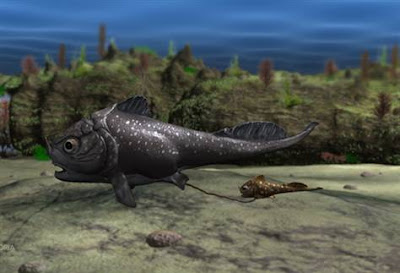
Fossil fish fooled around


My stepfather Del (pictured below after filleting the 30lb black drum he caught this summer) spotted this fish story in the weird news yesterday. Fossils of Late Devonian ptyctodontid and arthrodiran placoderm fishes discovered in Western Australia suggest that these fish, which were similar to modern sharks, were the 1st animals to have sex for pleasure. This achievement, rather than merely spawning, occurred in the early Devonian Period (400 to 410 million years ago) theorizes John Long of the L.A. County Natural History Museum and his colleagues: "Our finds show that these extinct armored fishes, the placoderms, had intimate copulation with males inserting claspers (a structure that is part of the pelvic fin) inside the female to deposit sperm."

Just 2 years ago, Long - then at Museum Victoria in Melbourne - announced another extraordinary discovery from the same fossil formation. He found a 10" female placoderm with an embryo and umbilical cord inside her body. "I think this is one of the most extraordinary fossil finds of all time, as it is the first time in history we have a maternal feeding structure preserved in any fossil. When I first saw the embryo inside the mother fish my jaw dropped, I was silent, stunned like a mullet. I realised that in my hands was the oldest known vertebrate embryo," said Long. It was the earliest evidence of an animal giving live birth, and pushed the known record of such reproduction back by some 200 million years. An embryo inside its mother indicates that placoderms must have copulated to produce offspring, instead of laying eggs and fertilizing them outside the mother's body.

After the discovery of the embryonic fish, other museums reexamined their placoderm fossils to assess whether smaller fish found inside their bodies were food they had eaten or young they were gestating. I have trouble visualizing all of this from the fossil, which is why I appreciated the artists' renditions above.

Monday, October 11, 2010

Leaves don't leap...


...they are pushed! In a phone conversation with my Dad yesterday, I remembered hearing about a scientist who proved that trees actively shed their leaves. I found the details on my 1st Google search. That scientist is decorated American botanist Peter Raven, and he has shown that the leaves of deciduous trees are not simply blown off by the wind, but severed by the tree. Triggered by chemicals activated by seasonal changes in light and temperature, special cells gather at the juncture of the leaf stem and the branch. They are called "abscission" cells, a word which has the same Latin root as the word "scissors." Within a few weeks, every leaf on the tree develops a microscopic bumpy line of cells (the red cells in the image below) that push the leaf, bit by bit, away from the stem and leaving it dangling. "So with that very slender connection, they're sort of ready to be kicked off," says Raven, who explains that the process is necessary to the tree's survival. If a tree kept its leaves permanently they would photosynthesize during warm weather all year round. Freezing with water in their veins would cause the leaves - and then the tree itself - to die. So the tree shucks its leaves in autumn as food production slows, and regrows them in spring as it speeds back up.

Sunday, October 10, 2010

Growing jewelry


My Mom, the gardener, thinks this is crazy. My sister, the jeweler, thinks it is cool (and wants one). They are the work of Icelandic designer Hafsteinn Juliusson and the silver rings sell for €150. Juliusson calls his creations "a clash of jewelry and gardening, couture and organism...designed for people in metropolitan cities." Others have compared the pieces to Chia pets, and the "green thumb" puns are plentiful. Growing Jewelry is topped with Icelandic moss, and needs to be watered, fed, sunned, and trimmed. If cared for properly, the moss is expected to stay green for 8 to 12 months.

As a side note, I have wondered more than once about the different spellings of "jewelry" and "jewellery." The word in even more variations (iuelrye, jowalre, juelerye) dates to the 14th c. and the OED explains that "jewellery" is more commonly used in a commercial context and is more closely associated with the work of a jeweller, while "jewelry" has a more poetic usage. Dictionary.com, however, simply chalks it up to the differences between American and British spelling.

HALLOWEEN-Click for captions

Loading...

Labels